Spacetime Warping and Gravity
Spacetime Curvature
The Shape of Gravity
In our everyday experience, gravity feels like a force pulling things down. Isaac Newton described it as a universal attraction between any two objects with mass. But Albert Einstein's theory of General Relativity offers a radically different perspective: gravity isn't a force at all. It's a consequence of the shape of the universe itself.
Imagine spacetime as a flat, stretched-out rubber sheet. If you place a heavy object, like a bowling ball, onto the sheet, it will create a dip or a curve. Now, if you roll a smaller marble nearby, it won't be pulled directly toward the bowling ball by some invisible force. Instead, it will follow the curve in the sheet created by the bowling ball's mass. This is the essence of General Relativity. Mass and energy tell spacetime how to curve, and that curvature tells objects how to move.
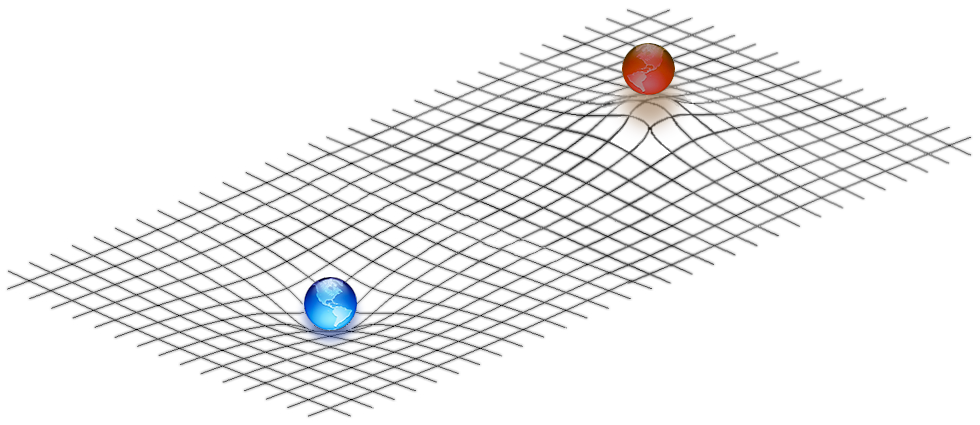
This warping of spacetime isn't just a metaphor; it's a precise mathematical description of how gravity works. To describe this complex geometry, physicists use a mathematical tool called a tensor.
tensor
noun
A mathematical object that describes physical properties and relationships, generalizing the concepts of scalars (single numbers) and vectors (magnitude and direction). Tensors can describe properties at a single point in space that may have different components when viewed from different coordinate systems.
While there are several tensors used to describe curvature, the most fundamental is the metric tensor.
The Metric Tensor
The metric tensor, often written as , is the central mathematical object in General Relativity. It functions as a kind of universal ruler for spacetime. It tells us how to calculate the distance, or more precisely, the spacetime interval, between two nearby events.
In flat spacetime, far from any significant source of gravity, the metric tensor has a very simple form. But in the presence of mass and energy, the components of the metric tensor change from point to point. This variation is what defines the curvature of spacetime. By knowing the metric tensor at every point, you know the complete geometry of that region of spacetime, and therefore you understand the gravitational field there.
The metric tensor encodes all the information about the geometry of spacetime, including its curvature.
Einstein's Field Equations
The relationship between spacetime curvature and the distribution of mass and energy is described by a set of equations known as the Einstein field equations. They are the heart of General Relativity. At first glance, they look incredibly dense, but the core idea is a beautiful balance between two sides.
This single, compact tensor equation is actually a set of 10 coupled, nonlinear partial differential equations. Solving them is notoriously difficult and has only been done for specific, often simplified, situations. But their meaning is profound.
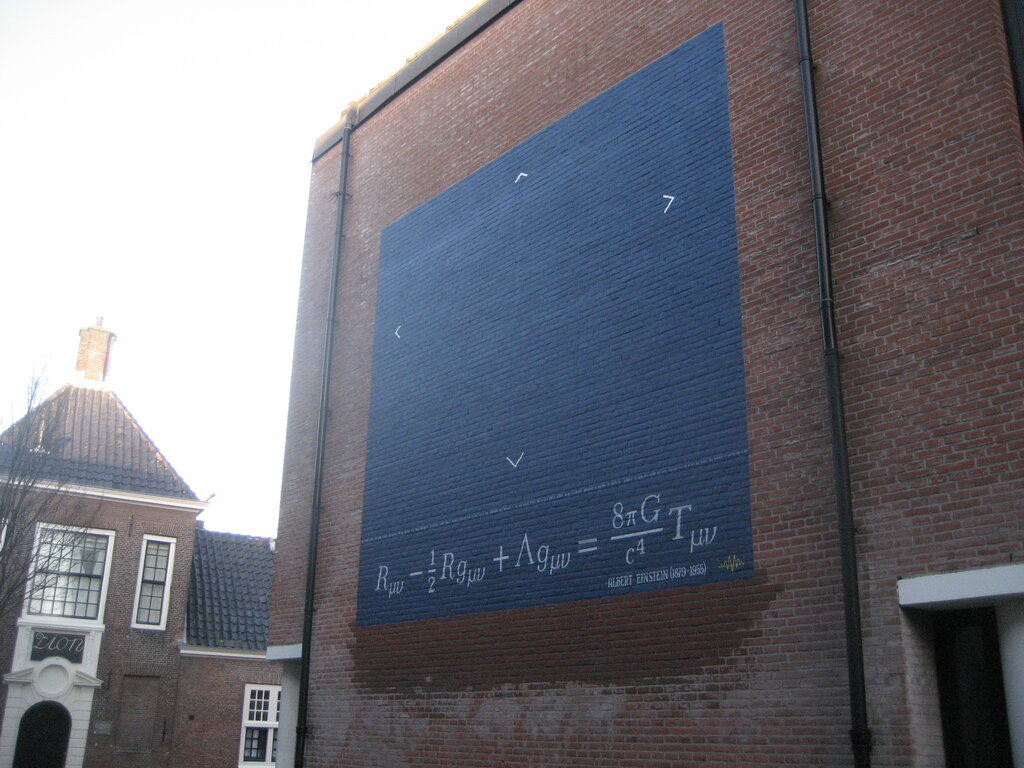
Mass and energy tell spacetime how to curve, and curved spacetime tells objects how to move.
By understanding that gravity is the curvature of spacetime, we can explain phenomena that Newtonian physics cannot, such as the bending of starlight around the Sun and the precise orbit of Mercury. This geometric view of the universe is one of the most significant shifts in the history of science.
According to Albert Einstein's theory of General Relativity, what is gravity?
In the common analogy of a bowling ball on a stretched rubber sheet, what does the bowling ball itself represent?