Spacecraft C&DH and Comm Integration
Spacecraft Subsystems Overview
The Spacecraft's Nervous System
A spacecraft is more like a living organism than a simple machine. It’s a collection of specialized parts, called subsystems, that all work together to achieve a mission. Just as the human body has a circulatory system, a nervous system, and a skeleton, a spacecraft has subsystems for power, propulsion, temperature control, and structure. Each one is critical.
Two of the most important parts are the Command and Data Handling (C&DH) subsystem and the Communication (Comm) subsystem. Think of them as the spacecraft's brain and its voice. They allow the spacecraft to think, act, and talk with us back on Earth.
At the heart of everything is the Command and Data Handling (C&DH) subsystem. This is the onboard computer, the central processor that manages the entire spacecraft. Its job is to receive commands, process information, and make sure every other subsystem is doing what it’s supposed to, when it's supposed to.
The C&DH acts as the mission's manager, executing sequences of commands and collecting data from all over the spacecraft.
For example, if mission control wants to take a picture of Jupiter, they don't talk directly to the camera. Instead, they send a command to the C&DH. The C&DH then checks the spacecraft's status, points the camera in the right direction using the attitude control system, tells the camera to open its shutter, and then collects the resulting image file. It also monitors the health of all systems, checking temperatures, voltage levels, and fuel reserves. This constant stream of health data is called telemetry.
The Link to Earth
All this commanding and data collecting would be useless if the spacecraft couldn't talk to us. That's where the Communication (Comm) subsystem comes in. It's the spacecraft's radio, responsible for sending and receiving signals across the vast distances of space.
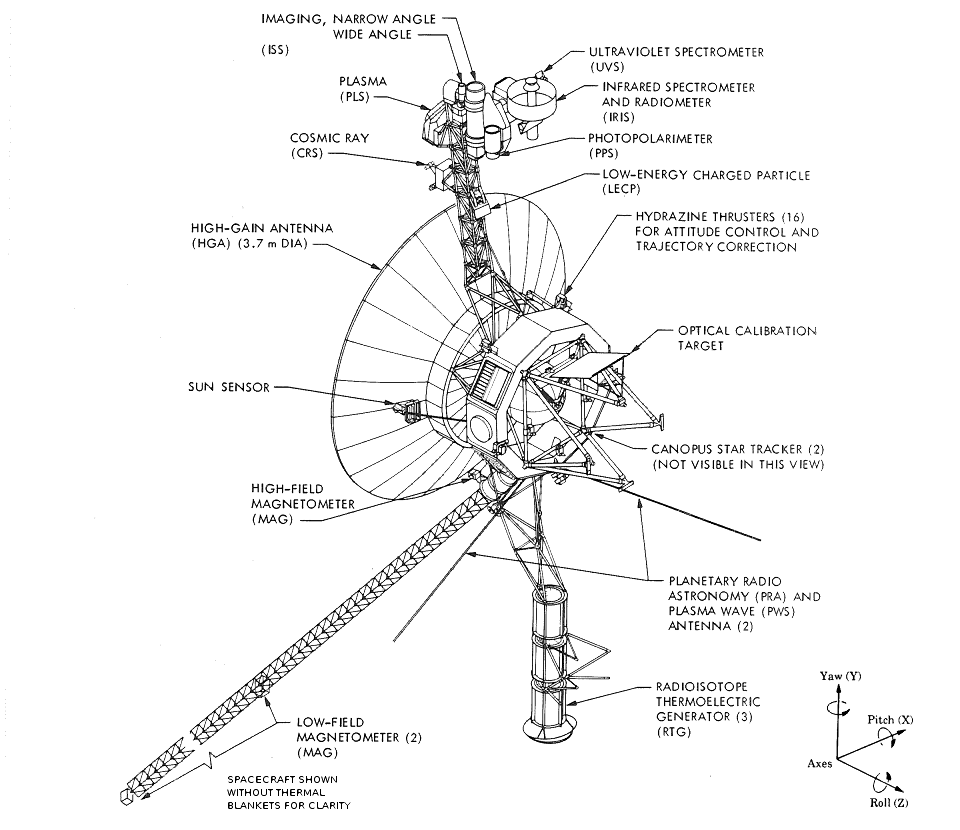
The Comm system has two primary jobs:
- Uplink: Receiving commands sent from ground stations on Earth.
- Downlink: Transmitting telemetry and valuable science data (like that photo of Jupiter) back to Earth.
This isn't as simple as making a phone call. The signals are incredibly weak by the time they cross millions of miles, so the Comm system needs sensitive receivers and powerful transmitters, usually paired with a large antenna.
A Perfect Partnership
The C&DH and Comm subsystems are in constant contact. They have to be. The Comm system is the only way for the C&DH to get its instructions from Earth, and the C&DH is the only way for the Comm system to get the data it needs to send home.
Here’s how they work together:
- A command is sent from Earth.
- The Comm subsystem's antenna picks up the faint radio signal.
- The Comm system demodulates the signal, turning it back into digital information, and passes the command to the C&DH.
- The C&DH validates the command and executes it, perhaps by activating a scientific instrument.
- The instrument collects data and sends it back to the C&DH.
- The C&DH packages this science data, along with routine health telemetry, and sends it to the Comm system.
- The Comm system transmits the data package back to Earth.
This seamless loop of information is what makes any space mission possible. The C&DH provides the intelligence, while the Comm system provides the connection, working together as the brain and voice of the mission.
Which spacecraft subsystem is best described as the "brain" of the mission, responsible for processing information and managing all other systems?
The constant stream of health data from a spacecraft, such as temperatures and voltage levels, is known as __________.