Sound Design Essentials
Sound Fundamentals
What Is Sound?
At its core, sound is simple vibration. When an object vibrates, it disturbs the particles in the medium surrounding it, whether that's air, water, or a solid object. These particles bump into their neighbors, which then bump into their neighbors, creating a wave of energy that travels outwards.
Think of dropping a pebble into a still pond. The pebble creates ripples that expand across the water's surface. Sound waves work similarly, but instead of moving up and down, they are waves of pressure. They consist of areas where particles are bunched together (compression) and areas where they are spread apart (rarefaction).
This chain reaction allows sound to travel. It moves fastest through solids, where particles are packed tightly together, and slowest through gases, where they are far apart. This is why you can hear a train coming by putting your ear to the track long before you can hear it through the air. In a vacuum like outer space, there are no particles to vibrate, so sound cannot travel at all.
The Building Blocks of Sound
Every sound you hear, from a whisper to a thunderclap, can be described by a few basic properties. The two most important are frequency and amplitude.
Frequency
noun
The number of complete wave cycles (one compression and one rarefaction) that occur in one second.
Frequency is measured in Hertz (Hz). One Hz equals one cycle per second. To our ears, frequency translates into pitch. A high frequency means more vibrations per second, which we perceive as a high-pitched sound, like a bird's chirp. A low frequency means fewer vibrations per second, resulting in a low-pitched sound, like the rumble of a bass drum.
High Frequency = High Pitch Low Frequency = Low Pitch
The other key property is amplitude. This refers to the size or intensity of the sound wave's pressure variations. In simpler terms, it's the wave's power.
We perceive amplitude as loudness. A sound wave with a large amplitude has a lot of energy and sounds loud. A wave with a small amplitude has less energy and sounds quiet. While amplitude is a physical measurement, loudness is our subjective perception of it. This is often measured in decibels (dB).
High Amplitude = Loud Sound Low Amplitude = Quiet Sound
The Color of Sound
Why do a guitar and a piano sound so different, even when they play the exact same note at the same loudness? The answer lies in harmonics and overtones.
Almost no sound in the real world is a single, pure frequency. Instead, sounds are complex mixtures of a primary frequency and many other, quieter frequencies. The main, loudest frequency that determines the note's pitch is called the fundamental frequency.
The other frequencies present are called overtones. When these overtones are whole-number multiples of the fundamental frequency (2x, 3x, 4x, etc.), they are called harmonics. For example, if a guitar string's fundamental is 100 Hz, its harmonics will be 200 Hz, 300 Hz, 400 Hz, and so on.
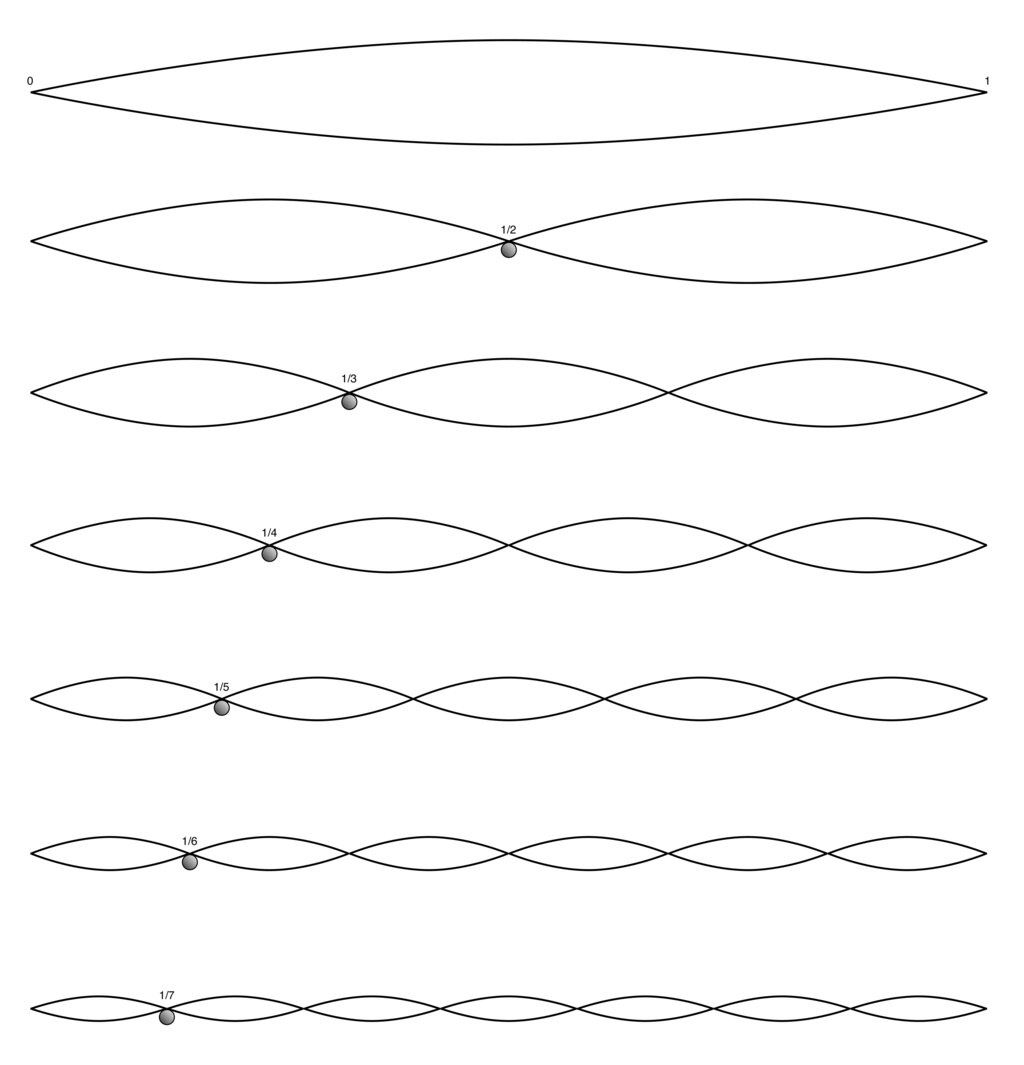
The unique blend and relative loudness of these harmonics give an instrument its specific character, or timbre (pronounced TAM-ber). It’s what allows us to distinguish between a violin and a trumpet. The physical shape, material, and design of an instrument all influence which harmonics are emphasized or suppressed, creating its signature sound.
How We Hear
Our ears are remarkable instruments designed to capture and interpret these vibrations. The process is a fascinating journey from air pressure to brain signals.
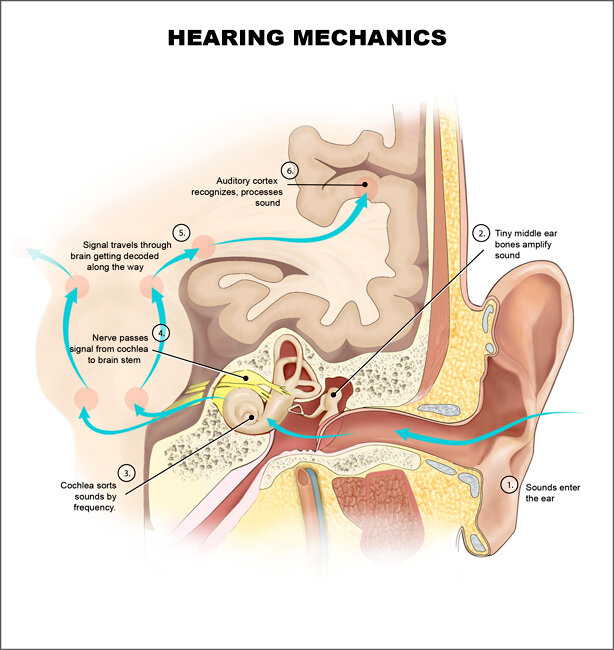
First, the outer ear funnels sound waves into the ear canal, where they strike the eardrum, causing it to vibrate. These vibrations are then passed along and amplified by three tiny bones in the middle ear. Finally, they reach the cochlea, a snail-shaped, fluid-filled tube in the inner ear.
Inside the cochlea, thousands of tiny hair cells are stimulated by the vibrations in the fluid. These cells act as transducers, converting the mechanical vibrations into electrical signals. Different cells respond to different frequencies. These electrical signals are then sent along the auditory nerve to the brain, which interprets them as the rich world of sound we experience every day.
The typical range of human hearing is from about 20 Hz to 20,000 Hz (or 20 kHz). This range shrinks as we age, especially at the higher frequencies.
Now, let's test your understanding of these fundamental concepts.
Through which of the following mediums does sound travel the fastest?
The frequency of a sound wave determines its perceived _______.
With these basics in place, you have a solid foundation for understanding how sound is recorded, manipulated, and shaped.