Sophomore Chemistry Foundations and Reactions
Periodic Trends and Bonding
The Pull of the Nucleus
At the heart of every atom, protons in the nucleus pull on the surrounding electrons. But not all electrons feel this pull equally. Electrons in the outermost shell, called valence electrons, are shielded from the full force of the nucleus by the inner-shell electrons. The net positive charge an electron actually experiences is called the effective nuclear charge (). Think of it as the true magnetic force an outer electron feels.
This simple concept is the key to understanding almost every periodic trend. As you move from left to right across a period, you add a proton to the nucleus ( increases) and an electron to the same valence shell. The number of shielding electrons () stays the same. The result? increases, pulling the entire electron cloud in tighter.
Patterns on the Table
Three key properties of atoms change predictably across the periodic table, all thanks to effective nuclear charge and the number of electron shells.
Atomic Radius: This is half the distance between the nuclei of two identical atoms bonded together. It decreases from left to right across a period because the increasing pulls the valence shell closer. It increases down a group because you're adding a whole new, more distant electron shell with each step.
Ionization Energy (IE): This is the minimum energy required to remove an electron from a gaseous atom. As increases across a period, the nucleus holds onto its electrons more tightly, so IE increases. Moving down a group, the outermost electron is in a higher energy level, further from the nucleus and more shielded. It's easier to remove, so IE decreases.
Electronegativity: This measures an atom's ability to attract shared electrons in a chemical bond. Developed by , this trend mirrors ionization energy. Atoms with a strong pull on their own electrons (high IE) also have a strong pull on a shared pair. Therefore, electronegativity increases across a period and decreases down a group. Fluorine is the most electronegative element.
Bonding: An Electron Story
Atoms form bonds to achieve a more stable electron configuration, typically a full outer shell of eight electrons (the octet rule). The difference in electronegativity () between two atoms determines what their electrons will do. Will they be transferred or shared?
| Feature | Ionic Bond | Covalent Bond |
|---|---|---|
| Electron Action | Transfer of electrons from one atom to another | Sharing of electrons between atoms |
| Element Types | Typically a metal and a nonmetal | Typically two nonmetals |
| Electronegativity Diff. | Large () | Small () |
| Result | Formation of charged ions that attract | Formation of a neutral molecule |
| Example | Sodium Chloride (NaCl) | Water () |
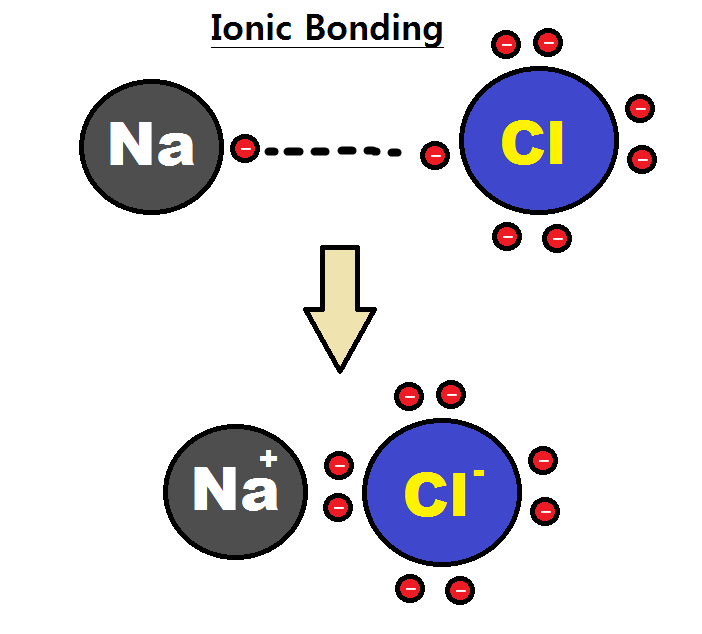
In an ionic bond, one atom essentially donates an electron to another. This happens when a metal (low electronegativity) meets a nonmetal (high electronegativity). The metal becomes a positive ion (cation) and the nonmetal becomes a negative ion (anion). Their opposite charges create a strong electrostatic attraction. For example, sodium gives its single valence electron to chlorine, forming stable and ions.
In a covalent bond, atoms share electrons to complete their octets. This occurs between two atoms with similar, high electronegativities, usually two nonmetals. The shared pair of electrons is attracted to both nuclei, holding the atoms together in a molecule. We can visualize this sharing using to keep track of valence electrons.
When Sharing Isn't Equal
Sharing in covalent bonds isn't always fair. When two different atoms bond, the one with the higher electronegativity pulls the shared electrons closer to itself. This creates a polar covalent bond, where one end of the bond is slightly negative () and the other is slightly positive (). This separation of charge is called a dipole moment.
The geometry of a molecule determines if these individual bond dipoles add up or cancel out. In water (), the two polar O-H bonds are arranged at an angle. The dipoles don't cancel, making the entire water molecule polar. In carbon dioxide (), the two polar C=O bonds are on opposite sides of the carbon atom. They are equal and opposite, so their dipoles cancel out, making the molecule nonpolar overall. This molecular polarity is crucial for explaining properties like solubility and boiling points.
What is the primary reason the effective nuclear charge () increases when moving from left to right across a period?
Which of the following best describes the trend for ionization energy as you move down a group on the periodic table?
These trends and bonding principles form the foundation for predicting how elements will interact to create the vast array of compounds that make up our world.