Sophisticated Feline Facts
Vestibular System Mechanics
The Inner Compass
A cat's remarkable agility isn't magic; it's a masterpiece of biological engineering. At the heart of this system is the vestibular apparatus, a tiny, intricate set of structures tucked away in the inner ear. This system acts as a sophisticated inertial navigation unit, providing the brain with a constant stream of data about motion and orientation.
It has two primary functions: detecting rotational movements (like twisting and turning) and sensing linear acceleration (like moving forward or the constant pull of gravity). Together, these abilities give a cat an unfailing sense of its position in three-dimensional space, allowing it to perform incredible feats of balance, even with its eyes closed.
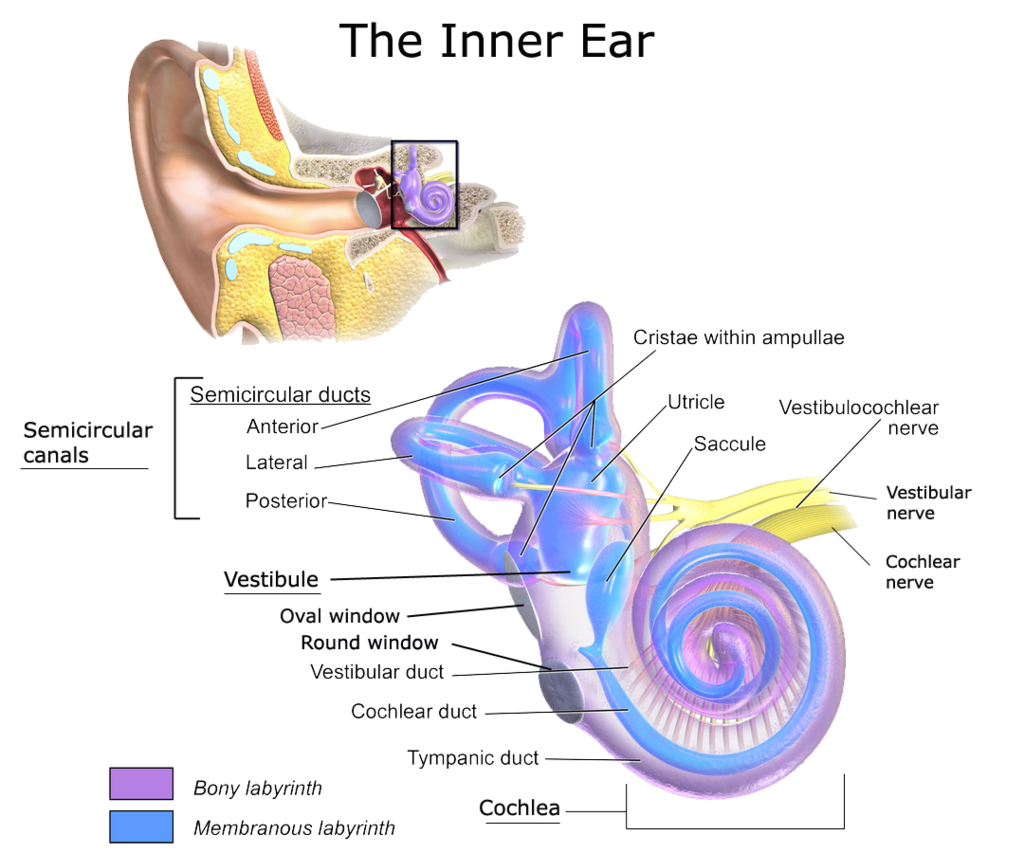
The vestibular apparatus is composed of two main component types: the semicircular canals and the otolith organs. Each is specialised for a different kind of motion.
Sensing Spin
For detecting rotation, the cat relies on three semicircular canals. These fluid-filled tubes are arranged at roughly right angles to each other, like the three sides meeting at the corner of a box. This orientation allows them to measure angular acceleration around three perpendicular axes: pitch (nodding yes), yaw (shaking your head no), and roll (tilting your head side to side).
Inside each canal is a fluid called endolymph. When the cat's head turns, the bony canal moves with it, but the endolymph inside lags slightly due to inertia. This relative motion of the fluid pushes against a gelatinous structure called the cupula, which sits in a small bulge in the canal known as the ampulla. Embedded within the cupula are tiny mechanoreceptors called hair cells. As the cupula bends, it bends these hair cells, which triggers a neural signal to the brain, precisely encoding the direction and speed of the rotation.
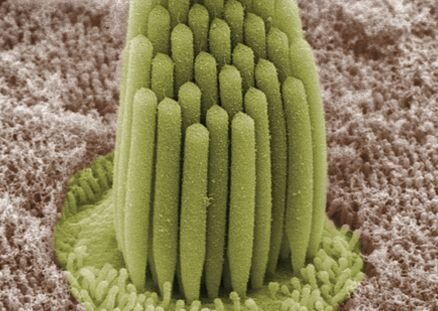
This mechanism is incredibly sensitive. The brain integrates the signals from all three canals to build a complete picture of how the head is turning in space. This is a key part of the vestibulo-ocular reflex, which allows a cat to keep its eyes fixed on a target even while its head is moving.
Gravity and Acceleration
While the canals handle rotation, the otolith organs detect linear acceleration. These are two sac-like structures called the utricle and saccule. They are responsible for sensing motion in a straight line—forwards, backwards, up, or down—and, crucially, the constant downward pull of gravity.
Inside each organ is a patch of hair cells covered by a gelatinous layer. Embedded in this layer are tiny, dense crystals of calcium carbonate called otoconia, or colloquially, "ear stones." Because these crystals have mass, they respond to gravity and acceleration.
When a cat tilts its head, gravity pulls the heavy otoconia, causing the gelatinous layer to shift and bend the underlying hair cells. The same thing happens when the cat accelerates forwards; the otoconia lag behind, bending the hair cells in the opposite direction of the movement. The utricle is primarily sensitive to horizontal movements, while the saccule detects vertical movements. The brain interprets the specific pattern of bent hair cells to determine the head's tilt angle and the direction of linear acceleration. This is how a cat always knows which way is up.
This constant sense of gravity, combined with rotational data from the semicircular canals, is then integrated with information from the cat's proprioceptive neural pathways. Proprioception is the sense of the relative position of one's own parts of the body. Nerves in the muscles and joints tell the brain where each limb is. By combining vestibular data (where the head is in space) with proprioceptive data (where the body parts are relative to the head), the brain constructs a dynamic, real-time model of the entire body. This allows for the lightning-fast adjustments that keep a cat balanced on a narrow fence or enable it to land on its feet when it falls.
What is the primary function of a cat's vestibular apparatus?
Which component is responsible for detecting the constant downward pull of gravity, helping a cat always know which way is up?
The cat's vestibular system is a marvel of efficiency, providing the rapid, precise feedback necessary for its signature grace and agility.