Solving Algebraic Functions
Understanding Functions
What is a Function?
Think of a function as a simple, reliable machine. You put something in, and you get something specific out. For example, a coffee machine is a function. You press the 'espresso' button (the input), and you get a shot of espresso (the output). You'll never press 'espresso' and get a latte. The machine follows a consistent rule.
In math, a function is a rule that assigns exactly one output to each input.
This 'one output for one input' rule is the most important thing to remember about functions. It's what makes them so predictable and useful. The inputs can be numbers, names, or anything else, and the same goes for the outputs. The key is the relationship between them. An input can't lead to multiple different outputs.
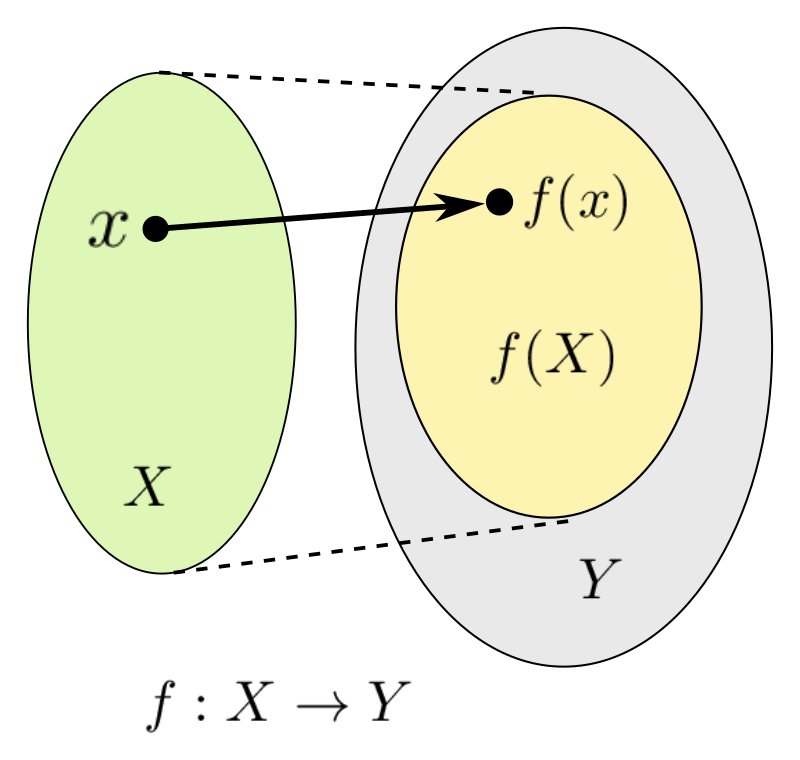
It's perfectly fine for different inputs to lead to the same output, though. For instance, a function might assign a letter grade (the output) to a percentage score (the input). Scores of 92, 95, and 98 might all receive an 'A'. That's still a function because each individual score leads to only one specific grade.
Functions vs. Non-Functions
To really understand what a function is, it helps to see what isn't one. The defining line is always that 'one output' rule. If any single input can produce more than one output, the relationship is not a function.
| Relationship | Input | Output(s) | Function? |
|---|---|---|---|
| The price of items in a store | An item (e.g., milk) | Its price (e.g., $3.50) | Yes. Each item has only one price. |
| A person's biological mother | A person | Their biological mother | Yes. Each person has only one. |
| A person's children | A person | Their children | No. A person can have more than one child. |
| The equation | A number, | The number plus 2, | Yes. For any , there's only one . |
| The relation | A number, | and | No. The input 4 gives two different outputs. |
The table shows that some relationships are functions and some are not. The relationship between a person and their children is not a function because one input (a parent) can be linked to multiple outputs (their children). Similarly, in the equation , the input would give two possible outputs for : 3 and -3. Since one input leads to two outputs, it's not a function.
Why Functions Matter
Functions are the building blocks of mathematics, representing relationships between inputs and outputs.
Functions are more than just an abstract math concept; they are essential tools for describing the world around us. They help us model relationships, make predictions, and understand patterns of change.
For example, the distance a car travels over time can be described as a function. The input is time, and the output is distance. If you know the car's speed, you can predict exactly how far it will have gone after a certain amount of time.
Economists use functions to model the relationship between price and demand. Scientists use them to predict population growth or the decay of a radioactive substance. In computer programming, functions are fundamental pieces of code that take an input and perform a specific task to produce an output.
By understanding functions, you gain a powerful framework for thinking about cause and effect. You learn to see the connections between variables and to express those connections in a precise, mathematical way. This is a foundational skill for almost every field of science, engineering, and technology.
What is the most important rule that a relationship must follow to be considered a function?
Which of the following real-world relationships is NOT a function?