Solids Bonding and States of Matter
States of Matter
The States of Matter
Everything around us, from the water we drink to the air we breathe, is made of matter. Matter is just a general term for all the physical stuff in the universe. But this stuff doesn't always look or act the same. Depending on conditions like temperature and pressure, it can exist in different forms, or states. The most common states you'll encounter every day are solid, liquid, and gas.
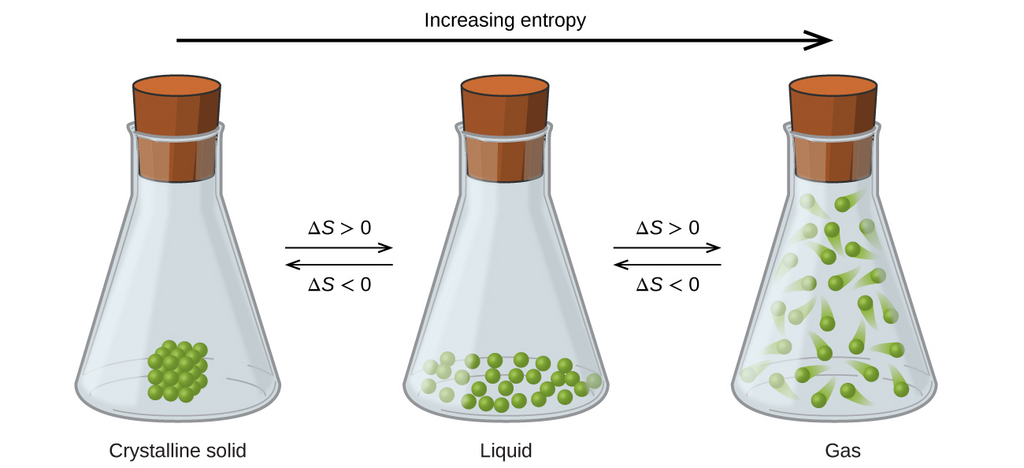
The key difference between these states comes down to how the tiny particles (atoms and molecules) that make up a substance are behaving. Are they locked in place, sliding past each other, or flying around freely? The energy of these particles and the strength of the forces pulling them together determine the answer.
A Closer Look
Let's break down the distinct characteristics of solids, liquids, and gases.
In a solid, particles are packed tightly together in a fixed arrangement. They can't move around much, they just vibrate in place. This is why a solid has a definite shape and a definite volume. A block of ice is a solid; it doesn't change its shape or size unless you do something to it.
A liquid has particles that are still close together, but they aren't locked into position. They can slide past one another, which allows the liquid to flow and take the shape of its container. A liquid has a definite volume, but not a definite shape. Pour water from a glass into a bowl, and its shape changes, but you still have the same amount of water.
In a gas, particles have a lot of energy and are spread far apart. The forces between them are very weak, so they move around randomly and at high speeds. A gas has no definite shape or volume. It will expand to fill any container it's in, like the air in a room.
| Property | Solid | Liquid | Gas |
|---|---|---|---|
| Shape | Definite | Takes shape of container | Takes shape of container |
| Volume | Definite | Definite | Fills volume of container |
| Particle Arrangement | Tightly packed, ordered | Close together, random | Far apart, random |
| Particle Movement | Vibrate in place | Flow past one another | Move freely and quickly |
Changing States
Substances don't have to stay in one state forever. Adding or removing energy, usually in the form of heat, can cause them to undergo a phase transition. You see these transitions all the time.
Here’s a quick rundown of the transitions:
- Melting: Solid to liquid (ice turning to water).
- Freezing: Liquid to solid (water turning to ice).
- Vaporization: Liquid to gas (water boiling into steam).
- Condensation: Gas to liquid (water vapor forming dew on grass).
- Sublimation: Solid directly to gas (dry ice turning into carbon dioxide gas).
- Deposition: Gas directly to solid (water vapor forming frost on a cold window).
The two main factors that control these transitions are temperature and pressure.
Increasing the temperature gives a substance's particles more energy, causing them to move faster and overcome the forces holding them together. That's why heating ice makes it melt and then boil. Decreasing the temperature does the opposite.
Pressure also plays a crucial role. Squeezing particles together (increasing pressure) makes it harder for them to break apart, which can favor the liquid or solid state. Conversely, lowering the pressure makes it easier for a substance to become a gas. This is why water boils at a lower temperature at high altitudes, where the air pressure is lower.
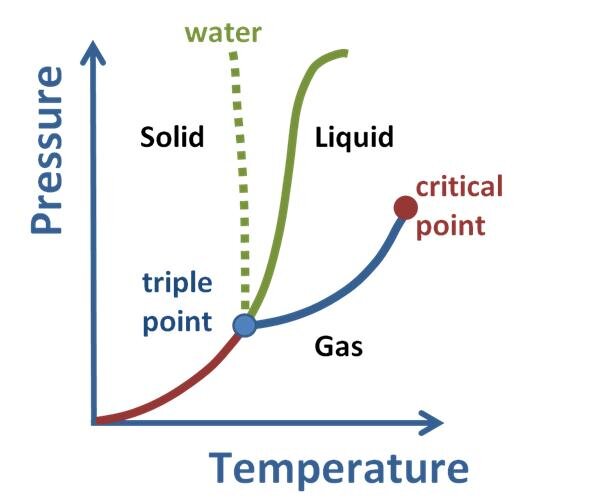
Scientists use phase diagrams, like the one above, to map out which state a substance will be in under any given combination of temperature and pressure. The lines on the diagram show the exact conditions where phase transitions occur. Where all three lines meet is the triple point, a unique condition where the solid, liquid, and gas phases can all exist at the same time.
Ready to check your understanding?
Which of the following best describes the characteristics of a substance in the liquid state?
The process of a solid, like dry ice, turning directly into a gas without first becoming a liquid is called:
Understanding these fundamental states provides a foundation for exploring the properties and behaviors of all kinds of different substances.