Solidity Token Creation
Introduction to Blockchain
The Shared Notebook
At its heart, a blockchain is like a digital notebook that's shared among a vast network of computers. Instead of one person or company owning the notebook, everyone on the network has a copy. When a new entry, or transaction, is made, it gets added to every copy of the notebook at the same time.
This notebook is made up of pages, which in the crypto world are called "blocks." Each block is filled with a list of recent transactions. Once a block is full, it's added to the end of the chain of previous blocks, creating a chronological, unbreakable record. This is where the name "blockchain" comes from: a chain of blocks.
The most important feature of this system is that it's decentralized. There's no central authority like a bank or government controlling the ledger. Instead, the power is distributed among all the participants in the network.
Decentralization means control is spread out, not concentrated in one place. This makes the system transparent and resistant to censorship or manipulation.
How the Chain Stays Secure
So, if anyone can have a copy of the notebook, what stops someone from changing an entry and giving themselves a million dollars? This is where cryptography comes in.
Each block is sealed with a unique digital fingerprint called a hash. This hash is generated based on the data inside the block. Even a tiny change to the transaction data would create a completely different hash. Crucially, each new block also contains the hash of the previous block. This is what links them together into a secure chain.
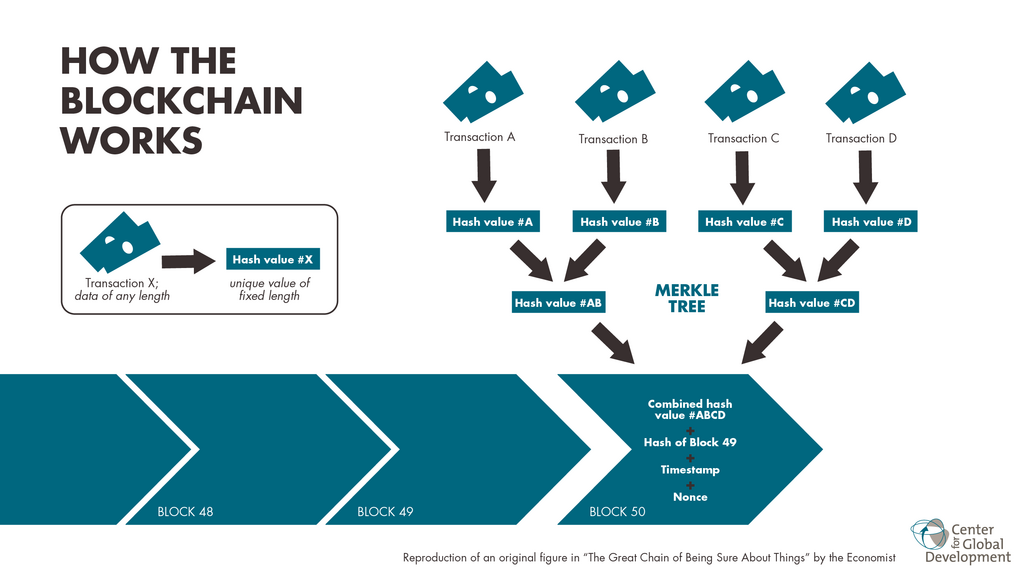
If a bad actor tried to alter a transaction in an old block, the block's hash would change. This would break the link to the next block, because the next block would still be pointing to the original hash. To make the change stick, they would have to recalculate the hash for every single block that came after it, all across thousands of computers on the network, faster than the network could add new, valid blocks. It's practically impossible.
Agreeing on the Truth
With no one in charge, how does the network agree on which new blocks to add to the chain? This is solved by a consensus mechanism, which is just a set of rules that everyone agrees to follow.
consensus
noun
A general agreement among the participants of a decentralized network.
The most famous consensus mechanism is Proof of Work (PoW), used by Bitcoin. In this system, powerful computers known as "miners" compete to solve a complex mathematical puzzle. The first miner to solve the puzzle gets to add the next block of transactions to the chain and is rewarded with cryptocurrency. This process requires a huge amount of energy, which is why it's so secure. It's too expensive to cheat.
Another popular method is Proof of Stake (PoS). Instead of miners competing with computing power, participants called "validators" lock up, or "stake," some of their own cryptocurrency as collateral. The network then randomly selects a validator to create the next block. If they act dishonestly, they can lose their staked coins. This provides a financial incentive to follow the rules.
Enter Smart Contracts
Early blockchains like Bitcoin were designed just for sending and receiving digital currency. But what if a blockchain could do more? This is where smart contracts come in.
A smart contract is just a program that runs on the blockchain. It's a set of rules, written in code, that automatically executes when certain conditions are met. Think of it like a digital vending machine.
You insert money (a transaction), select an item (an instruction in the code), and the machine automatically dispenses your snack (the outcome). The rules are pre-programmed, and no cashier is needed.
Smart contracts are the building blocks of decentralized applications, or "dApps." They allow developers to create complex systems on the blockchain, from financial tools and games to voting systems and supply chain management. Because they live on the blockchain, they inherit its security and transparency. Once a smart contract is deployed, it runs exactly as written and cannot be changed.
This ability to run code on a decentralized network is what makes creating things like custom digital tokens possible. The blockchain provides the secure and transparent ledger, and smart contracts provide the logic that governs how these tokens are created, sent, and managed.
What is the best analogy for a blockchain, based on its core function?
If a malicious actor successfully alters the data in a single block, what happens to the chain?