Solidity and Blockchain Essentials
Blockchain Fundamentals
What Is a Blockchain?
At its heart, a blockchain is a special kind of digital notebook. Imagine a ledger that’s copied and spread across thousands of computers around the world. This ledger is made up of a growing list of records, called blocks.
Each block contains a batch of transactions. Once a block is filled, it's linked to the previous one, forming a chain. This structure gives the blockchain its name.
This technology was originally created in 2008 as the public transaction ledger for Bitcoin. But its potential goes far beyond digital currency. The power of blockchain comes from three core ideas: it's decentralized, transparent, and immutable.
The Core Principles
Understanding these three principles is key to understanding blockchain.
Decentralization This means there's no single person or organization in charge. Traditional systems, like banks, are centralized. A bank controls your money and its ledger is stored on its private servers. If that server goes down, you can't access your funds.
In a blockchain network, every participant has a copy of the ledger. No single entity controls it. This distribution of power makes the system more resilient and fair. There's no central point of failure.
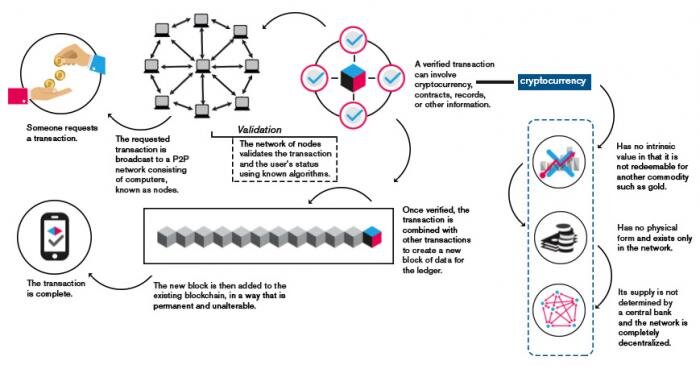
Transparency While not all blockchains are public, many, like Bitcoin's, are. Anyone can view the list of transactions. This doesn't mean your personal identity is revealed—transactions are tied to a public address, which is a string of characters. This creates a system of pseudonymous transparency, where the activity is visible, but the actors are not immediately identifiable.
Immutability This is a fancy word for unchangeable. Once a transaction is recorded in a block and added to the chain, it's practically impossible to alter or remove it. Each block is cryptographically linked to the one before it. Changing a block would require changing every single block that came after it across the entire network, which is computationally infeasible. This makes the ledger permanent and tamper-proof.
How It Works
Let's break down the key components that make a blockchain function.
Block
noun
A collection of transaction data. Each block includes the data, a unique cryptographic fingerprint called a hash, and the hash of the previous block.
The hash is crucial. It acts as a digital seal. If even a single character in the block's data changes, the hash will change completely. By including the previous block's hash, each new block cements the one before it into place, creating a secure chain.
Nodes and Consensus
The computers participating in the network are called nodes. Each node holds a copy of the blockchain. For a new block to be added, the nodes must agree on its validity. This agreement is reached through a consensus mechanism.
There are different types, but two are most common:
-
Proof of Work (PoW): This was the first consensus mechanism, used by Bitcoin. Nodes, often called "miners," compete to solve a complex mathematical puzzle. The first one to solve it gets to add the next block to the chain and is rewarded with cryptocurrency. This process requires immense computational power and energy.
-
Proof of Stake (PoS): This is a more energy-efficient alternative used by networks like Ethereum. Instead of miners, there are "validators." Validators lock up, or "stake," their own cryptocurrency as collateral. The network then randomly selects a validator to create the next block. If they act dishonestly, they can lose their staked coins.
Applications of Blockchain
While cryptocurrencies are the most famous application, blockchain's ability to create a secure, transparent, and decentralized record has many other uses. It's not just about money.
- Supply Chain Management: Companies can use blockchain to track products from the factory to the store shelf. This provides a transparent and unalterable record, ensuring authenticity and preventing fraud.
- Voting Systems: A blockchain-based voting system could be secure, transparent, and auditable, potentially reducing fraud and increasing trust in elections.
- Digital Identity: You could control your own digital identity, sharing only the necessary information with service providers without relying on a central authority to manage it.
- Healthcare: Securely storing and sharing patient medical records, giving patients control over who can see their data.
This foundational technology opens up a new way of thinking about how we trust and exchange value in a digital world. It's the environment where technologies like smart contracts, which we'll explore later, come to life.
Ready to test your knowledge?
Which of the following best describes the principle of immutability in a blockchain?
What is the key difference between a decentralized blockchain network and a traditional centralized system like a bank?