Solar System Thermal Dynamics
Orbital Thermal Dynamics
Dancing in the Dark
A spacecraft's temperature is a delicate dance between absorbing heat and radiating it away. In orbit, this dance is choreographed by its position relative to the Sun and nearby celestial bodies. The most critical factor is the geometry of its orbit, which dictates how much time it spends in direct sunlight versus in the cold shadow of a planet. This relationship is quantified by the Beta angle (β).
The Beta angle is the angle between the Sun's direction and the plane of a satellite's orbit. A β angle of 0° means the satellite's orbital plane is edge-on to the Sun, leading to the longest possible eclipses as the satellite passes directly behind the Earth on every orbit. A β angle of 90° means the orbital plane is face-on to the Sun, and the satellite experiences continuous sunlight, never entering Earth's shadow. For most orbits, the Beta angle changes throughout the year as the Earth orbits the Sun, causing seasonal variations in the spacecraft's thermal environment. The duration of these eclipses creates cyclic thermal stress, as the spacecraft rapidly cools in shadow and heats up again in sunlight.
The Triple Threat of Space Heat
A spacecraft's thermal load comes from three primary sources: direct solar radiation, sunlight reflected off a nearby planet (albedo), and infrared radiation emitted by the planet itself. Mastering thermal control means accounting for all three.
Direct solar flux is the most powerful source. Its intensity decreases with the square of the distance from the Sun, a relationship known as the inverse-square law. We can calculate the solar flux () at any distance (in Astronomical Units, or AU) from the Sun using a simple formula.
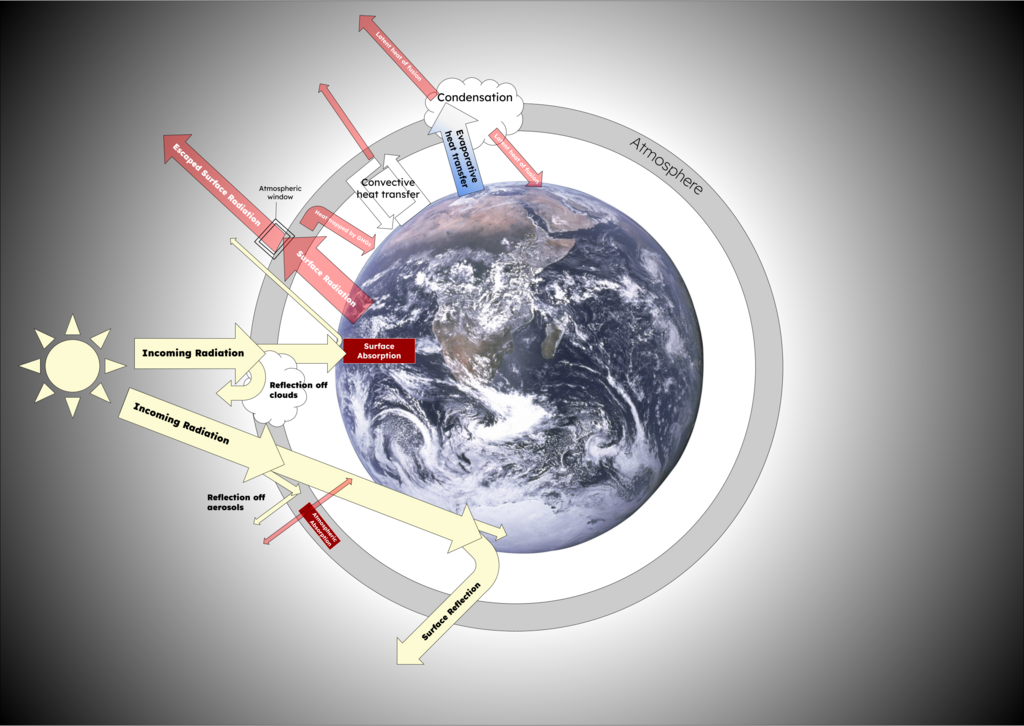
Next is albedo radiation, which is the solar energy reflected off the surface and atmosphere of a planet. Earth's albedo is about 0.3, meaning it reflects 30% of the sunlight that hits it. This reflected light can be a significant heat source for satellites in Low Earth Orbit (LEO). Finally, planets emit their own heat as infrared (IR) radiation. Even on its night side, a planet like Earth radiates heat into space, which can warm a passing spacecraft. For a LEO satellite, the Earth's IR emission provides a relatively constant, gentle warming effect.
Finding the Balance
A spacecraft's orientation, or attitude, is just as important as its location. By carefully controlling which surfaces face the Sun, engineers can manage the thermal load. This is where view factors come in. A is a geometric value from 0 to 1 that describes how much of the radiation leaving one surface strikes another. A flat plate pointed directly at the Sun has a view factor of 1 relative to the Sun's rays hitting its surface. If that same plate is turned edge-on, its view factor is 0, and it absorbs no direct solar energy.
In the vacuum of space, radiation is the only way for a spacecraft to shed heat. It does so according to the Stefan-Boltzmann law, which states that the power radiated is proportional to the fourth power of its absolute temperature. An object reaches thermal equilibrium when the energy it absorbs equals the energy it radiates.
Thermal engineers design systems for the 'worst-case' scenarios. The 'hot case' for a satellite might be when it has a high Beta angle (maximum sun exposure), is closest to the Sun in its orbit, and is oriented to absorb maximum solar and albedo radiation. The 'cold case' could be during the longest possible eclipse, far from the Sun, with its most emissive surfaces pointing towards deep space. An interplanetary probe traveling to Jupiter faces a cold case dominated by a weak Sun, while a probe heading to Mercury must survive an intense hot case.
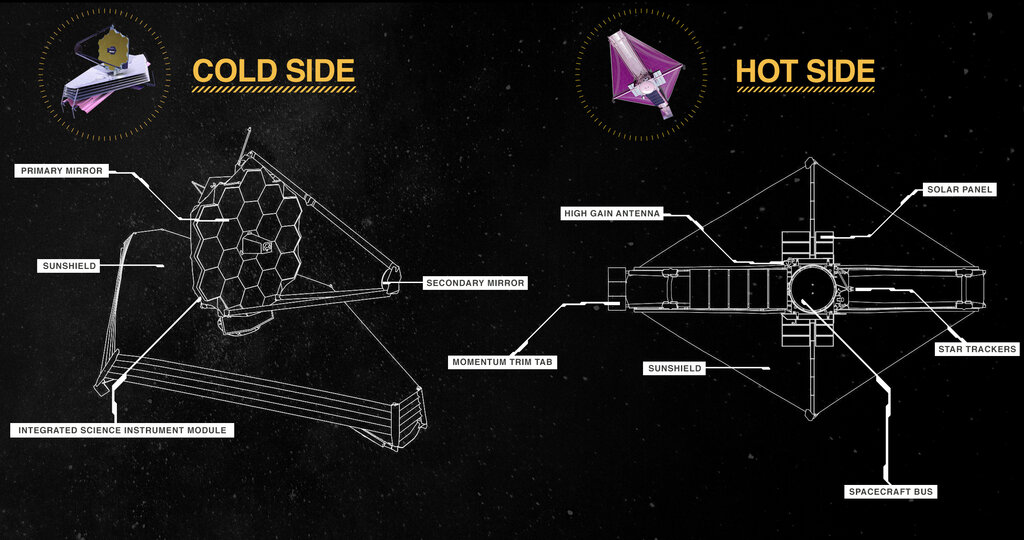
Understanding these principles is the foundation of designing thermal control systems, from simple passive coatings and radiators to active systems with heaters and fluid loops. It's a constant balancing act to keep a spacecraft's delicate electronics within their operational temperature range, no matter where they are in the solar system.