Solar System Odyssey
Solar System Formation
A Cloud of Dust
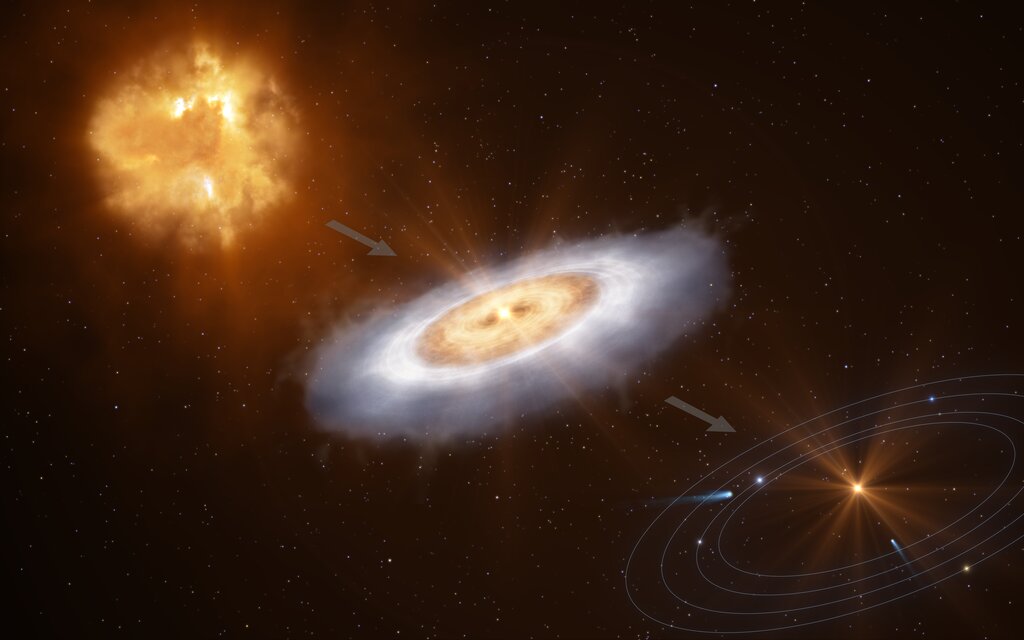
Our solar system wasn't always here. About 4.6 billion years ago, this corner of the galaxy was just a part of a vast, cold cloud of gas and dust. This wasn't just any cloud; it was a giant molecular cloud, many light-years across.
Something disturbed this cosmic cloud, maybe the shockwave from a nearby exploding star, a supernova. This disturbance caused a pocket of the cloud to begin collapsing under its own gravity.
This idea, that our solar system formed from a collapsing nebula, is known as the nebular hypothesis. As the cloud collapsed, it started to spin faster, just like an ice skater pulling their arms in. Conservation of angular momentum is a powerful force, even on a galactic scale. The spinning motion flattened the cloud into a huge, rotating disk.
The Sun's Fiery Birth
Most of the cloud's material, more than 99% of it, spiraled into the center of this newly formed disk. The pressure and temperature there grew immense. Atoms were crushed together so intensely that they began to fuse, releasing an enormous amount of energy in a process called nuclear fusion. This was the birth of our Sun.
The rest of the material continued to orbit the young Sun in a flat, spinning disk. This was the protoplanetary disk, the nursery from which the planets would eventually be born.
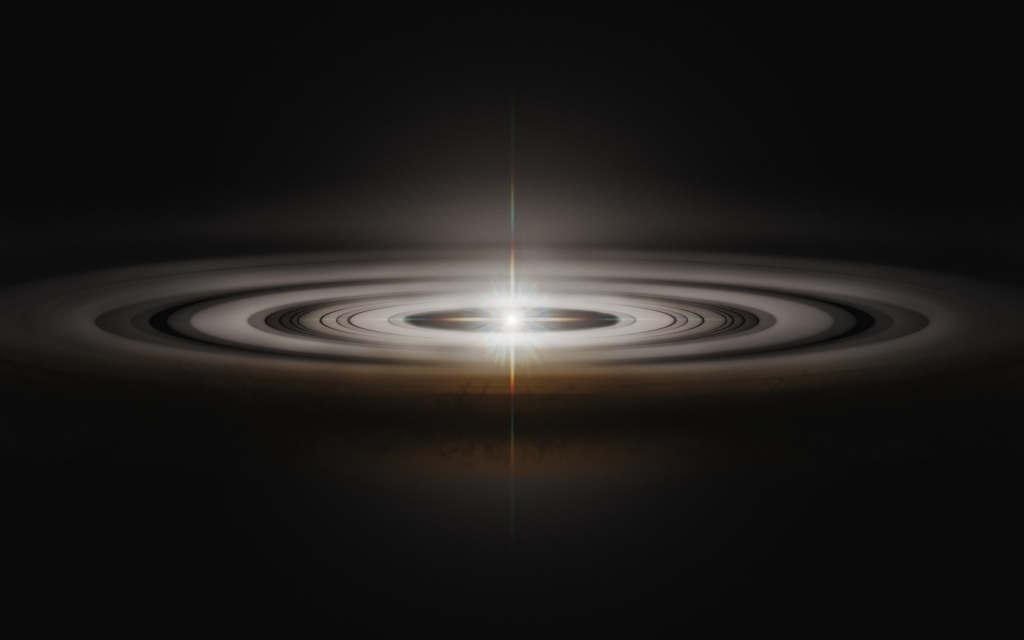
This disk wasn't uniform. It was hotter near the center, close to the blazing protostar, and much colder in its outer reaches. This temperature difference would have a profound effect on what came next.
Building Planets
Within the protoplanetary disk, tiny grains of dust and ice began to bump into each other. At first, they were held together by static electricity. As these clumps grew larger, gravity took over, pulling in more and more material. This process of gradual growth is called accretion.
This process is called “accretion,” and resulted in the production of many planetesimals (small objects that build up into planets), and eventually, the planets themselves.
These initial building blocks, ranging from a few feet to several miles across, are called planetesimals. As they orbited the Sun, planetesimals collided and merged, growing ever larger. The biggest ones became protoplanets, massive bodies with enough gravity to clear out their orbital paths by absorbing or flinging away smaller objects. Over millions of years, these protoplanets evolved into the planets we know today.
Planetesimal
noun
A small celestial body that could serve as a building block for a planet through accretion.
An Icy Divide
The composition of the planets was determined by their distance from the young Sun. A crucial dividing line existed in the protoplanetary disk, known as the frost line.
Inside the frost line, it was too warm for volatile compounds like water, ammonia, and methane to freeze. Only rock and metal could exist as solids. This is why the inner planets, Mercury, Venus, Earth, and Mars, are small and rocky.
Beyond the frost line, it was cold enough for those volatile compounds to condense into solid ice. This meant there was a much larger reservoir of solid material available for planet building. The protoplanets in this region grew massive enough to capture huge amounts of hydrogen and helium gas from the surrounding disk, forming the gas giants Jupiter and Saturn, and the ice giants Uranus and Neptune.
And that is how our solar system came to be, born from a collapsing cloud and shaped by distance and temperature into the diverse family of planets we see today.
What is the name of the widely accepted theory explaining that our solar system formed from a vast, collapsing cloud of gas and dust?
What physical principle caused the rotating solar nebula to spin faster and flatten into a disk as it collapsed?