Solar System Dynamics and Composition
Orbital Mechanics
The Unseen Architects of the Solar System
The planets glide through space on paths that seem serene and predictable. But this clockwork motion isn't as simple as it looks. The orbits of planets and moons are shaped by an intricate gravitational dance, a constant push and pull between every object in the Solar System. While Johannes Kepler's laws describe the elegant elliptical paths of planets around the Sun, and Isaac Newton's law of universal gravitation gives us the force behind that motion, the reality is far more complex. No planet or moon travels in a perfect, undisturbed ellipse. Each body is constantly nudged by the gravity of its neighbors, creating tiny deviations from its ideal path known as orbital perturbations .
These perturbations are usually small, causing orbits to wobble and shift over millions of years. But sometimes, these gravitational nudges fall into a rhythm. When the orbital periods of two bodies form a simple ratio, like 2:1 or 3:2, they give each other a synchronized gravitational kick in the same spot of their orbits, over and over again. This phenomenon is called a mean-motion resonance (MMR).
Rhythmic Tugs and Resonant Orbits
Think of pushing someone on a swing. If your pushes are random, not much happens. But if you time your pushes to match the swing's natural rhythm, it goes higher and higher. Gravitational resonances work similarly. They can amplify small effects, creating stable patterns that protect objects from collisions or, alternatively, eject them from their orbits entirely.
A classic example is the relationship between Neptune and Pluto. For every three times Neptune orbits the Sun, Pluto orbits exactly twice. This stable 3:2 resonance ensures that even though Pluto's orbit crosses inside Neptune's, the two bodies are always far apart when Pluto is at its closest point to the Sun. The resonance acts as a cosmic bodyguard, preventing a catastrophic collision. A particularly striking example of this rhythmic interaction is the among Jupiter's moons.
The constant, rhythmic tugs from this resonance force the orbits of Io and Europa to be more eccentric, or stretched out, than they would be otherwise. This flexing of the moons' interiors generates immense heat through friction, powering Io's extreme volcanism and maintaining the liquid water ocean believed to exist beneath Europa's icy shell.
The Dance of Spin and Tides
Gravity's influence doesn't stop at orbital paths; it also shapes how planets and moons rotate. This is where tidal forces come in. A large body's gravity pulls more strongly on the near side of a smaller body than on its far side. This difference in force stretches the smaller body, creating two bulges on opposite sides. Earth's rotation tries to drag these tidal bulges ahead of the Moon. The Moon's gravity then pulls back on these bulges, creating a braking effect that has slowed Earth's rotation over billions of years.
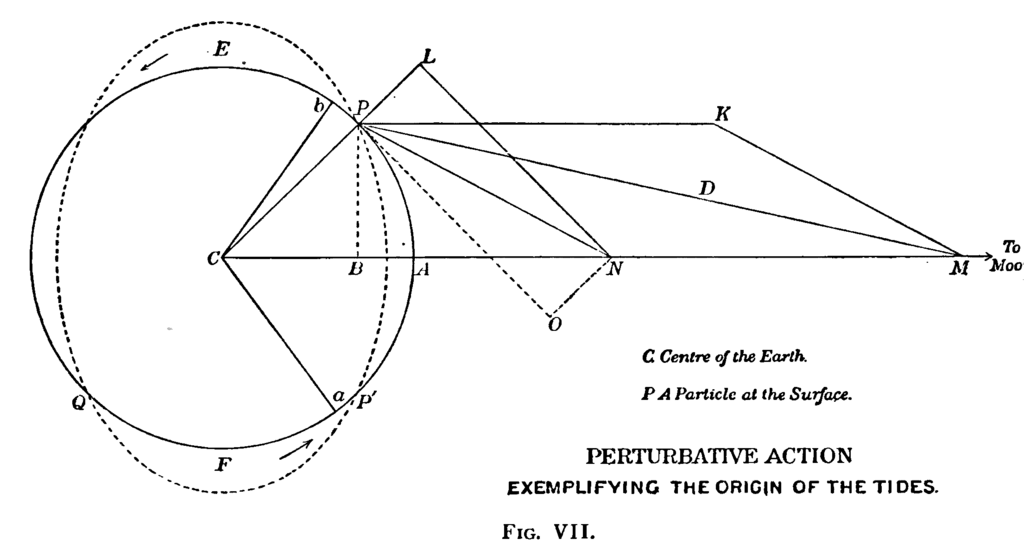
For the Moon, this process worked in reverse. Earth's much stronger gravity created significant tidal bulges on the early Moon, slowing its rotation until its rotational period matched its orbital period. This 1:1 spin-orbit resonance is called , and it's why we always see the same face of the Moon. This is the most common form of resonance in the Solar System, affecting most major moons.
But not all spin-orbit resonances are 1:1. Mercury, for instance, is locked in a more peculiar 3:2 spin-orbit resonance with the Sun. It rotates on its axis exactly three times for every two orbits it completes around the Sun. This stable state is a compromise between the Sun's tidal forces and Mercury's highly eccentric orbit. It results in a bizarrely long solar day on Mercury that lasts for two of its years.
From stabilizing orbits to generating volcanic activity and locking moons in a perpetual gaze, these gravitational resonances are the unseen architects of the Solar System, turning simple orbits into a complex, interconnected system.