Solar Energy Engineering and Implementation
Core System Components
From DC to AC: The Inverter's Job
Your solar panels produce direct current (DC) electricity, but your home and the national grid run on alternating current (AC). The inverter is the component that bridges this gap, acting as the brain of your solar installation. Its primary job is conversion, but the way it does this has a major impact on your system's efficiency and cost.
The most common approach uses . In this setup, several solar panels are wired together in series, forming a 'string'. The combined DC output from this string feeds into a single, central inverter. It's a straightforward and cost-effective solution, which explains its popularity.
However, it has a significant drawback. Because the panels are linked in a chain, the entire string's performance is limited by its weakest link. If just one panel is shaded by a tree branch or a passing cloud, the output of every panel in that string drops.
To solve the shading problem, engineers developed Module-Level Power Electronics (MLPEs). There are two main types: microinverters and power optimisers.
Microinverters are small inverters installed on the back of each individual solar panel. They convert DC to AC right at the source. This means each panel operates independently. If one panel's output dips, the others are completely unaffected. This maximises the system's overall energy harvest and provides detailed, panel-by-panel performance monitoring.
Power optimisers offer a hybrid solution. Like microinverters, a small optimiser is attached to each panel. However, instead of converting DC to AC, it conditions the DC electricity and feeds it to a central string inverter. This allows each panel to produce its maximum power without being dragged down by others, but at a lower cost than a full microinverter system.
Managing the Flow
In systems that include battery storage, a charge controller is essential. It sits between the solar panels and the batteries, acting as a gatekeeper to protect the battery from overcharging. It regulates the voltage and current coming from the panels to ensure the battery is charged safely and efficiently.
There are two main types of charge controllers: Pulse Width Modulation (PWM) and (MPPT).
A PWM controller is the simpler of the two. It works like a switch, rapidly connecting and disconnecting the solar array to the battery. When the battery is full, the switch stays off. This technology is older, less expensive, and works well in small systems where the solar panel's nominal voltage is matched to the battery bank's voltage (e.g., a 12V panel charging a 12V battery). Its main weakness is inefficiency; it forces the panel to operate at the battery's voltage, which is rarely the panel's ideal operating voltage.
An MPPT controller is more sophisticated and efficient. It's a smart DC-to-DC converter that can take a higher voltage from the solar panels and convert it to the lower voltage required by the batteries. This decoupling allows the panels to operate at their optimal voltage, where they produce the most power.
By continuously tracking the panel's maximum power point, an MPPT controller can harvest up to 30% more energy than a PWM controller, especially in cold weather or when the battery is low. This efficiency gain makes them the standard choice for all but the smallest off-grid systems.
Storing the Sun
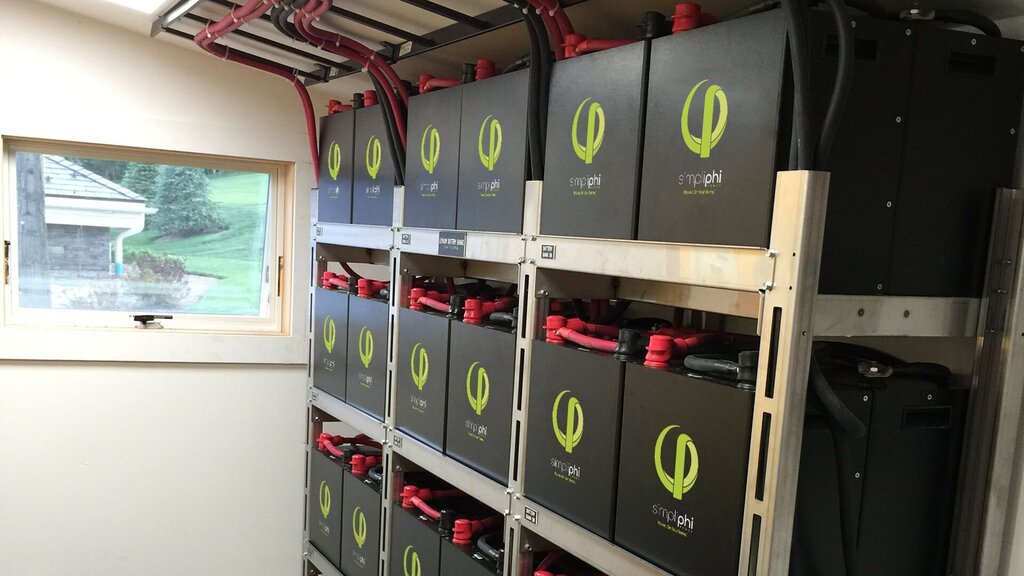
The battery bank is where you store solar energy for use when the sun isn't shining. The right battery chemistry and capacity are vital for the reliability and longevity of an off-grid or hybrid solar system.
For many years, deep-cycle lead-acid batteries were the go-to choice. They are a mature, reliable, and relatively inexpensive technology. However, they are heavy, require regular maintenance (like checking water levels in flooded types), and have a limited lifespan, especially if they are deeply discharged.
More recently, Lithium-ion batteries, specifically the (LiFePO₄) variant, have become dominant. While their upfront cost is higher, they offer a host of advantages: they are much lighter, require no maintenance, and can handle far more charge-discharge cycles.
Two key metrics determine a battery's useful life: Depth of Discharge (DoD) and cycle life.
Depth of Discharge (DoD) refers to the percentage of the battery's total capacity that has been used. A DoD of 80% means 80% of the energy has been drained, leaving 20% in reserve.
Cycle life is the number of charge and discharge cycles a battery can endure before its capacity degrades to a specific level (usually 80% of its original rating). These two metrics are directly linked. Regularly discharging a battery to a high DoD will reduce its total cycle life.
This is where LiFePO₄ batteries truly shine. A typical lead-acid battery might be rated for 500 cycles at a 50% DoD. Exceeding this depth of discharge will dramatically shorten its life. In contrast, a LiFePO₄ battery can often provide several thousand cycles at an 80-90% DoD, making it a much more durable and cost-effective solution over the long term.
| Feature | Lead-Acid | Lithium Iron Phosphate (LiFePO₄) |
|---|---|---|
| Depth of Discharge (DoD) | 50% recommended | 80-90% common |
| Cycle Life | ~500-1000 cycles | 3000-7000+ cycles |
| Efficiency | ~80-85% | ~95% |
| Maintenance | Regular (fluid checks) | None |
| Upfront Cost | Low | High |
| Lifetime Cost | Higher | Lower |
What is the primary function of an inverter in a solar panel system?
A homeowner notices that a single large tree branch casts a shadow over one solar panel for two hours every afternoon. If their system uses a traditional string inverter, what is the most likely outcome?
Understanding how these core components interact is key to designing a solar energy system that is efficient, reliable, and built to last.