Soil Bearing Capacity Explained
Introduction to Soil Mechanics
What is Soil, Really?
To an engineer, soil is much more than just dirt. It's a complex material whose behavior dictates how we build everything from roads to skyscrapers. Understanding it starts with seeing what it's made of.
Every soil, whether it's sandy beach or thick clay, is a mix of three things: solid particles, water, and air. These are known as the three phases of soil. The solid particles are the mineral and organic bits that form the soil's skeleton. The spaces between these particles, called voids, are filled with either water or air, or a combination of both.
The solid particles themselves are broken down by size. Geologists and engineers talk about gravel, sand, silt, and clay. Gravel and sand particles are large enough to see with the naked eye. Silt particles are much finer, like flour, while clay particles are microscopic and have unique properties because of their flat shape and electrical charge. Most soils are a mixture of these different particle sizes.
A Family of Soils
Classifying soil is the first step in predicting how it will behave. Will it be strong and stable, or weak and prone to shifting? The answer usually depends on the mix of sand, silt, and clay.
To standardize this, engineers use classification systems. One of the most common visual tools is the soil textural triangle. By figuring out the percentage of sand, silt, and clay in a sample, you can pinpoint its exact classification on the chart.
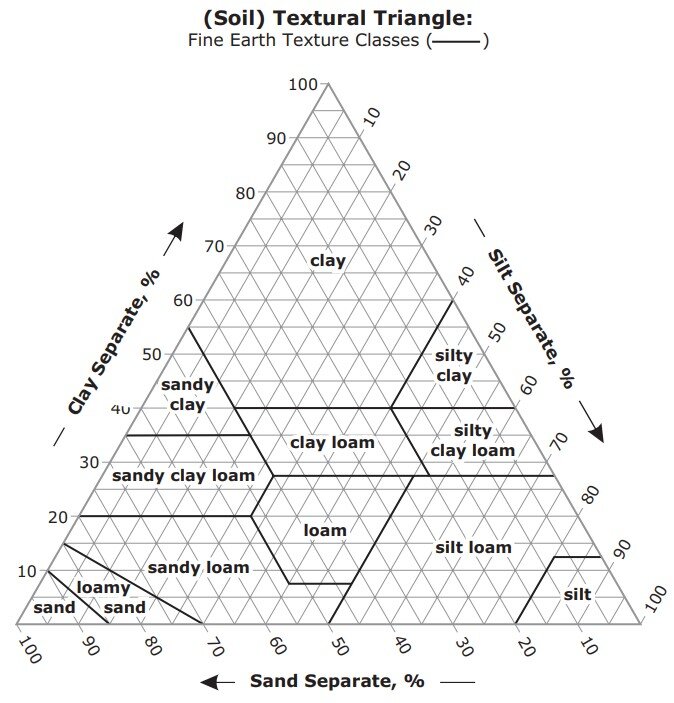
For example, a soil that is 40% sand, 40% silt, and 20% clay would be classified as "loam." A soil with 70% sand, 15% silt, and 15% clay would be "sandy loam." Each classification tells an engineer a lot about the soil's likely strength, drainage, and suitability for a project.
Key Soil Properties
Beyond classification, we need to measure specific properties to understand a soil's condition. Three of the most fundamental are density, moisture content, and permeability.
Density
noun
A measure of how much mass or weight is packed into a specific volume. In soil mechanics, this is often expressed as unit weight.
A soil's unit weight tells us how heavy it is for its size. It's calculated by dividing the total weight of the soil sample (including solids and water) by its total volume.
Next is moisture content, which is simply the amount of water in a soil. But it's not measured relative to the total volume. Instead, it's the weight of the water divided by the weight of the dry solid particles. This gives a stable measure that doesn't change if the soil is compacted or loosened.
Finally, we have permeability. This property describes how easily water can flow through a soil. Think of pouring water into a bucket of gravel versus a bucket of clay. The water will rush through the gravel but will barely seep into the clay.
Gravel and sand have high permeability because the void spaces between their large particles are big and well-connected. Clays have very low permeability because their tiny, flat particles pack together tightly, creating a difficult path for water to follow.
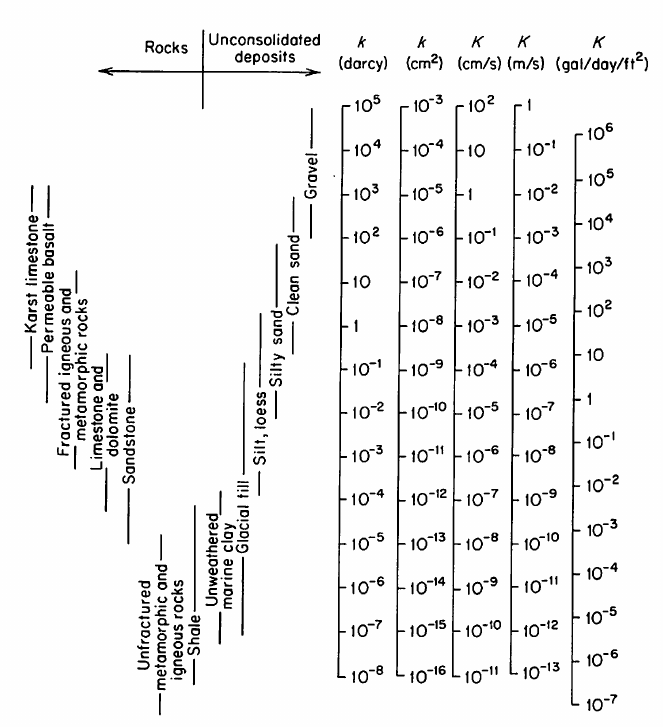
Permeability is crucial for understanding drainage, predicting how quickly the ground will settle under a load, and determining if a dam will leak. These three properties—density, moisture content, and permeability—form the foundation of soil mechanics.