Software Implementation Fundamentals
Software Development Principles
Building Better Software
Writing software is like building a house. You can throw together a shack with scrap wood and it might stand for a while, but it won't be reliable or easy to add a new room to. A well-built house, however, follows architectural principles. It has a solid foundation, logical room layouts, and plumbing that makes sense. You can easily add a new wing or rewire a room without tearing the whole thing down.
Software development has its own architectural principles. These aren't strict rules, but guidelines that help developers create software that is robust, easy to understand, and simple to change over time. Two of the most important pillars are object-oriented design and a structured development lifecycle.
Object-Oriented Design and SOLID
Object-oriented design (OOD) is a way of thinking about software that models the real world. Instead of just writing a long list of instructions, you create “objects” that have both data (properties) and behaviors (methods). A Car object, for example, would have properties like color and speed, and methods like startEngine() and accelerate().
To help us design good objects that work well together, we have the SOLID principles. It's an acronym for five concepts that keep our code clean and flexible.
SOLID helps prevent your software from becoming a tangled mess, making it easier to maintain and extend.
S - Single Responsibility Principle This means every class or module should have only one reason to change. Think of a Swiss Army knife. It's cool, but if the corkscrew breaks, you have to replace the whole tool. It would be better if your corkscrew, knife, and screwdriver were separate tools. In software, if a single class handles user authentication, data logging, and email notifications, a change to the logging system could accidentally break user login. Separating these concerns into different classes makes the system safer and easier to manage.
O - Open/Closed Principle Software should be open for extension, but closed for modification. This sounds contradictory, but it's not. Imagine you have a system that calculates shipping costs for different carriers. Instead of modifying the main calculation code every time you add a new carrier like FedEx or DHL, you should be able to add a new module for that carrier without touching the existing, working code. The system is extended, but the core, tested part remains closed and unchanged.
L - Liskov Substitution Principle
If you have a class Bird, you might also have a subclass Penguin. This principle states that you should be able to use the Penguin object anywhere you'd use a Bird object without causing errors. If your program has a makeBirdFly() function, passing it a Penguin object would break things. This signals a design flaw. It means Penguin isn't a true, substitutable Bird in this context, and your design needs a rethink—perhaps with separate FlyingBird and NonFlyingBird classes.
I - Interface Segregation Principle Clients should not be forced to depend on methods they do not use. Think of a restaurant menu. A huge, single menu with breakfast, lunch, dinner, and dessert is overwhelming for a customer who just wants coffee. It's better to have separate menus. Similarly, in software, a “fat” interface with dozens of methods forces implementing classes to deal with methods they don't need. It's better to break it down into smaller, more specific interfaces.
D - Dependency Inversion Principle
High-level modules should not depend on low-level modules. Both should depend on abstractions. Imagine a lamp plugged directly into a wall. It only works with that specific type of outlet. A better design is for both the lamp and the wall outlet to conform to a standard plug-and-socket design (an abstraction). The lamp doesn't care about the wall's internal wiring, only the socket interface. In code, this means a high-level ReportGenerator class shouldn't depend directly on a low-level MySQLDatabase class. Instead, both should depend on a generic Database interface. This way, you could easily swap MySQL for another database without changing the report generator.
The Software Development Life Cycle
Just as important as how you design your code is how you manage the entire process of creating it. The Software Development Life Cycle (SDLC) provides a structured framework for taking a project from an idea to a finished product and beyond. It breaks the work into distinct, manageable phases.
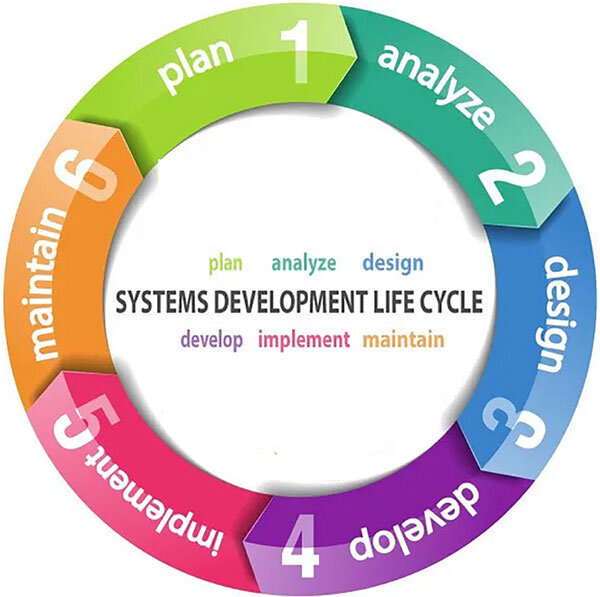
While different models like Waterfall or Agile exist, they generally share a common set of phases:
-
Planning & Requirement Analysis: This is the foundational stage. The team gathers requirements from stakeholders, customers, and experts to understand what the software needs to do. Feasibility, cost, and resources are all assessed.
-
Design: Here, architects and developers create the blueprint for the system. They determine the overall architecture, user interfaces, security measures, and specific modules. This is where principles like SOLID are heavily applied.
-
Development (Implementation): This is the coding phase. Developers take the design documents and write the actual code, turning the blueprint into a functional system.
-
Testing: Once the code is written, it needs to be tested thoroughly. Quality assurance (QA) teams look for bugs, defects, and ensure the software meets all the original requirements. This involves various types of testing, from checking individual units of code to testing the entire system.
-
Deployment: After the software passes testing, it's released to users. This might involve deploying it to servers, publishing it on an app store, or installing it on customer computers.
-
Maintenance: The work isn't over after deployment. The maintenance phase involves fixing any bugs that are discovered by users, making updates to keep the system running on new hardware or operating systems, and adding new features over time. This phase feeds back into the planning stage for the next version, making the process a true cycle.
Software engineering is the process of designing, building, testing, deploying, and maintaining software products, computer systems, and useful tools.
Following a structured SDLC ensures that everyone on the team knows what needs to be done and when, reducing chaos and increasing the chances of building a successful, high-quality product that actually solves the intended problem.
A class is designed to both connect to a database and format data into an HTML report. This class violates which SOLID principle?
According to the Open/Closed Principle, software entities should be open for ______, but closed for ______.