Software, Client-Server, and Browser Basics
Introduction to Software Development
The Recipe for Software
Building software is a bit like constructing a house. You don't just show up with a pile of bricks and start stacking. You need a plan, a blueprint, and a team of people with different skills. Software development is the entire process of creating, deploying, and maintaining software, from the initial idea to the final product that people use every day.
Just like a construction project, this process needs structure to avoid chaos. That's where a formal methodology comes in.
The Software Development Life Cycle
To manage the complexity of building software, teams follow a process known as the Software Development Life Cycle, or SDLC. It’s a framework that breaks down the work into a series of clear, manageable stages.
The software development life cycle (SDLC) is a systematic framework that defines the complete process for planning, creating, testing, and deploying software applications.
While there are many different models for the SDLC (like Waterfall or Agile), they generally all include the same core phases. Think of it as a continuous loop, where the process is always ongoing.
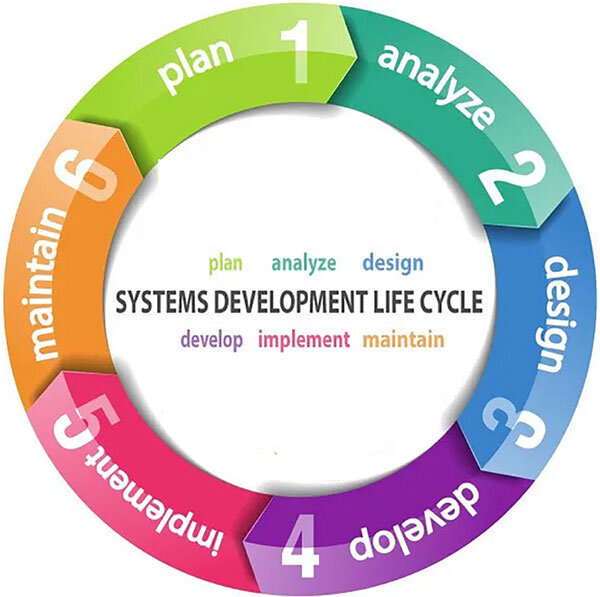
Here’s a quick look at what happens in each stage:
- Plan: This is the starting point. The team defines the project's goals, scope, and resources. What problem are we solving? Who is it for? Can we even build it?
- Analyze: Here, the team gathers detailed requirements. They talk to stakeholders—the future users, business managers, etc.—to understand exactly what the software needs to do.
- Design: This is the blueprint phase. Developers and architects map out how the software will be built. They decide on the programming language, the database structure, and how different parts of the application will work together.
- Develop: This is where the coding happens. Developers write the code based on the design documents, building the actual features of the software.
- Implement: Also called deployment, this is when the software is released to users. It might be installed on company servers or launched on an app store.
- Maintain: The job isn't over after launch. The team fixes bugs that pop up, makes updates, and adds new features based on user feedback. This phase can last for years.
Different Styles of Programming
Once a developer sits down to write code, they don't just type randomly. They follow a certain style or approach for organizing their code. These styles are called programming paradigms.
paradigm
noun
A typical example or pattern of something; a model.
A programming paradigm provides the rules and structure for how to think about and solve a problem. It's not a specific language, but an approach that many languages might support. Two of the most common paradigms are procedural programming and object-oriented programming.
Procedural Programming is like following a recipe. You write a sequence of steps, and the computer executes them in order. It's direct and straightforward.
Object-Oriented Programming (OOP) is more like building with LEGOs. You create self-contained "objects" that have their own data and behaviors. For example, in a banking app, you might have a Customer object with data like name and accountBalance, and behaviors like deposit() and withdraw(). These objects can then interact with each other.
Choosing a paradigm helps developers write code that is organized, readable, and easier to maintain over time.
The Team Behind the Code
Software development is rarely a one-person show. It takes a team of people with specialized roles to bring a project to life. While job titles can vary, here are some of the key players you'll find on a typical software team.
| Role | What They Do |
|---|---|
| Software Developer/Engineer | Writes, tests, and maintains the code that makes the software work. |
| Product Manager | Defines the vision for the product, prioritizes features, and represents the user's needs. |
| UI/UX Designer | Designs the user interface (UI) and user experience (UX). They focus on making the software easy and enjoyable to use. |
| Quality Assurance (QA) Engineer | Tests the software to find and report bugs before it reaches the user. |
| DevOps Engineer | Manages the tools and processes that allow for smooth and efficient software deployment and operation. |
Together, these roles collaborate through each phase of the SDLC to build a high-quality product. This combination of a structured process, thoughtful code design, and teamwork is what turns a simple idea into powerful, useful software.
What is the primary purpose of the Software Development Life Cycle (SDLC)?
In which phase of the SDLC do developers talk to stakeholders to gather detailed requirements about what the software needs to do?