Socratic Philosophy
Socratic Problem
Socrates is the foundational spark of Western philosophy, yet he remains its deepest mystery because he wrote absolutely nothing down. What we know of him comes entirely from the conflicting literary portraits left by his contemporaries. This challenge of piecing together the true, historical Socrates from these biased, competing representations is known as the .
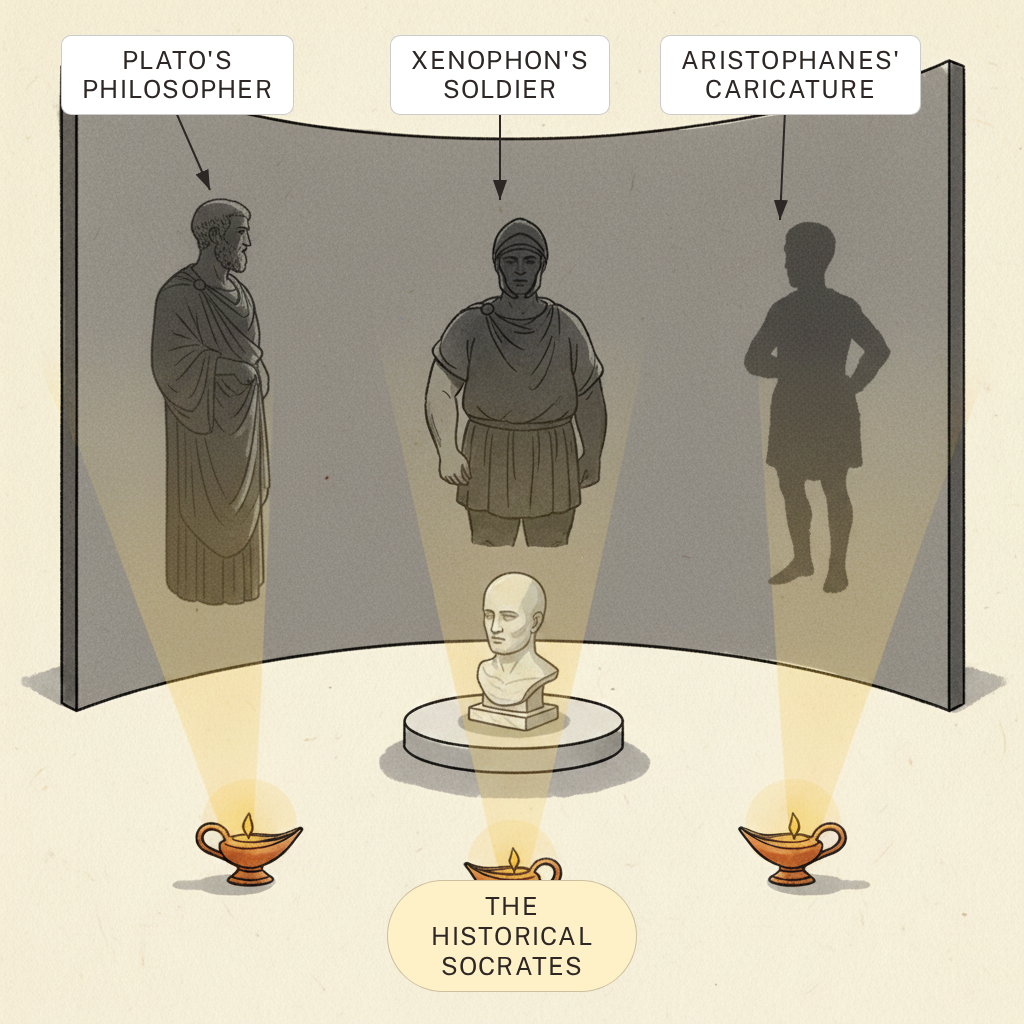
To understand how deep this discrepancy runs, we have to examine the four primary witnesses who wrote about him:
- Aristophanes, the comic playwright, caricatured Socrates in his play The Clouds as a cynical, money-grabbing who lived in the clouds and taught young men how to make weak arguments defeat stronger ones.
- Xenophon, a practical military general and historian, presented Socrates as a highly conventional, common-sense moral adviser who gave helpful, if somewhat uninspired, life advice.
- Plato, his most famous student, created a brilliant, highly sophisticated philosopher who dismantles assumptions and explores deep metaphysics.
- Aristotle, who arrived in Athens after Socrates died, offered a more detached, analytical critique of Socrates' actual contributions to logic and ethics.
When we look closely at these accounts, the discrepancies are striking. Plato's intellectually revolutionary genius seems worlds apart from Xenophon's simple, law-abiding moraliser, and both reject the absurd charlatan portrayed by Aristophanes. Sorting through these accounts is a masterclass in source-critical methodology, where we must weigh the literary and political motives of each author against historical plausibility.
Which of these sources do you think would be the most difficult for historians to trust as a literal, objective account of Socrates' actual philosophical beliefs?