Socratic Philosophy
Cosmological to Ethical
From the Cosmos to the Soul
For centuries, the earliest Greek thinkers gazed at the stars and elements to uncover the fundamental building blocks of our physical world. But then, Socrates sparked a radical shift by turning our attention inward, away from the nature of the universe and toward the nature of our own conduct. In this chapter, we will trace this dramatic pivot from studying external matter to exploring the human soul, setting the groundwork for understanding how we define justice, virtue, and morality.
The Search for the First Principle
The thinkers who preceded Socrates were obsessed with a single quest: finding the , the fundamental "stuff" or first principle of the universe. They looked at the staggering diversity of the world and tried to reduce it to one common denominator. Thales famously proposed water was the root of all things, while Heraclitus argued that change itself, or fire, was the underlying reality. They were the world's first natural scientists, attempting to map the cosmos through observation rather than myth.
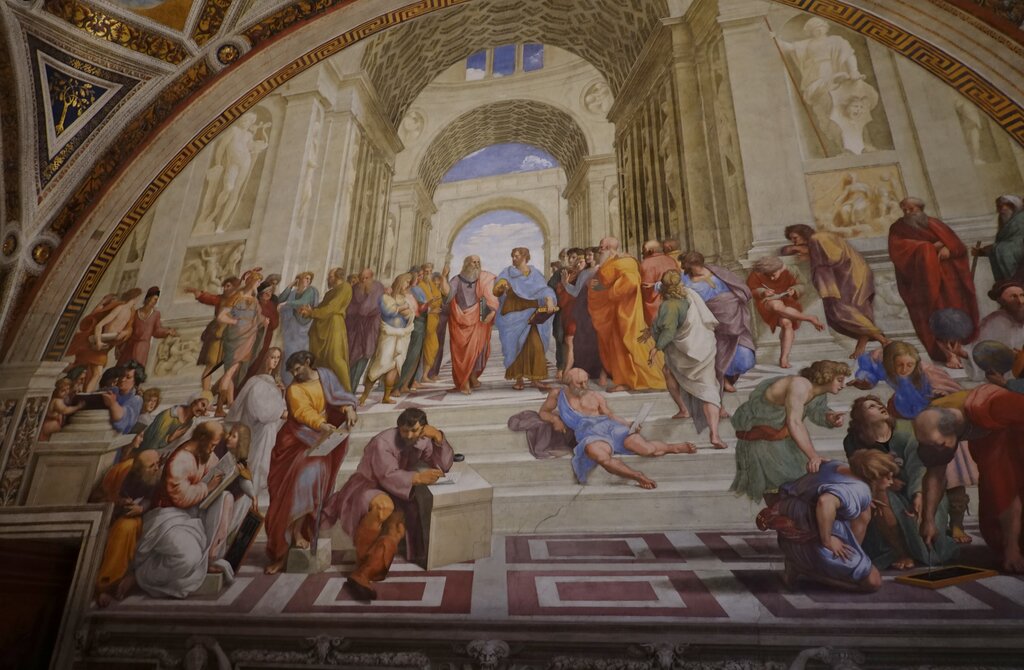
This external focus was brilliant, but it eventually hit a wall. You can have a perfect chemical breakdown of the ocean or a map of every star in the sky, but that map won't tell you whether it is right to lie to a friend or how to be a good citizen. The Pre-Socratics gained a map of the world but remained silent on human conduct. They could explain what the world is, but they couldn't explain how we should be.
The Socratic Re-Calibration
Socrates recognized this limitation. He didn't reject the importance of the physical world, but he believed the priority was wrong. To Socrates, understanding the soul was far more urgent than understanding the stars. He pivoted the philosophical compass by introducing the , a rigorous method of questioning designed to strip away false certainties and reveal the true definitions of moral terms.
He was one of the very first philosophers in history to encourage scholars and common citizens to turn their attention from the outside world to the condition of humankind – and to ask a simple, honest and undoubtedly critical question: what is right and what is wrong?
Think of it this way: the Pre-Socratics were like cartographers drawing a highly detailed map of a city. They could tell you where the walls were, where the water flowed, and what the buildings were made of. Socrates, however, was the guide who asked, "Now that you have the map, how do you intend to live within these walls? What makes a life here worth living?"
This trade-off was deliberate. Socrates was willing to risk ignorance about the 'why' of the physical universe if it meant securing the 'how' of human existence. He moved philosophy from the laboratory of nature to the laboratory of the soul, demanding definitions of virtue and justice that were as precise as the mathematical formulas of the thinkers who came before him.
This re-calibration did not represent a loss of knowledge, but a refinement of it. By narrowing the scope of his inquiry, Socrates deepened the impact of philosophy, transforming it from a distant study of the heavens into an intimate, urgent guide for the well-lived life.