Socialism Fascism Communism Capitalism Compared
Introduction to Political Ideologies
The Ideas That Shape Our World
Every society is built on a set of ideas about how it should work. These ideas cover everything from who should have power to how goods should be distributed. Together, these shared beliefs and values form a political ideology. It’s a blueprint for public life.
Political ideology is a set of beliefs and values that shape an individual's or group's understanding of how society should be organized and how political power should be exercised
Ideologies aren't just abstract theories; they drive political parties, shape laws, and can even start revolutions. To understand the world, we need to understand the major ideologies that have shaped it. Let's look at four of the most influential: capitalism, socialism, communism, and fascism.
Capitalism
Capitalism is an economic and political system where private individuals or companies own the means of production. Think factories, tools, and land. The main goal is to operate these for profit in a competitive market. Prices, production, and the distribution of goods are determined by supply and demand in what is often called the "free market."
Its roots go back centuries, but capitalism as we know it began to flourish during the Industrial Revolution in the 18th and 19th centuries. Thinkers of the Enlightenment, like Adam Smith, laid its philosophical foundation. They argued that self-interest and competition would lead to economic prosperity for all.
Capitalism
noun
An economic and political system in which a country's trade and industry are controlled by private owners for profit, rather than by the state.
The core principles of capitalism are:
- Private Property: Individuals and companies have the right to own assets.
- Self-Interest: People are free to pursue their own economic benefit.
- Competition: The rivalry among sellers for customers' business keeps prices in check and encourages innovation.
- Free Market: The forces of supply and demand, with minimal government intervention, determine what is produced and at what price.
Socialism
Socialism emerged as a critical response to the inequalities of industrial capitalism. Proponents saw the harsh working conditions and the vast gap between the rich factory owners and the poor workers and sought a more equitable alternative. The central idea is that the means of production should be owned or regulated by the community as a whole.
Early socialist thinkers in the 19th century, like Henri de Saint-Simon and Robert Owen, proposed utopian communities based on cooperation. Later, Karl Marx and Friedrich Engels developed a more revolutionary form of socialism. They argued that a worker's revolution was necessary to replace capitalism with a system based on collective ownership.
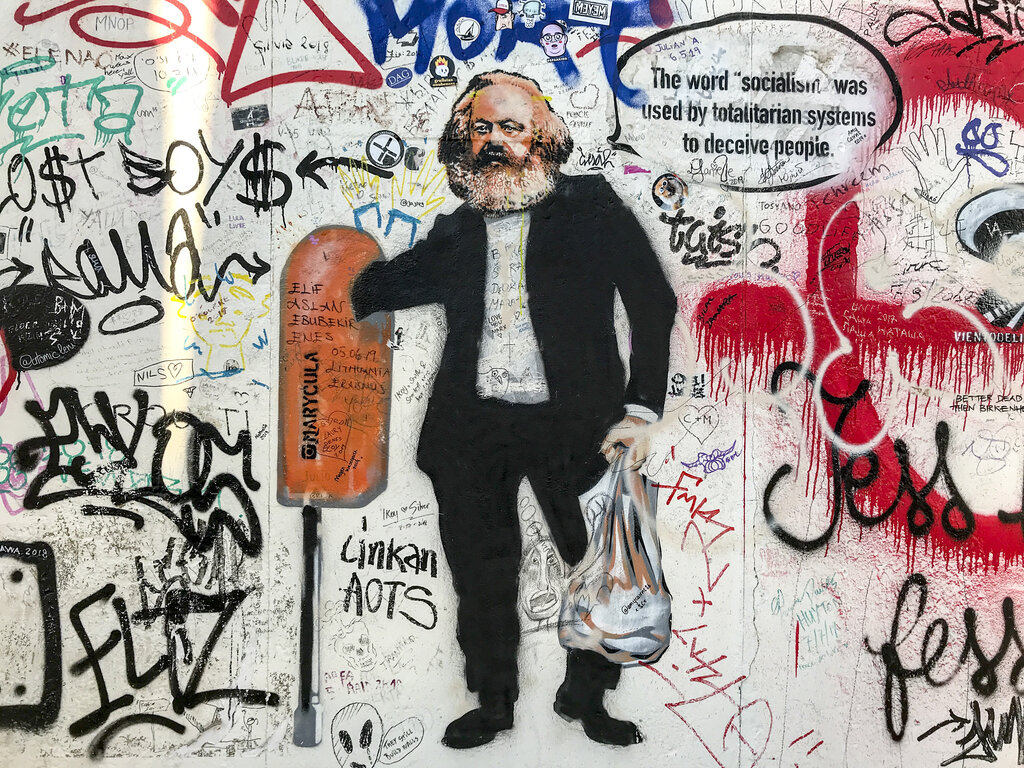
Socialism is a broad ideology with many variations, but most share these core principles:
- Collective Ownership: Key industries and resources are owned and managed by the public, either through the state or through worker cooperatives.
- Economic Equality: A commitment to reducing wealth disparities and ensuring a basic standard of living for everyone.
- Cooperation: The belief that society should be based on collaboration rather than competition.
Communism
Communism is often seen as a more radical form of socialism. In theory, it is the final stage of socialism. According to Karl Marx, after a socialist state is established, it would eventually "wither away," leading to a communist society.
This final society would be both stateless and classless. All property would be communally owned, and each person would contribute to society according to their ability and receive according to their needs. The most famous articulation of this idea is in Marx and Engels's 1848 pamphlet, The Communist Manifesto.
From each according to his ability, to each according to his needs.
Core principles of theoretical communism include:
- Abolition of Private Property: All means of production are owned by the community. There is no concept of private ownership as seen in capitalism.
- Classless Society: Social hierarchies based on wealth or status are eliminated.
- Stateless Society: A centralized government is no longer needed, as people collectively manage their own affairs.
Fascism
Fascism is a complex and often misunderstood ideology that emerged in the early 20th century, most notably in Italy under Benito Mussolini and Germany under Adolf Hitler. It arose from the turmoil following World War I, fueled by intense nationalism, fear of communism, and economic instability.
Unlike the other ideologies, which focus primarily on economic organization, fascism is defined by its extreme nationalism and authoritarianism. It prioritizes the nation and the state above the individual.
Fascism
noun
A political philosophy, movement, or regime that exalts nation and often race above the individual and that stands for a centralized autocratic government headed by a dictatorial leader.
Core principles of fascism include:
- Extreme Nationalism: An intense, almost religious devotion to the nation-state. This often includes a belief in national or racial superiority.
- Totalitarianism: The state seeks to control every aspect of public and private life. There is no room for individual freedom or opposition.
- Dictatorial Rule: A single charismatic leader holds all power, embodying the will of the nation.
- Militarism: A glorification of war and military conquest as a means of national rejuvenation.
Which political ideology is primarily defined by extreme nationalism and an authoritarian state that controls all aspects of life?
In a capitalist system, what are the primary forces that determine the production and price of goods?
These four ideologies represent fundamentally different visions for society. Understanding their origins and core ideas is the first step toward analyzing how they have shaped, and continue to shape, the world we live in.