Soccer Fundamentals
Introduction to Soccer
The Beautiful Game
Soccer, known as football in most of the world, is a simple game at its core. Two teams of eleven players try to get a ball into the opposing team's goal. The catch? You can use any part of your body except your hands or arms. The team that scores the most goals wins. It’s a game of skill, teamwork, and constant motion.
The Playing Field
A soccer match takes place on a rectangular field called a pitch. At each end, there's a goal. The field is marked with white lines that define the playing area and key zones.
The outer boundary lines are the touchlines (sidelines) and the goal lines (end lines). The field is divided in half by the halfway line, with a center circle in the middle where the game starts. In front of each goal is a large box called the penalty area. This is a critical zone for both attackers and defenders.
If the ball crosses the touchline, the game restarts with a throw-in. If it crosses the goal line, it results in either a goal kick (if the attacking team last touched it) or a corner kick (if the defending team last touched it).
Players and Positions
Each of the 11 players on a team has a specific role, though these can be flexible. The positions are generally grouped into four main categories: goalkeepers, defenders, midfielders, and forwards.
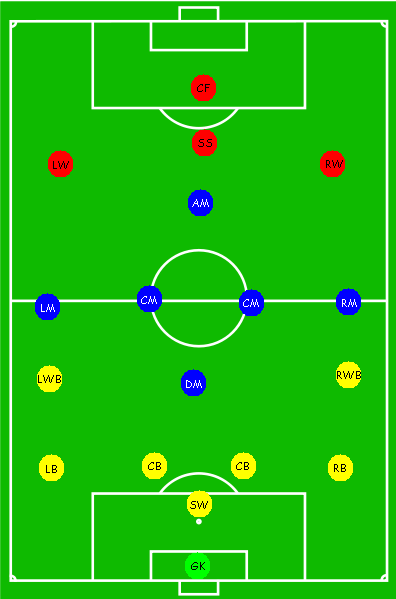
Goalkeeper (GK): The last line of defense. The goalkeeper's job is to stop the ball from entering their goal. They are the only player allowed to use their hands, but only within their own penalty area.
Defenders (DF, CB, LB, RB): These players are positioned in front of their goal. Their main task is to stop the opposing team's attackers from getting close and scoring.
Midfielders (MF, CM, DM, AM): They operate in the middle of the field, acting as the link between defenders and forwards. They are responsible for both defending and attacking, covering a lot of ground during a match.
Forwards (FW, ST, W): Also known as strikers, these are the primary goal scorers. They play closest to the opponent's goal and are focused on creating and finishing scoring chances.
Scoring and Time
A goal is scored when the entire ball crosses the goal line, between the posts and under the crossbar. Each goal is worth one point. A standard professional soccer match consists of two halves of 45 minutes each, for a total of 90 minutes of regulation time.
The clock doesn't stop for interruptions like injuries or the ball going out of play. Instead, the referee adds 'stoppage time' (or 'injury time') at the end of each half to compensate for lost time.
| Concept | Description |
|---|---|
| Match Duration | Two 45-minute halves (90 minutes total) |
| Stoppage Time | Time added by the referee at the end of each half |
| Scoring | One point per goal |
| Winning | The team with the most goals at the end of the match wins |
If the score is tied at the end of regulation time in a knockout competition, the game might go into extra time or a penalty shootout to determine a winner. In league play, a tie often results in each team earning one point.
What is the primary role of a midfielder in soccer?
If the attacking team kicks the ball over the opponent's goal line (but not in the goal), how does the game restart?