Smart ILI Pipeline Inspection Mastery
Smart Tool Selection
Choosing the Right Tool
Different pipeline threats require different inspection tools. Just as a doctor wouldn't use a stethoscope to check for a broken bone, a pipeline engineer needs to select the right In-Line Inspection (ILI) tool to find specific flaws. The choice hinges on the type of threat you're looking for, the product in the pipeline, and the level of detail required. The main technologies fall into three categories: Magnetic Flux Leakage (MFL), Ultrasonic Testing (UT), and Geometry tools.
Magnetic Flux Leakage
MFL tools work by saturating the pipe wall with a powerful magnetic field. In a flawless section of pipe, this magnetic flux stays contained within the steel. However, where there is metal loss—from corrosion, pitting, or a gouge—the reduced wall thickness can't hold the same amount of flux. This forces some of the magnetic field to leak out of the pipe's surface.
Changes in the amount of magnetic flux leaking out of the metal as the MFL pig passes through the pipeline typically indicate areas where the condition of the metal has changed due to pitting, cracking, erosion or corrosion.
Sensors on the ILI tool detect these leaks, pinpointing the location and estimating the severity of the metal loss. The orientation of the magnetic field is crucial and leads to two main types of MFL.
Axial MFL (AMFL) tools apply a magnetic field parallel to the pipeline's length. This makes them excellent for detecting volumetric defects like corrosion, where the flaw has length, width, and depth. However, they are less effective at finding cracks that run parallel to the magnetic field, like cracks along a longitudinal seam weld.
Circumferential MFL (CMFL) tools, also known as transverse MFL, apply a magnetic field that wraps around the pipe's circumference. This orientation is ideal for detecting linear flaws oriented along the pipe's axis, such as long seam cracks or stress corrosion cracking (SCC). High-resolution MFL tools often combine both axial and circumferential magnets to provide comprehensive coverage in a single run.
Ultrasonic Testing
Ultrasonic Testing (UT) tools operate like medical ultrasounds. They emit high-frequency sound waves into the pipe wall and measure the time it takes for the echoes to return. By analyzing these echoes, the tool can make precise measurements.
The key advantage of UT is its ability to provide direct, quantitative measurements of wall thickness rather than inferring it from a secondary signal like magnetic flux.
This makes UT the preferred method for monitoring general wall loss and verifying pipeline integrity. There are two primary types of ultrasonic waves used in ILI tools, each suited for different tasks.
Compression Waves are sent straight into the pipe wall, perpendicular to the surface. They are used for highly accurate wall thickness measurements. The time it takes for the sound to travel to the outer wall and back directly corresponds to the thickness of the steel. This is ideal for mapping corrosion and verifying the remaining pipe wall.
Shear Waves are sent into the pipe wall at an angle. This angled path allows the waves to bounce off the inner and outer surfaces, sweeping through the material to detect cracks and crack-like defects. Because they travel at an angle, they are very sensitive to any feature that disrupts their path, making them the gold standard for crack detection and sizing.
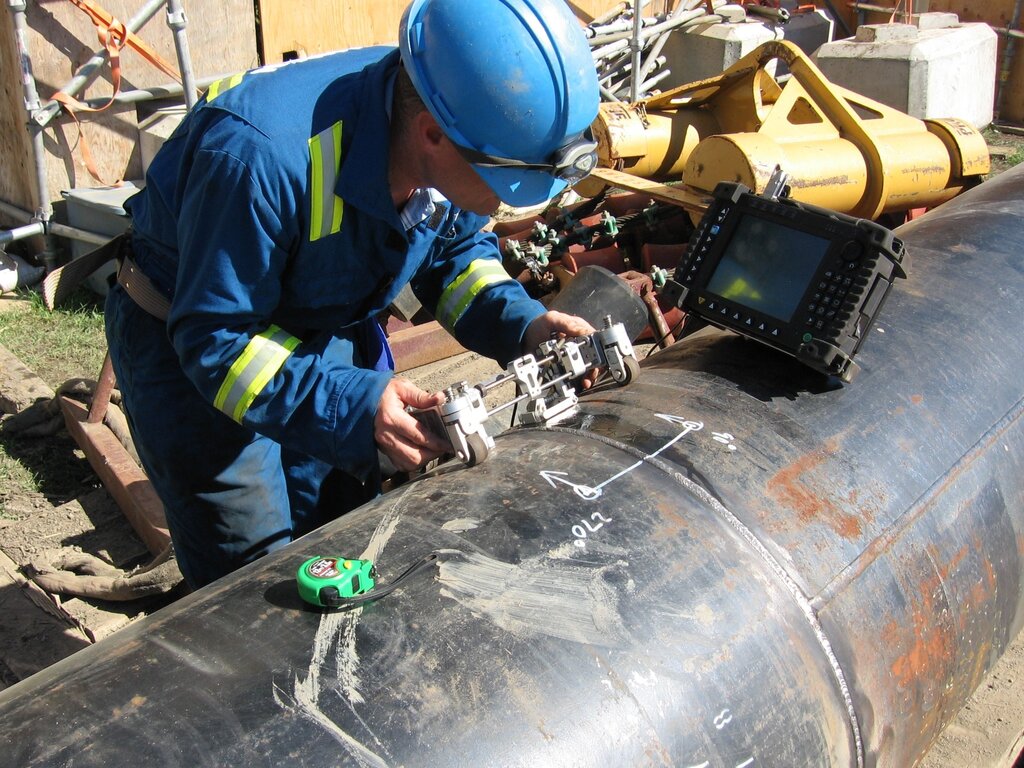
The biggest limitation of conventional UT is its need for a liquid couplant. The ultrasonic sensors must be immersed in a liquid (like crude oil, water, or diesel) to transmit sound waves into the steel. This makes UT inspection impossible in gas pipelines without batching the tool between slugs of liquid, which is a complex and costly operation.
Geometry Tools
While MFL and UT tools look for flaws in the pipe wall, geometry tools measure the shape of the pipe wall. Their primary job is to detect and size deformations like dents, buckles, wrinkles, and changes in the pipe's roundness (ovality). These features can be caused by third-party damage, ground movement, or improper construction, and they can pose a significant threat to a pipeline's integrity.
Early geometry tools were simple mechanical caliper arms that physically touched the pipe wall to measure its internal diameter. Modern tools are far more sophisticated. Many use a ring of UT sensors to map the pipe's internal profile with incredible precision. By combining this geometry data with inertial mapping unit (IMU) data, engineers can perform strain analysis. This analysis identifies areas where a dent has created high stress concentrations, which could lead to cracking or failure over time.
| Technology | Best for Detecting | Requires Liquid | Notes |
|---|---|---|---|
| Axial MFL | General corrosion, pitting, metal loss | No | Most common ILI technology. |
| Circumferential MFL | Axial cracks, long seam weld defects | No | Often combined with AMFL for full coverage. |
| UT Compression Wave | Precise wall thickness measurement | Yes | Provides direct, quantitative data. |
| UT Shear Wave | Cracks (SCC, fatigue) | Yes | Most reliable method for crack detection. |
| EMAT | Cracks and corrosion in gas lines | No | Solves the couplant problem for gas pipelines. |
| Geometry (Caliper/UT) | Dents, ovality, buckles, strain | No | Essential for assessing mechanical damage. |
Ultimately, selecting the right ILI technology involves a careful assessment of the pipeline's history, operating conditions, and the most likely threats it faces. Often, the best integrity program involves running multiple types of tools over the pipeline's life to build a complete picture of its condition.
An engineer needs to detect a crack running along the length of a pipeline's longitudinal seam. Which In-Line Inspection (ILI) technology is specifically designed for this type of linear, axially-oriented flaw?
What is the primary limitation of conventional Ultrasonic Testing (UT) that makes it challenging to use in natural gas pipelines?
Choosing the right tool is the first step in ensuring a pipeline operates safely and reliably for years to come.