Smart Contract Security Auditing
Introduction to Smart Contracts
What Are Smart Contracts?
Think of a vending machine. You insert money (the condition), select an item, and the machine automatically dispenses your snack (the outcome). There's no cashier, no negotiation. The rules are built into the machine.
A smart contract is like a digital vending machine. It's a program that runs on a blockchain and automatically executes the terms of an agreement when specific conditions are met.
A smart contract consists of lines of code programmed into a blockchain that automatically execute when certain conditions are met.
Their main purpose is to remove the need for a trusted middleman, like a bank or a lawyer. Instead of relying on an intermediary to enforce rules, the code does it for you. This makes transactions faster, cheaper, and often more secure because the process is automated and transparent.
How They Work on the Blockchain
Smart contracts are built on simple “if-then” logic. If a specific event happens, then the contract executes a pre-programmed action. For example, if a customer pays $100 worth of cryptocurrency for a digital concert ticket, then the smart contract automatically sends the ticket to the customer's digital wallet.
Once a smart contract is deployed on a blockchain, it becomes part of the public, unchangeable ledger. Its code can't be altered, and its actions are visible to everyone on the network. This immutability and transparency are what create trust in the system. You don't have to trust the other party in the agreement; you just have to trust that the code will run as written.
These contracts are the fundamental building blocks of decentralized applications, or DApps. Without smart contracts, DApps couldn't perform their functions in an automated, decentralized way.
Smart Contracts in Action
Smart contracts are not just a theoretical concept; they power a wide range of applications that you can use today. Here are a few examples:
Decentralized Finance (DeFi): Instead of applying for a loan from a bank, you could borrow cryptocurrency from a DeFi platform. A smart contract would hold your collateral, and if you repay the loan on time, it automatically returns your collateral. If you don't, the contract automatically gives the collateral to the lender.
Voting Systems: Smart contracts can be used to create transparent and tamper-proof voting systems. Each vote is recorded on the blockchain, and the smart contract tallies the results automatically, ensuring the outcome is fair and verifiable by anyone.
Supply Chain Management: A company can use a smart contract to track a shipment. When a GPS tracker confirms the goods have arrived at a warehouse, the smart contract automatically releases payment to the supplier. This eliminates delays and disputes over payments.
The code behind these contracts is often written in programming languages like Solidity, which is designed for the Ethereum blockchain. Here is a simple example of what a smart contract for an online purchase might look like.
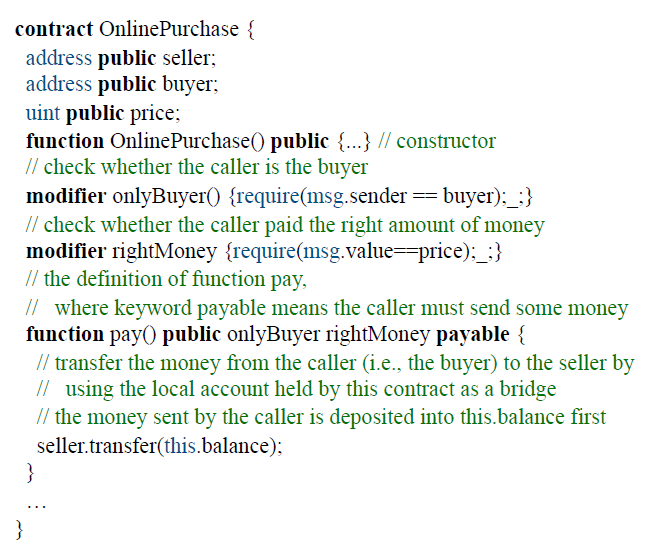
Because these contracts often handle valuable digital assets and cannot be changed once deployed, it's absolutely critical that their code is free of bugs or security holes. This is where the process of smart contract auditing comes in, which ensures the code behaves exactly as intended.
Time to check your understanding.
What is the primary purpose of a smart contract?
A smart contract can be described as operating on simple __________ logic.
Now that you know what smart contracts are and how they work, you're ready to learn about the importance of securing them.