Small-Signal Analysis of BJT Amplifier Configurations
Transistor Basics
The Transistor Valve
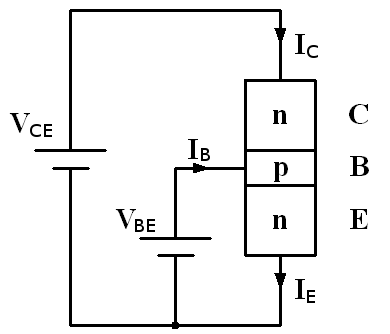
At its core, a Bipolar Junction Transistor (BJT) is a semiconductor device that acts like an electrically controlled valve. It's made by sandwiching one type of semiconductor material between two layers of the opposite type. This creates two common arrangements: NPN (Negative-Positive-Negative) and PNP (Positive-Negative-Positive). For now, we'll focus on the more common NPN type.
Every BJT has three terminals, each connected to one of the semiconductor layers:
Think of an NPN transistor like a faucet. The Collector is the water source, and the Emitter is the drain. The Base is the knob that controls the flow. A tiny bit of current flowing into the base allows a much larger current to flow from the collector to the emitter. Without a base current, the valve is shut, and almost no current can pass from collector to emitter.
In an NPN transistor, when a small current flows into the base terminal, it allows a larger current to flow from the collector to the emitter.
This relationship is fundamental. The emitter current () is the sum of the collector current () and the base current ().
The amplifying power of a transistor is described by its current gain, represented by the Greek letter beta (). It's the ratio of the collector current to the base current. For a typical BJT, can range from 50 to over 200.
This means a tiny base current of 1 milliampere (mA) could control a much larger collector current of 100 mA. This is the essence of amplification.
Regions of Operation
A transistor doesn't just amplify; its behavior changes depending on the voltages applied to it. It operates in one of three distinct modes or regions.
Cutoff: The transistor is "off." It acts like an open switch, blocking current flow from collector to emitter. This happens when the voltage between the base and emitter is too low to turn the transistor on.
Active: The transistor acts as an amplifier. The collector current is proportional to the base current (). This is the region where we can make a small signal bigger.
Saturation: The transistor is "fully on." It acts like a closed switch. The collector current reaches its maximum value, limited not by the base current but by the external circuit components. Increasing the base current further won't increase the collector current.
For building amplifiers, the goal is to keep the transistor operating in the active region. The other two regions are primarily used when a transistor functions as a digital switch, turning things on and off.
| Region | State | Base-Emitter Junction | Collector-Base Junction | Application |
|---|---|---|---|---|
| Cutoff | Off | Reverse-Biased | Reverse-Biased | Open Switch |
| Active | Amplifier | Forward-Biased | Reverse-Biased | Amplification |
| Saturation | On | Forward-Biased | Forward-Biased | Closed Switch |
Let's check your understanding of these core concepts.
What is the primary function of a Bipolar Junction Transistor (BJT) in an analog circuit?
In the common faucet analogy for an NPN transistor, the Base terminal is analogous to the...
With these fundamentals in place, we can begin to explore how transistors are used to build amplifier circuits.