Small Molecule Reactor Engineering
Kinetics in Small Molecules
The Reaction's True Pace
When designing a reactor, the balanced chemical equation tells you the destination—what products you'll get from your reactants. But it doesn't tell you how fast you'll get there. For that, we need kinetics. Specifically, we need to know if a reaction is elementary or non-elementary.
An elementary reaction occurs in a single step. The molecules collide and transform into products exactly as written in the stoichiometric equation. For these straightforward reactions, we can write the rate law directly from the stoichiometry. For example, in the elementary reaction , the rate is directly proportional to the concentrations of A and B.
Most reactions aren't this simple. Non-elementary reactions involve multiple steps—a sequence of elementary reactions that form intermediate products before arriving at the final products. The overall balanced equation for a non-elementary reaction hides this complexity. You cannot determine its rate law just by looking at the stoichiometry.
Consider the gas-phase reaction of hydrogen and bromine: . It looks simple, but its actual mechanism involves multiple steps including the formation and reaction of bromine and hydrogen radicals (Br• and H•). Its experimentally determined rate law is far more complex than what the overall equation suggests.
The key takeaway: For non-elementary reactions, the rate law must be determined experimentally. Stoichiometry alone is misleading.
Finding the Rate Law
To engineer a process, we need a mathematical model for the reaction speed, known as the rate law. The rate law expresses the reaction rate as a function of concentration and temperature. For a generic reaction , the law is often expressed in a power-law form:
One common experimental approach is the method of initial rates. You run a series of experiments from the same starting temperature, but vary the initial concentration of one reactant while holding the others constant. By observing how the initial reaction rate changes, you can deduce the order for that reactant.
For example, if you double the initial concentration of reactant A and the initial rate quadruples, the reaction is second-order with respect to A (). If the rate doubles, it's first-order (). If the rate doesn't change, it's zero-order ().
| Experiment | [A]₀ (M) | [B]₀ (M) | Initial Rate (M/s) |
|---|---|---|---|
| 1 | 0.1 | 0.1 | 0.002 |
| 2 | 0.2 | 0.1 | 0.004 |
| 3 | 0.1 | 0.2 | 0.008 |
In the table above, comparing experiments 1 and 2 shows that doubling [A] doubles the rate. So, the reaction is first-order in A. Comparing experiments 1 and 3 shows that doubling [B] quadruples the rate, meaning the reaction is second-order in B. The overall rate law is .
Temperature's Influence
Reaction rates are highly sensitive to temperature. Increasing temperature generally increases the rate constant, , because it gives molecules more kinetic energy, leading to more frequent and more forceful collisions.
This relationship is described by the Arrhenius equation a cornerstone of chemical kinetics.
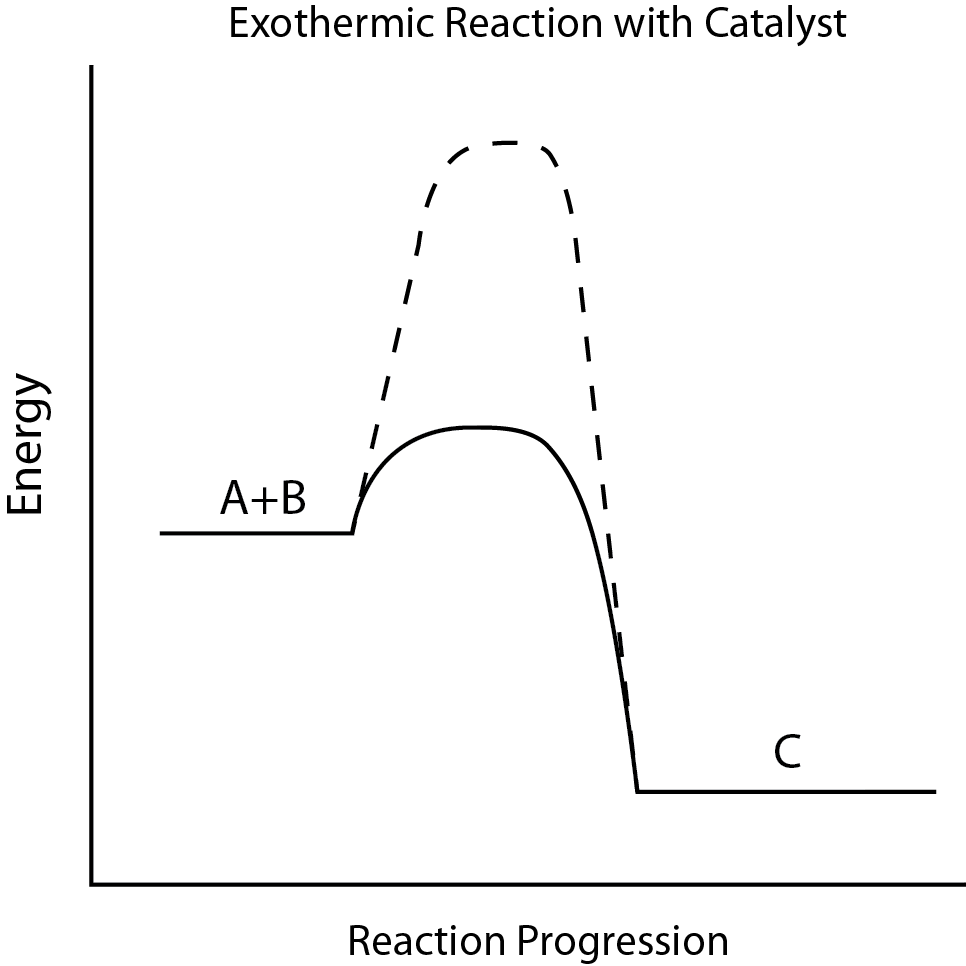
The activation energy, , is like a hill that reactants must climb to become products. A higher means a steeper hill and a slower reaction at a given temperature. The equation shows that increases exponentially as temperature rises.
To determine and experimentally, we can rearrange the equation into a linear form by taking the natural logarithm of both sides:
Speeding Up and Slowing Down
Often, a reaction is too slow to be practical. In these cases, we use a catalyst—a substance that increases the reaction rate without being consumed in the process. Catalysts work by providing an alternative reaction pathway with a lower activation energy (). With a smaller hill to climb, more reactant molecules have sufficient energy to react, and the rate increases dramatically.
Conversely, an inhibitor is a substance that decreases the reaction rate. Inhibitors can work in several ways, such as by blocking the active sites of a catalyst (a process known as poisoning) or by reacting with an essential intermediate in the reaction mechanism.
Understanding how to select catalysts and avoid inhibitors is critical for industrial chemical production. A well-chosen catalyst can make a previously uneconomical process profitable, while an unforeseen inhibitor can shut down a reactor.
A crucial application of these principles is in reactor design. For example, if you have a first-order reaction taking place in a continuous stirred-tank reactor (CSTR), the required reactor volume to achieve a certain conversion depends directly on the rate constant, . A higher temperature leads to a larger , which means you can achieve your target conversion with a smaller, less expensive reactor. However, higher temperatures also mean higher energy costs and potential for unwanted side reactions. Kinetic analysis allows engineers to find the optimal balance.
Time to check your understanding of these kinetic principles.
For which type of reaction can the rate law be determined directly from the stoichiometric coefficients of the balanced chemical equation?
Consider the reaction . Based on the experimental data below, what is the reaction order with respect to reactant B?
| Exp | [A] (M) | [B] (M) | Initial Rate (M/s) |
|-----|---------|---------|--------------------|
|  1  |  0.1    |  0.1    |       0.02         |
|  2  |  0.2    |  0.1    |       0.04         |
|  3  |  0.1    |  0.2    |       0.02         |
By combining experimental data with these kinetic models, we can predict how a reaction will behave under different conditions and design reactors that are safe, efficient, and economical.