Small Modular Nuclear Reactors Explained
Introduction to Nuclear Energy
The Dawn of the Atomic Age
Our story begins in the late 19th and early 20th centuries, when scientists like Marie Curie and Ernest Rutherford were making groundbreaking discoveries about radioactivity and the structure of the atom. They found that atoms, once thought to be indivisible, were made of smaller particles and held an incredible amount of energy locked inside their core, or nucleus.
The idea of harnessing this energy remained theoretical until 1938, when German chemists Otto Hahn and Fritz Strassmann accidentally split a uranium atom. This process, which they couldn't initially explain, was later named nuclear fission. It became clear that fission could release energy on a massive scale.
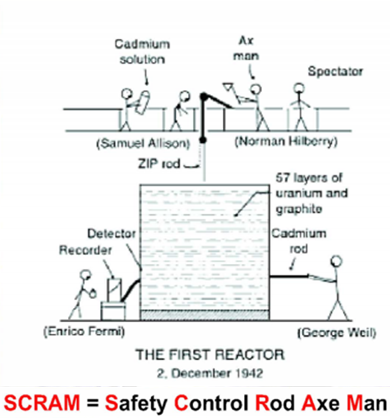
This discovery set off a race. On December 2, 1942, a team led by physicist Enrico Fermi achieved the first self-sustaining nuclear chain reaction. In a squash court under the stands of the University of Chicago's football field, they built a pile of uranium and graphite bricks called Chicago Pile-1. It was the world's first nuclear reactor, and it proved that atomic energy could be controlled.
Splitting the Atom
So, what exactly is nuclear fission? Imagine setting up a long line of dominoes. Tipping the first one creates a chain reaction that knocks down all the others. Nuclear fission works in a similar way, but with atoms and subatomic particles.
fission
noun
The act or process of splitting the nucleus of an atom into smaller parts, releasing a very large amount of energy.
The process starts when a neutron—a tiny particle with no electric charge—hits the nucleus of a heavy, unstable atom like uranium-235. The nucleus absorbs the neutron, becomes highly unstable, and splits into two smaller atoms. This split releases a tremendous amount of energy in the form of heat and radiation, along with two or three additional neutrons.
Those newly released neutrons can then fly off and strike other uranium nuclei, causing them to split as well. If there's a sufficient concentration of uranium atoms, known as a critical mass, this process repeats itself over and over, creating a self-sustaining chain reaction. This is the fundamental principle that powers a nuclear reactor.
How a Nuclear Reactor Works
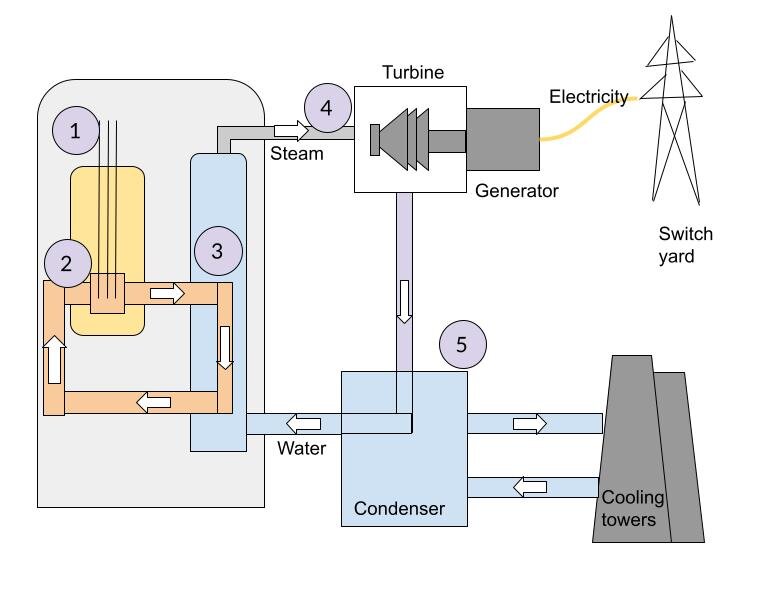
A nuclear power plant is essentially a very complex machine for boiling water. While that sounds simple, the process uses the intense heat from a controlled nuclear chain reaction to do it. The heart of the plant is the reactor core, which contains thousands of long, thin fuel rods filled with uranium pellets.
Here’s the basic sequence of events in a typical reactor:
- Fission Creates Heat: Inside the reactor core, the uranium atoms undergo fission, releasing a massive amount of heat.
- Heat Creates Steam: This heat is used to boil water, turning it into high-pressure steam. In some designs, like a Pressurized Water Reactor (PWR), the heated water is kept under pressure to prevent it from boiling and is used to heat a separate loop of water that does turn to steam.
- Steam Turns a Turbine: The steam is channeled to a turbine, causing its blades to spin at high speed, much like wind turning a windmill.
- Turbine Generates Electricity: The turbine is connected to a generator. As the turbine spins, so does the generator, producing electricity.
- Steam is Cooled: After passing through the turbine, the steam is cooled back into water in a condenser and is pumped back to be heated again, completing the cycle. The large, curved cooling towers you often see are used to cool the water that cools the steam.
To keep the chain reaction from spiraling out of control, reactors have control rods made of materials that absorb neutrons. By raising or lowering these rods into the core, operators can speed up, slow down, or stop the chain reaction completely.
Benefits and Challenges
Nuclear power plays a significant role in the global energy landscape, but it comes with a complex set of pros and cons. There are strong arguments both for and against its use, making it one of the most debated energy sources.
| Benefits | Challenges |
|---|---|
| Low Carbon Emissions | Nuclear Waste |
| Generates electricity without producing greenhouse gases like CO2. | Spent fuel is radioactive and must be stored securely for thousands of years. |
| High Power Output | Safety Concerns |
| A single plant can generate a huge amount of reliable, 24/7 power. | Accidents, though rare, can have devastating long-term consequences. |
| Small Land Footprint | High Costs |
| Requires much less land than solar or wind farms for the same output. | Building new plants is extremely expensive and takes a long time. |
| Energy Security | Public Perception |
| Reduces dependence on fossil fuels, which are often imported. | Public fear and mistrust can make it difficult to approve new projects. |
These factors create a complicated picture. On one hand, nuclear energy offers a powerful tool for fighting climate change. On the other, the challenges of waste and safety require careful, long-term management. As the world seeks clean and reliable energy, the debate over nuclear power's role continues.
Now that you've got the basics down, let's review what we've covered.
Who led the team that achieved the first self-sustaining nuclear chain reaction at the University of Chicago?
What is the primary role of the control rods inside a nuclear reactor?
Understanding these fundamentals—from the first controlled chain reaction to the operation of modern reactors—is key to appreciating the past, present, and future of nuclear energy.