Small Engine Repair Essentials
Engine Basics
Turning Fuel into Motion
At its heart, an internal combustion engine does one thing: it converts the chemical energy in fuel into mechanical motion. It accomplishes this through a series of small, controlled explosions. Imagine a tiny cannon firing over and over again, thousands of times a minute. Each firing pushes a metal plug, and the rapid, repeated motion of that plug is harnessed to do work, like spinning the blades of a lawnmower or the wheels of a go-kart.
This process requires three key ingredients: fuel (like gasoline), air (specifically, the oxygen in it), and a source of heat to start the reaction, which is usually a spark. When this mixture of fuel and air ignites in a confined space, it expands rapidly, creating a powerful burst of pressure. The entire engine is a machine built to contain and direct this pressure.
The Core Components
While engines come in many sizes and configurations, most small combustion engines share a few key parts. Let's look at the main players inside the engine.
- Cylinder: This is the chamber where the magic happens. It's a precisely machined tube where the piston travels up and down.
- Piston: A solid plug that fits snugly inside the cylinder. It gets pushed down by the force of the combustion and moves back up to push out exhaust gases.
- Spark Plug: Located at the top of the cylinder, it delivers the electrical spark that ignites the fuel-air mixture.
- Valves: Most engines have two valves per cylinder: an intake valve that opens to let the fuel-air mixture in, and an exhaust valve that opens to let the burnt gases out. Both are sealed shut during combustion to contain the explosion.
- Connecting Rod: This rod connects the piston to the crankshaft.
- Crankshaft: This is the backbone of the engine. It's a clever shaft that converts the linear, up-and-down motion of the piston into the rotational motion needed to do work. Think of how your leg pushes a bicycle pedal up and down to make the wheels spin in a circle; the crankshaft does the same job for the piston.
The Four-Stroke Cycle
Most cars and many small engines use a four-stroke cycle. This is a reliable and efficient sequence of four steps, or strokes, of the piston for every single power-producing explosion.
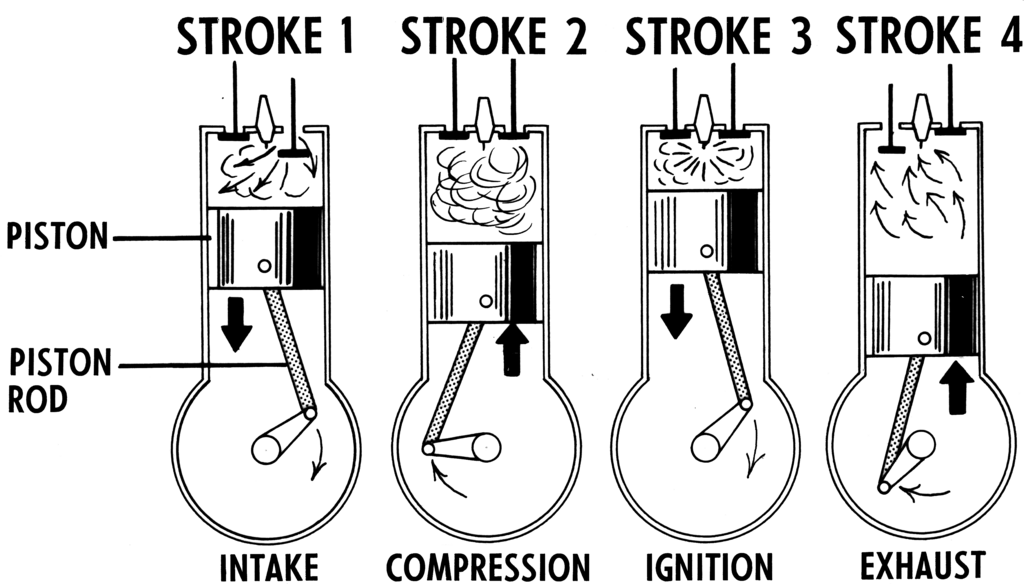
Here's the rhythm of the four-stroke engine:
-
Intake: The piston moves down, creating a vacuum. The intake valve opens, and a mixture of fuel and air is sucked into the cylinder.
-
Compression: The intake valve closes, and the piston moves back up. This squeezes the fuel-air mixture into a much smaller space, making it highly combustible.
-
Power (or Combustion): With both valves closed, the spark plug fires. The fuel-air mixture ignites, creating a massive expansion of hot gas that forces the piston down with great force. This is the stroke that creates the engine's power.
-
Exhaust: The exhaust valve opens. The piston moves back up, pushing the spent gases out of the cylinder to make way for the next cycle.
This entire four-stroke sequence happens thousands of times per minute, creating a continuous flow of power.
The Two-Stroke Alternative
Some engines, particularly in things like chainsaws, leaf blowers, and some older motorcycles, use a simpler two-stroke cycle. As the name implies, it completes the whole process in just two strokes of the piston (one up, one down).
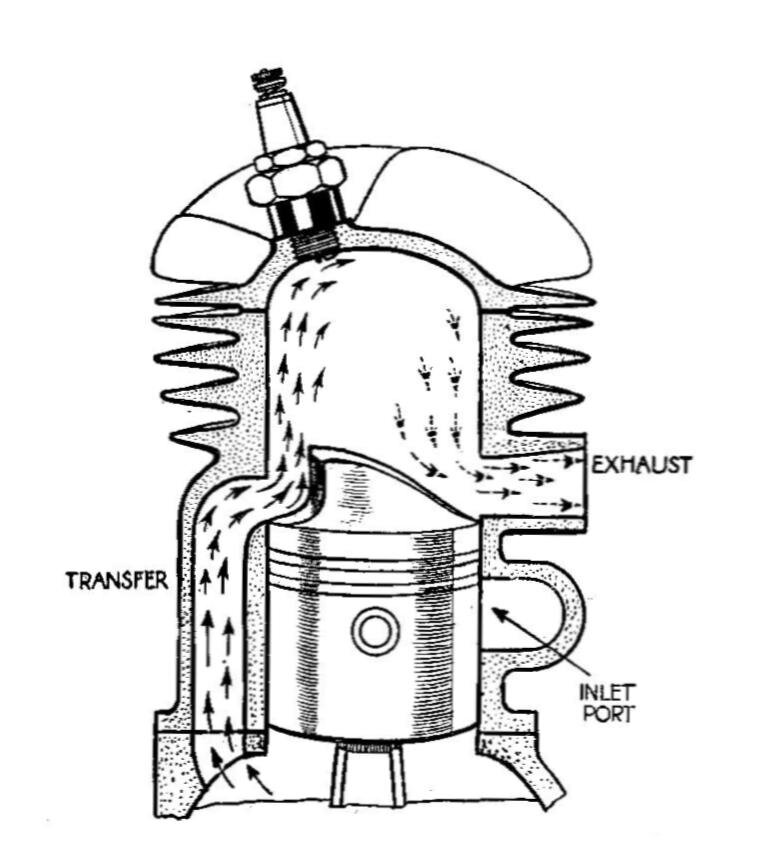
A two-stroke engine ingeniously combines the four steps. As the piston moves up, it's doing the compression stroke, but it's also creating a vacuum below it to draw in a fresh fuel-air mix. When the spark plug fires and pushes the piston down (the power stroke), the piston uncovers ports, or openings, in the cylinder wall. The burnt exhaust gases rush out one port while the fresh fuel-air mix rushes in through another, ready for the next compression stroke.
The key difference is that two-stroke engines lack a complex valve system. They use the piston itself to cover and uncover the intake and exhaust ports.
This design is simpler, lighter, and can produce more power for its weight. However, it's generally less fuel-efficient and produces more pollution because some unburnt fuel can escape with the exhaust.
What is the primary energy conversion that occurs in an internal combustion engine?
What is the main function of the crankshaft?
Whether it's a four-stroke or a two-stroke, the fundamental principle is the same: harnessing the power of combustion to turn a crankshaft. Understanding this cycle is the first step to understanding how countless machines in our world work.