Slopes of Coordinate Axes
Slope Formula Derivation
Calculating Slope
Any straight line has a constant steepness. This steepness is called the slope. It measures how much the line goes up or down for every step it takes to the right. Since you're familiar with plotting points on a , we can jump straight to how we measure this slope algebraically. The slope tells us the exact rate of change between any two points on the line.
To find the slope, you only need the coordinates of two different points on that line. Let's call them Point 1 and Point 2 . The slope, often represented by the letter , is calculated with a specific formula.
The expressions and are so common that they have their own shorthand. You'll often see them written using the Greek letter delta (), which means 'change in'. So, the slope formula can also be written as:
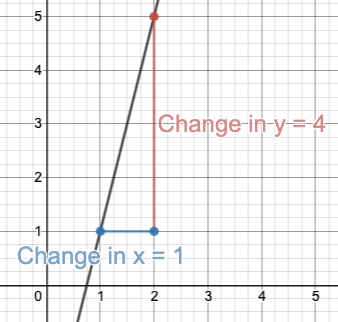
Let's calculate the slope for a line that passes through the points and .
First, we assign our points: Let And
Now, we plug these values into the formula.
Does Order Matter?
What if we had chosen as our first point and as our second? Let's see.
This time:
Plugging these into the formula gives us:
The result is identical. The key is consistency. Whichever point you choose to provide the first y-value must also provide the first x-value. You can't mix and match.
For example, this would be incorrect:
This consistency ensures that the slope correctly represents the line's regardless of which two points you pick or how you order them.
As long as you subtract the x and y coordinates in the same order, you will always get the correct slope.
What does the slope of a straight line represent?
Which formula correctly calculates the slope () of a line passing through points and ?