Slicing the Cube
Understanding Cross Sections
Slicing Through Solids
Imagine you have a solid object, like a loaf of bread or a block of cheese. When you slice through it with a knife, the flat surface you expose is a two-dimensional shape. In geometry, this exposed surface is called a cross section.
cross section
noun
The two-dimensional shape formed by the intersection of a plane and a three-dimensional object.
A cross section is essentially a view of the inside of a 3D object. The shape of the cross section depends on two things: the shape of the original object and the angle of the slice.
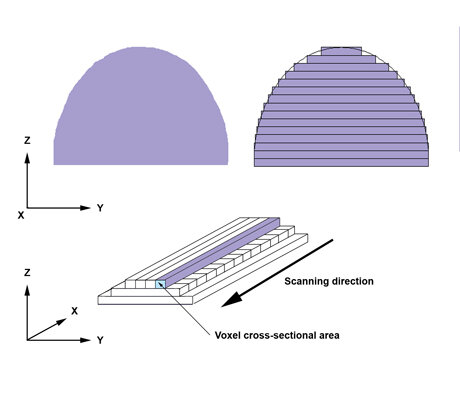
Think about slicing a cone. If you slice it parallel to its base, you get a perfect circle. But if you tilt the slice, you can create an oval (an ellipse), a U-shape (a parabola), or even a two-part curve (a hyperbola).
Why It Matters
Understanding cross sections is more than just a mental exercise. It's a fundamental concept used in many fields. Architects and engineers use them to create blueprints and visualize the internal structure of buildings and machines. In medicine, CT scans and MRIs are essentially creating a series of cross-sectional images of the body to see what's happening inside.
By studying cross sections, we can understand the properties of a 3D object without having to see the whole thing at once. It helps us break down complex shapes into simpler, 2D figures that are easier to analyze.
A cross section simplifies a three-dimensional problem into a two-dimensional one.
Let's practice what we've learned.
What is a cross section in geometry?
What two factors primarily determine the shape of a cross section?
Thinking in cross sections is a powerful tool. It allows us to look inside solid shapes and understand their underlying structure, one slice at a time.