siRNA: From Discovery to Drug Development
Introduction to RNA Interference
The Cell's Mute Button
Deep inside your cells, a constant stream of instructions flows from your DNA. These instructions, carried by molecules called messenger RNA (mRNA), tell your cellular machinery which proteins to build. But what if a cell needs to turn down the volume on a specific instruction? That's where RNA interference, or RNAi, comes in.
RNA interference, or RNAi, is a form of gene regulation.
Think of RNAi as a natural and highly specific gene-silencing system. It doesn't alter the original DNA blueprint. Instead, it intercepts and destroys specific mRNA messages before they can be translated into proteins. This process allows cells to fine-tune which genes are active at any given moment.
The discovery of this mechanism was a surprise. In the 1990s, scientists trying to deepen the color of petunias by adding an extra gene for purple pigment found that it sometimes had the opposite effect, turning the flowers white. The extra gene was somehow silencing both itself and the plant's natural color gene. A few years later, researchers Andrew Fire and Craig Mello observed a similar, powerful silencing effect in worms when they injected them with double-stranded RNA. Their work revealed that this was a fundamental biological process, earning them a Nobel Prize in 2006.
The Silencing Pathway
The RNAi process is like a tiny, targeted search-and-destroy mission inside the cell. It all starts when a piece of double-stranded RNA (dsRNA) appears in the cytoplasm. This is unusual, as most RNA in the cell is single-stranded, so the cell's machinery treats it as a signal to act.
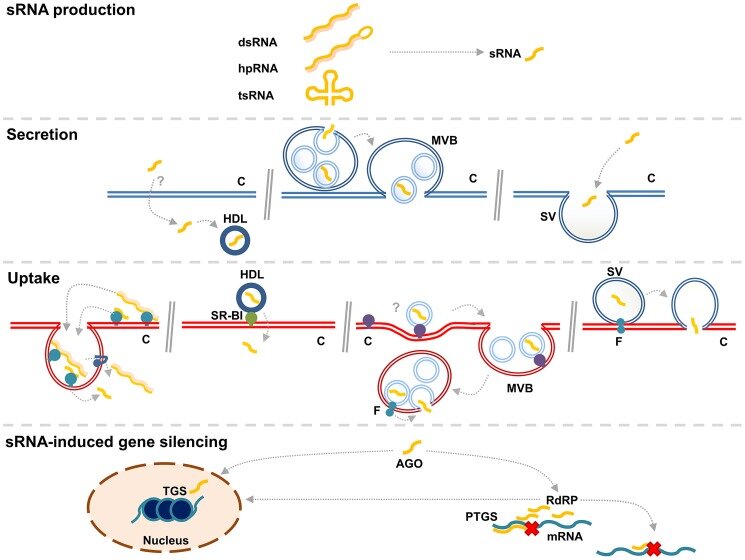
First, an enzyme called Dicer acts like a pair of molecular scissors. It finds the long dsRNA and chops it into small, manageable pieces about 20-25 nucleotides long. These small fragments are the key players in RNAi.
Next, one of these small RNA fragments is loaded into a protein complex called RISC, which stands for RNA-Induced Silencing Complex. The RNA strand acts as a guide, giving RISC the exact sequence it needs to find its target. The RISC-guide complex now patrols the cytoplasm, searching for mRNA molecules with a sequence that perfectly matches its guide RNA.
When RISC finds a matching mRNA, it binds to it. If the match is perfect, an enzyme within RISC, called Argonaute, cleaves the mRNA, effectively cutting it in two. The cell's cleanup crew then degrades the pieces. If the match is imperfect, RISC might just sit on the mRNA, physically blocking it from being read by the ribosome, the cell's protein-making factory.
Either way, the result is the same: the genetic message is silenced, and no protein is produced from that mRNA.
Meet the Key Players
The small RNA fragments created by Dicer fall into two main categories, each with a slightly different origin and role.
siRNA
noun
Short for small interfering RNA. These are typically derived from foreign RNA sources, like viruses, and have a sequence that is a perfect match to their target mRNA.
The primary role of siRNAs is defense. When a virus injects its genetic material (often dsRNA) into a cell, the RNAi machinery kicks in. Dicer chops up the viral RNA into siRNAs, which then program RISC to find and destroy any more viral RNA it finds. It's a highly effective antiviral system built into our cells.
miRNA
noun
Short for microRNA. These are encoded in an organism's own genome and are used to regulate its own genes. They often bind to their target mRNA with an imperfect match.
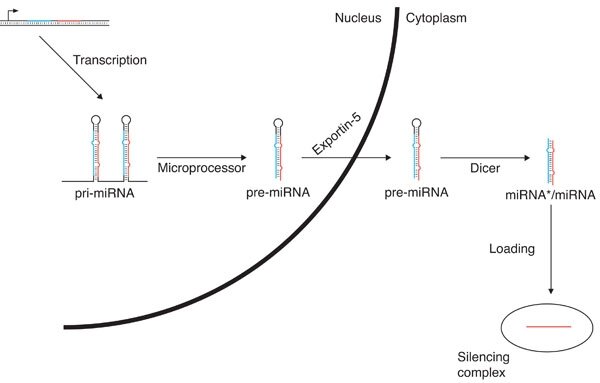
Unlike siRNAs that act as a defense mechanism, miRNAs are a fundamental tool for gene regulation. Our own DNA contains genes that code for these miRNAs. They are produced as hairpin-shaped precursors that are then processed by Dicer. Because they often don't match their target mRNA perfectly, a single miRNA can regulate hundreds of different genes, acting as a master switch to control complex cellular processes like development, cell division, and metabolism.
So, while both siRNAs and miRNAs use the same Dicer and RISC machinery, their origins and primary functions differ. siRNAs are the cell's sentinels against foreign invaders, while miRNAs are the subtle regulators of the cell's own genetic symphony.
What is the primary function of RNA interference (RNAi) within a cell?
The enzyme that acts like molecular scissors to chop long double-stranded RNA into smaller, 20-25 nucleotide fragments is called __________.
RNA interference is a powerful, precise, and natural process that gives cells an extra layer of control over their genes.