Simplifying Class 11 Physics Waves
Wave Equation Physics
The Shape of a Traveling Wave
A wave is a disturbance moving through a medium. To describe it, we need to know the displacement of any part of the medium at any point in time. We can capture this entire picture with a single function, . Here, is the displacement from equilibrium, is the position along the medium, and is time. This function gives us a complete snapshot of the wave at any instant.
The function describes the vertical displacement of a string at position and time . A positive value means the string is above its resting position, while a negative value means it's below.
The most fundamental type of periodic wave has the shape of a sine or cosine function. Any complex wave can be described as a sum of these simple sinusoidal waves. Because of this, we'll focus on the sine wave as our model for a traveling wave.
Anatomy of a Sine Wave
The mathematical description of a sinusoidal wave traveling in the positive direction is a function that links position and time to displacement.
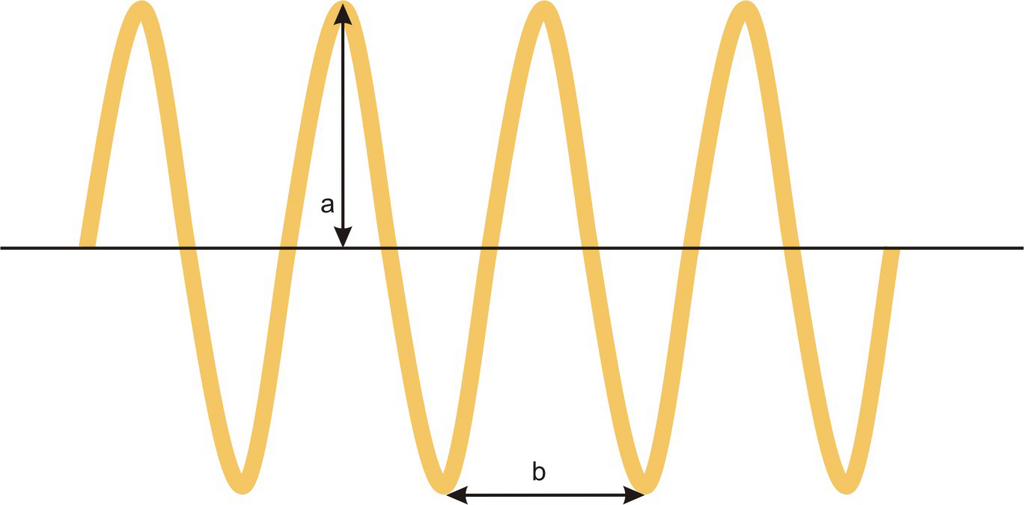
Let's break down the terms inside the sine function. The entire argument, , is called the phase of the wave. It determines the state of oscillation at any point in space and time.
The , , describes how the wave repeats itself in space. It's related to the wavelength by the formula . A large wavenumber means a short wavelength and many oscillations packed into a small space.
The describes how the wave repeats itself in time. It's related to the period and frequency by . A high angular frequency means the medium is oscillating up and down very quickly.
Finally, the phase constant shifts the wave in space. It accounts for the wave's starting position at and . Two waves can have the same amplitude, wavelength, and frequency, but if they are out of sync, their phase constants will be different.
How Fast Does a Wave Travel?
The speed of a wave, often called the phase velocity, is the speed at which a point of constant phase travels. For example, how fast does a specific crest of the wave move? To find this, we can take our phase, , and set it to a constant value, since every point on a crest has the same phase.
Now, if we take the derivative of this entire equation with respect to time, the derivative of the constant on the right side is zero. This tells us how must change with to keep the phase constant.
The term is, by definition, the velocity of our point of constant phase. We call this the phase velocity, . Solving for it gives us a fundamental relationship.
We can connect this back to the more familiar relationship between speed, frequency, and wavelength. By substituting the definitions of and , we get:
Speed in the Real World
The wave speed is a general property of all waves, but the actual speed value is determined not by the wave itself, but by the physical properties of the medium it travels through. For a transverse wave on a stretched string, like a guitar string, the speed depends on two things: how tight the string is (the tension) and how heavy it is (the mass per unit length).
Mechanical waves are waves which propagate through a material medium (solid, liquid, or gas) at a wave speed which depends on the elastic and inertial properties of that medium.
The tension acts as the restoring force that pulls the string back to equilibrium, while the mass provides the inertia that resists this change in motion. A higher tension means a stronger restoring force, causing the disturbance to propagate faster. A greater mass per unit length means more inertia, slowing the wave down.
This is why tightening a guitar string (increasing ) raises the pitch of the note it produces. The higher wave speed leads to a higher frequency of vibration for the standing wave that is formed.
So while the equation gives us the shape and motion of a wave, the speed at which that shape moves is ultimately governed by the fundamental physics of the material carrying it.