Simple Machine Mechanics
Mechanical Advantage Fundamentals
The Force-Distance Trade-Off
Simple machines seem almost magical. They let us lift heavy objects, split logs, and raise sails with a fraction of the effort normally required. But they don't create energy out of thin air. The secret lies in a fundamental trade-off. Machines allow you to apply a smaller force over a longer distance to move a heavy load over a shorter distance. This concept is rooted in the Work-Energy Theorem, which tells us that the work done on an object equals the change in its kinetic energy. In the context of machines, we talk about input work and output work.
The work you put into a machine is called the input work (). The work the machine does on the load is the output work (). In a perfect, frictionless world, energy is conserved, meaning all the work you put in comes out the other end. So, for an ideal machine:
Ideal vs. Actual Advantage
This perfect scenario lets us calculate a machine's Ideal Mechanical Advantage, or IMA. The IMA is a theoretical measure of the force multiplication a machine provides, assuming no energy is lost to friction. It’s purely a ratio of distances.
For example, if you pull 5 meters of rope on a pulley system to lift a box 1 meter, the IMA is 5/1 = 5. Ideally, the pulley system multiplies your force by five.
Of course, we don't live in a perfect world. Friction is an unavoidable force that opposes motion, converting some of the input work into heat. This means the actual force output is always less than what the IMA suggests. To account for this, we use the Actual Mechanical Advantage, or AMA. The AMA is the ratio of the actual forces.
The AMA tells you the real-world force multiplication you get from a machine. Because of energy losses, the AMA of any real machine is always less than its IMA.
Measuring Performance: Efficiency
So, if we're always losing some work to friction, how do we measure how well a machine performs? We calculate its efficiency. Efficiency () is a measure of how much of the input work is successfully converted into useful output work. It’s often expressed as a percentage.
We can also calculate efficiency by comparing the AMA to the IMA. This gives a clear picture of how much of the machine's ideal potential is lost to real-world imperfections.
A machine with an efficiency of 0.8, or 80%, converts 80% of the input work into useful output work. The remaining 20% is lost, primarily as heat due to friction. No machine can be more than 100% efficient, as that would violate the law of conservation of energy.
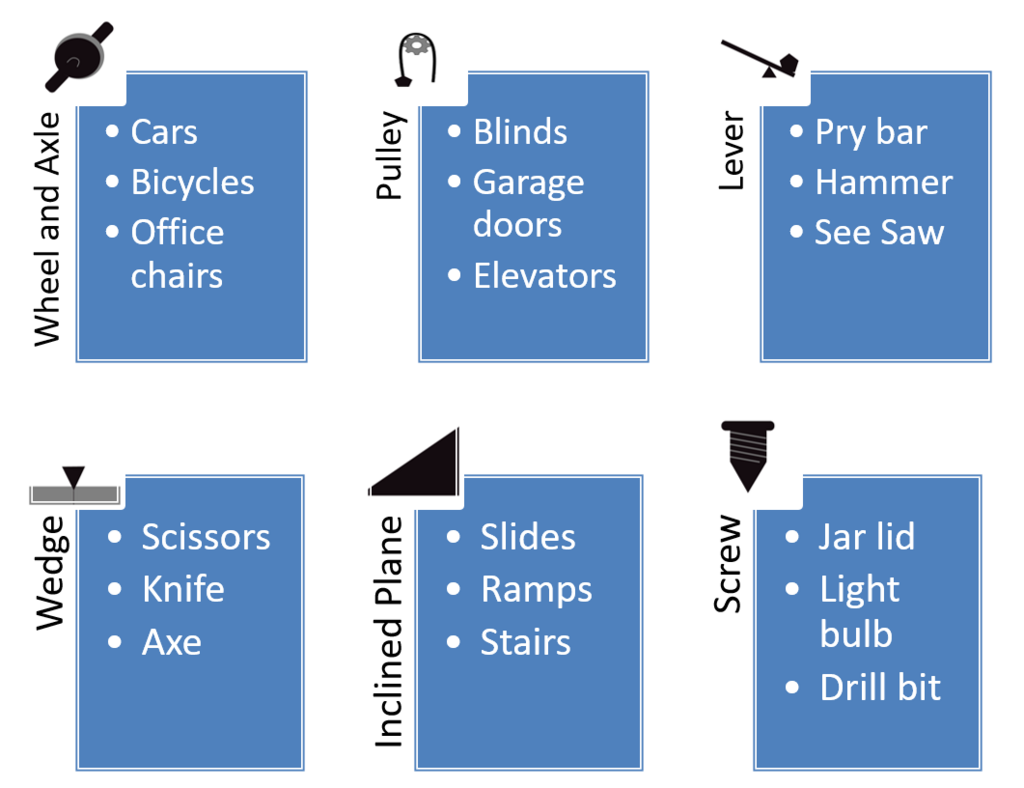
Understanding the interplay between IMA, AMA, and efficiency is the key to analyzing any simple machine. It allows engineers to quantify the trade-offs involved and design systems that get the job done with the least amount of wasted effort.