Simple Machine Mechanical Advantage
Lever Mechanics
The Law of the Lever
At the heart of every lever is a simple, elegant principle: the law of moments. Since you're already familiar with torque, you know it’s a rotational force. A lever is in equilibrium when the torque exerted by the effort force perfectly balances the torque exerted by the load. This balance point is the key to how levers give us an advantage.
Imagine a classic see-saw. For it to be perfectly level, the turning effect on one side must equal the turning effect on the other. This principle was famously understood by the ancient Greek mathematician Archimedes, who grasped that distance could be traded for force. The relationship is captured in a single equation.
This formula shows that a small effort force can balance a large load force, provided the effort arm is proportionally longer than the load arm. This ability to multiply force is the lever's superpower.
Mechanical Advantage
How much does a lever amplify our effort? We measure this using a ratio called Ideal Mechanical Advantage (IMA). The term 'ideal' is used because this calculation ignores real-world factors like friction. It tells us the theoretical force multiplication provided by the machine.
Mechanical advantage is a measure of the force amplification achieved by using a tool, mechanical device or machine system.
For any lever, the IMA is simply the ratio of the length of the effort arm to the length of the load arm.
This leads to the fundamental trade-off of all simple machines: the force-distance trade-off. If you want to lift a heavy object with a small force, you must apply that force over a much greater distance. You don't get 'free' work; you just make the work easier to perform by changing how you apply force and motion. Think of using a long wrench to loosen a tight nut. You move your hand a large distance in a circle to make the nut turn a tiny bit, but the force required is much less.
Lever Classes and IMA
The IMA of a lever depends entirely on the arrangement of its three key components: the fulcrum, the effort, and the load. Let's see how this plays out in each class.
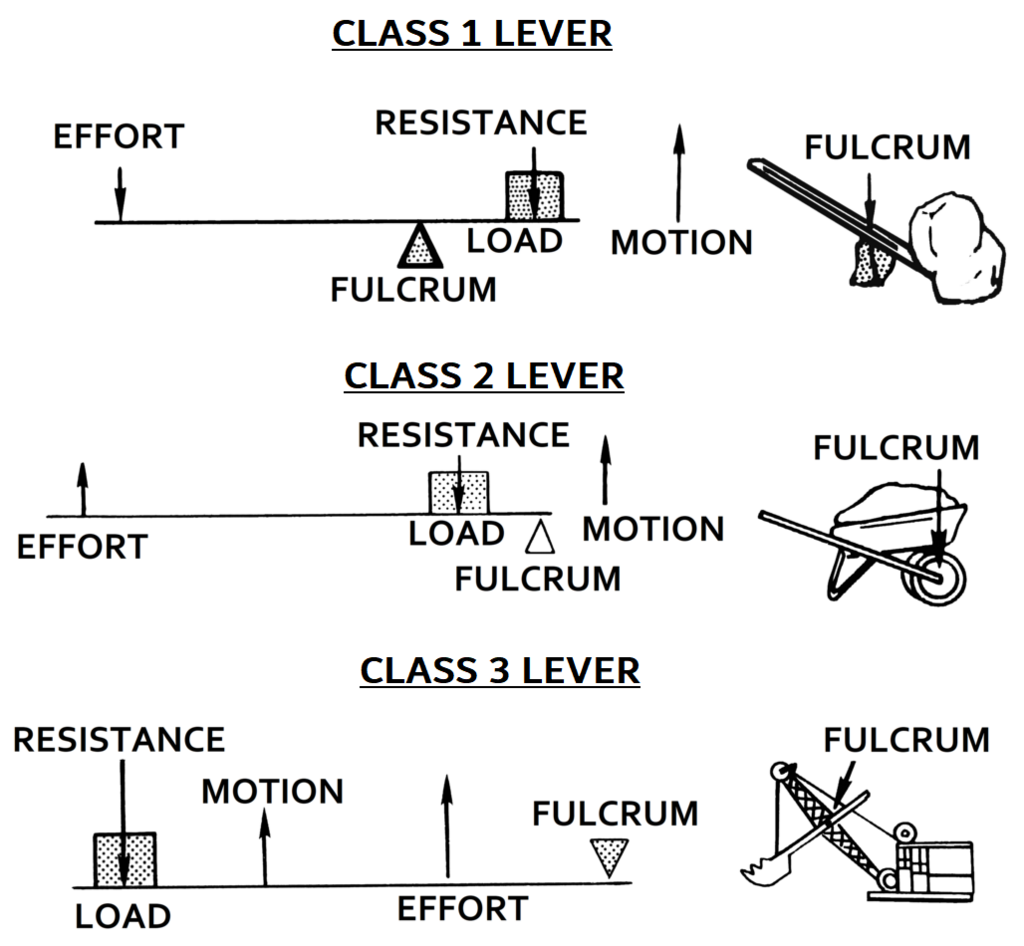
First-Class Levers With the fulcrum positioned between the effort and the load, a first-class lever is the most versatile. Think of a crowbar prying a rock. If you place the fulcrum close to the rock (the load), you create a very long effort arm and a very short load arm.
Let's say your crowbar is 1.2 metres long, and you place a pivot 0.2 metres from the end under the rock. Your effort arm () is 1.0 metre, and your load arm () is 0.2 metres. The IMA would be . You multiply your effort force by five. Moving the fulcrum changes this ratio, so the IMA can be greater than, less than, or equal to 1.
Second-Class Levers The load is situated between the fulcrum and the effort. A wheelbarrow is a perfect example; the wheel's axle is the fulcrum, the load is in the basin, and you provide the effort by lifting the handles. In this arrangement, the effort arm is always longer than the load arm.
Because is always true, the IMA of a second-class lever is always greater than 1. This means they are force multipliers. They always make it easier to lift a heavy load.
Third-Class Levers Here, the effort is applied between the fulcrum and the load. Your own arm is a great example. Your elbow is the fulcrum, your bicep muscle provides the effort just below the elbow, and the load is the weight in your hand. Fishing rods and tweezers are other examples. For these levers, the effort arm is always shorter than the load arm ().
This means the IMA is always less than 1. You have to apply more force than the load itself! So what's the point? The payoff is range of motion and speed. Your bicep only has to contract a small amount to make your hand move a large distance very quickly. These levers are distance multipliers rather than force multipliers.
According to the law of moments, when is a lever in equilibrium?
You are using a 1.5-metre long crowbar to lift a heavy stone. You place a pivot (the fulcrum) 0.3 metres from the stone. What is the Ideal Mechanical Advantage (IMA) of this setup?
Understanding the interplay between force, distance, and fulcrum position allows you to analyse and design any lever system, from simple tools to complex machinery.