Simple Machine Mechanical Advantage
Lever Equilibrium Mechanics
The Balancing Act of Levers
A lever in balance is a perfect picture of static equilibrium. For this to happen, the turning effects on both sides of the pivot point, or fulcrum, must cancel each other out. You might remember this turning effect as torque, or a moment, calculated as force multiplied by the perpendicular distance from the pivot. When a lever is balanced, the clockwise moments must equal the anti-clockwise moments. This is known as the Principle of Moments.
By arranging the fulcrum, load, and effort in different ways, we can create tools that either multiply our force or increase our range of motion. This is the simple genius behind all levers, which are categorized into three distinct classes.
Three Classes of Levers
The classification of a lever depends entirely on the relative positions of the fulcrum, the load, and the effort.
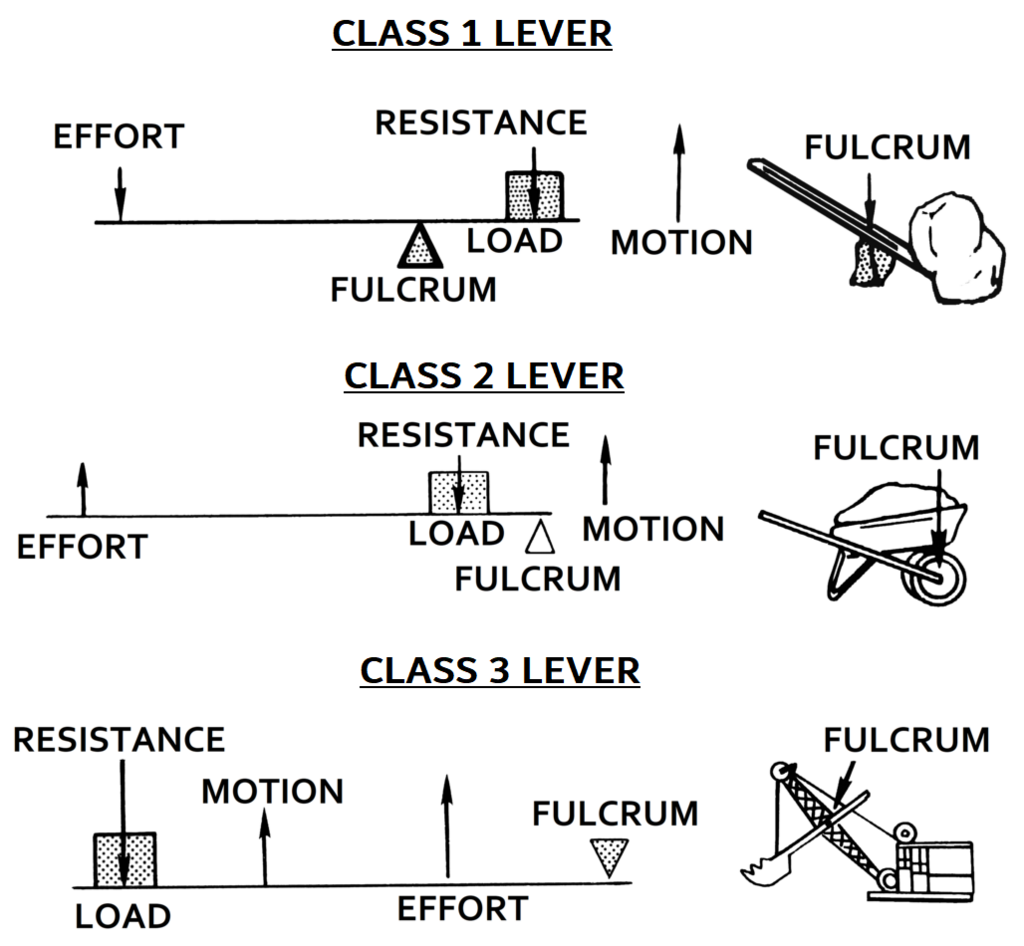
Class 1 Levers have the fulcrum positioned between the effort and the load. Think of a see-saw or using a crowbar to lift a heavy rock. Depending on the fulcrum's position, they can be used to multiply force or multiply distance. If the effort arm is longer than the load arm, the lever provides a force advantage.
Class 2 Levers place the load between the fulcrum and the effort. A wheelbarrow is a classic example: the wheel's axle is the fulcrum, the contents are the load, and you provide the effort at the handles. This class of lever always provides a mechanical advantage, meaning the effort required is always less than the load.
Class 3 Levers are defined by having the effort applied between the fulcrum and the load. Examples include tweezers, a fishing rod, or your own forearm. Here, the effort you apply is always greater than the load you are moving. So why use them? They provide a distance advantage; a small movement of the effort results in a much larger movement at the load's position, offering speed and range of motion.
Gaining an Advantage
The effectiveness of a lever in multiplying force is quantified by its Mechanical Advantage (MA). It's the simple ratio of the load force to the effort force.
From the principle of moments for an ideal, frictionless lever, we can also express MA in terms of the lever arms.
Another important ratio is the Velocity Ratio (VR). Based on the law of conservation of energy, the work you put in (Effort × distance moved by effort) must equal the work done on the load (Load × distance moved by load), assuming no frictional losses. The VR is the ratio of these distances.
Let's consider a practical example. Suppose you're using a 2-metre long crowbar to lift a 150 kg stone. You place the fulcrum 0.25 metres from the stone. The load arm is 0.25 m, and the effort arm is m. The load force is N. How much effort is needed?
Levers are more than just historical tools; they are integral components in countless modern machines and even our own bodies. Understanding their principles of equilibrium and advantage is a key step in mastering mechanical engineering.