Similar Triangles Explained
Triangle Basics
The Building Block of Shapes
A triangle is one of the simplest shapes in geometry. It's a polygon with three sides, three corners (called vertices), and three interior angles. Despite their simplicity, triangles are incredibly strong and stable, which is why you see them everywhere in construction, from bridges to skyscraper frames.
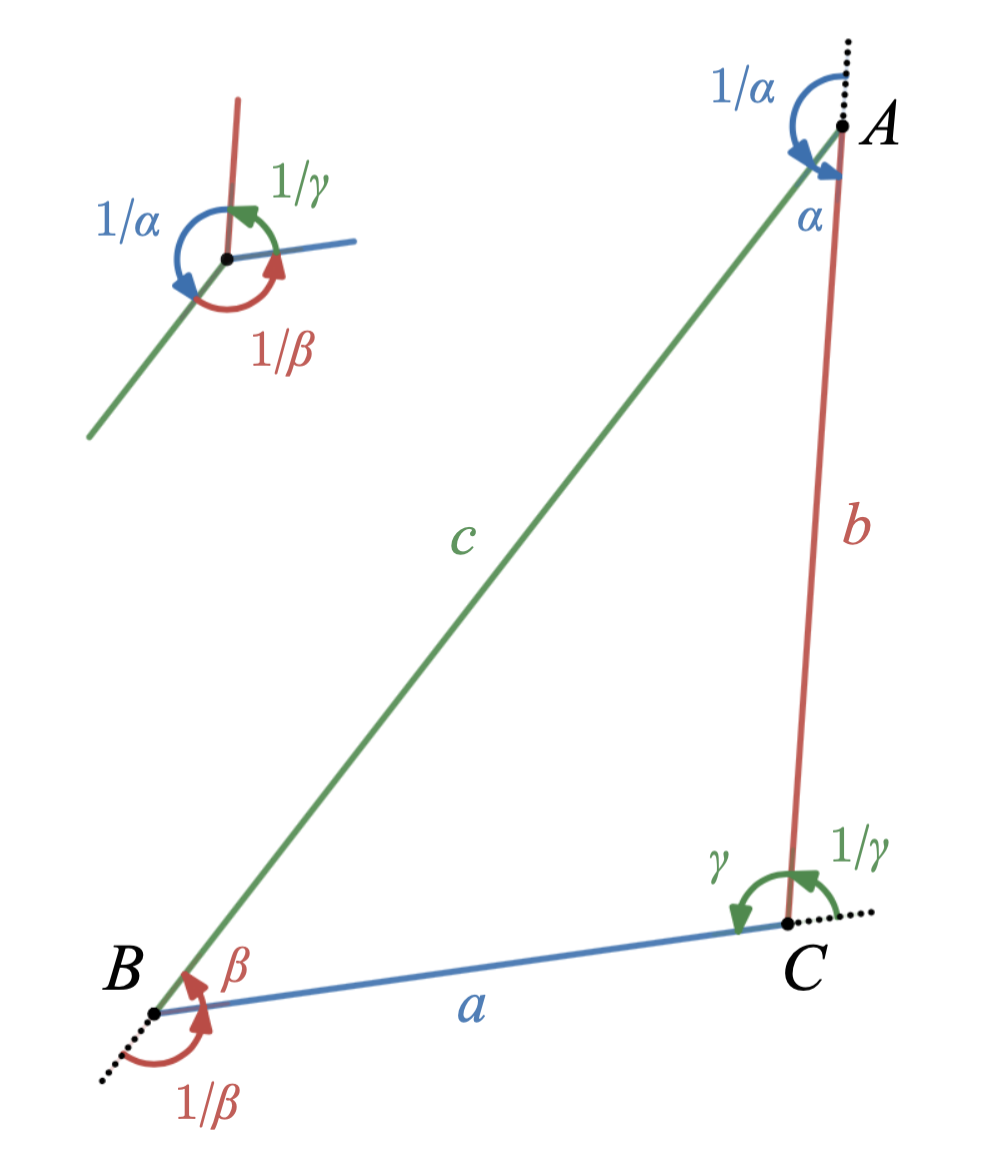
One of the most fundamental rules of triangles is that the sum of their three interior angles always equals 180 degrees. It doesn’t matter if the triangle is long and skinny or wide and stout. The angles will always add up to .
This rule is a cornerstone of geometry and helps us find missing angles and understand the relationships within the shape.
Not All Triangles Are Alike
Triangles can be sorted into different categories based on the lengths of their sides or the measure of their angles.
Classifying by sides gives us:
- Equilateral: All three sides and all three angles are equal. Since the angles add up to 180°, each angle must be 60°.
- Isosceles: Two sides are equal. The two angles opposite the equal sides are also equal.
- Scalene: No sides are equal, and no angles are equal. Every side and angle is unique.
We can also classify triangles by their largest angle:
- Acute Triangle: All three angles are less than 90°.
- Obtuse Triangle: One angle is greater than 90°.
- Right Triangle: One angle is exactly 90°. This special type has some unique properties.
The Power of Right Triangles
Right-angled triangles are special because they are the basis of trigonometry and have a famous theorem named after the Greek mathematician Pythagoras.
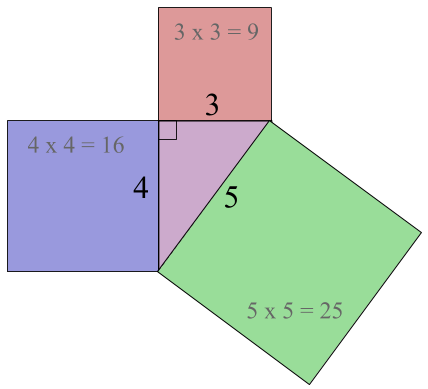
The Pythagorean theorem describes the relationship between the lengths of the three sides of a right triangle. The two sides that form the right angle are called legs, and the longest side opposite the right angle is called the hypotenuse.
In a right-angled triangle, the square of the length of the hypotenuse is equal to the sum of the squares of the lengths of the two legs.
If we label the legs a and b and the hypotenuse c, the relationship can be written as a simple, elegant formula:
This theorem is a powerful tool. If you know the lengths of any two sides of a right triangle, you can always find the length of the third. For example, if one leg is 3 units long and the other is 4 units long, we can find the hypotenuse.
So, the hypotenuse is 5 units long. This relationship has been used for thousands of years in fields like architecture, navigation, and engineering.
What is the sum of the three interior angles of any triangle?
A triangle with no equal sides and no equal angles is called a(n) _________ triangle.
These basic principles—the types of triangles, the 180-degree rule, and the Pythagorean theorem—form the foundation for understanding more complex geometric concepts.