Silicon Unveiled From Sand to Circuits
Introduction to Silicon
Meet Silicon
Silicon is a fundamental building block of our modern world, but let's start with the basics. On the periodic table, it goes by the symbol Si. Every element has a unique atomic number, which tells us how many protons are in its nucleus. For silicon, that number is 14.
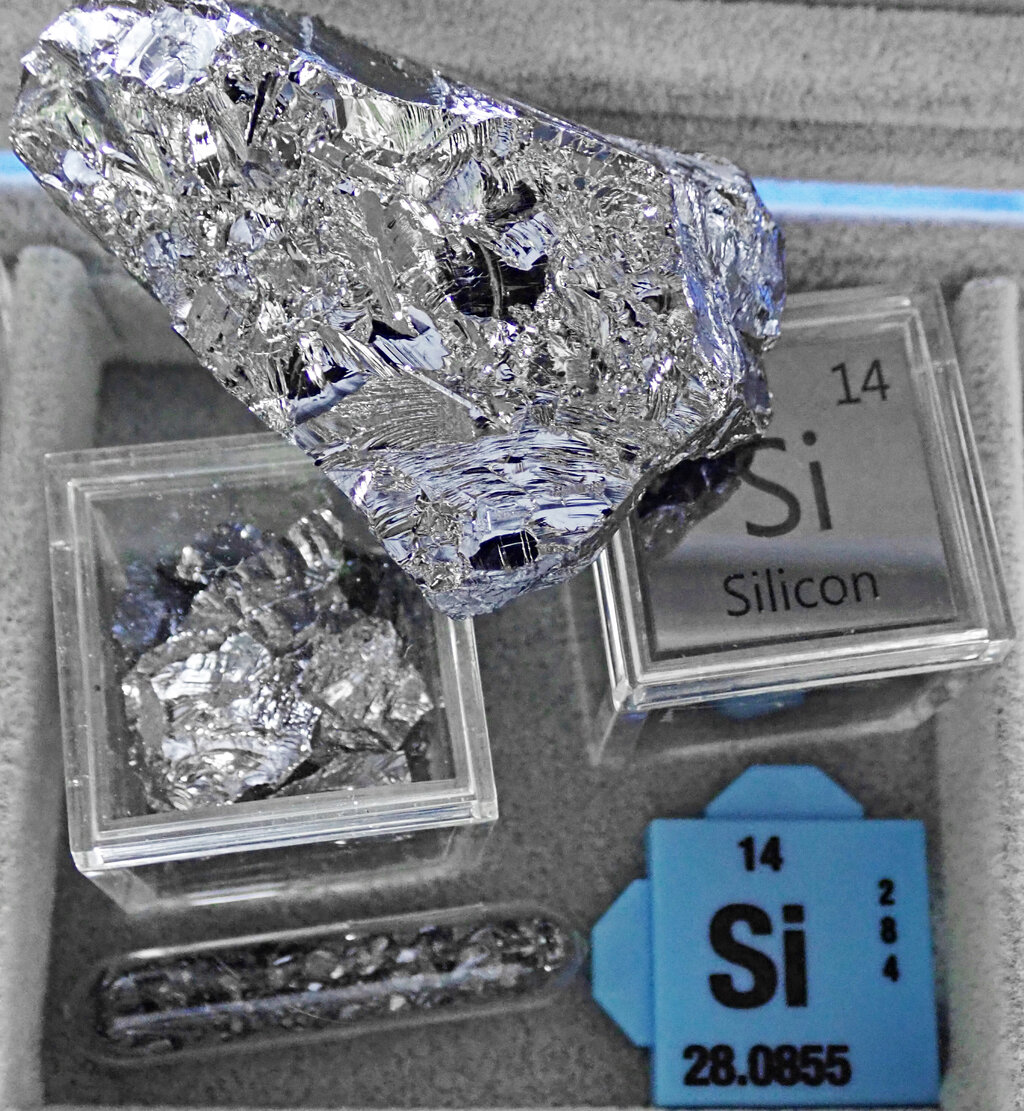
This number places it in group 14 and period 3 of the table. It sits just below carbon, a hint that they share some interesting chemical traits. But unlike carbon, which is a nonmetal, and tin and lead below it, which are metals, silicon has a unique identity all its own.
Under the Hood
The 14 protons in silicon's nucleus are balanced by 14 electrons, which orbit the nucleus in distinct energy levels, or shells. The arrangement of these electrons determines how silicon interacts with other elements. This arrangement is called its electron configuration.
These four outermost electrons are the key to silicon's behavior. They are the ones involved in forming chemical bonds. An atom is most stable when its outer shell is full, which usually means having eight electrons. With four valence electrons, silicon is perfectly halfway: it can either give up four electrons or gain four more to become stable. This flexibility is central to its chemistry.
A Tale of Two Types
Physically, pure silicon is a hard, brittle solid with a metallic luster and a grayish color. It has a high melting point of 1414 °C and a density of 2.33 grams per cubic centimeter, making it lighter than aluminum.
But its most interesting property is that it doesn't fit neatly into the categories of metal or nonmetal. Instead, it's a metalloid.
metalloid
noun
An element that has properties intermediate between those of metals and nonmetals.
Metalloids, also known as semimetals, occupy a zigzagging staircase on the periodic table that separates the metals on the left from the nonmetals on the right. Like metals, silicon can conduct electricity. However, it's a semiconductor, meaning it conducts electricity much less effectively than a true metal like copper, but better than an insulator like glass. This fine-tuned conductivity is what makes it so valuable.
Chemical Personality
At room temperature, silicon is relatively unreactive. It doesn't react with air, water, or most acids. This stability is one reason it's so durable. However, at higher temperatures, it becomes more willing to engage with other elements.
Its four valence electrons allow it to form four covalent bonds, similar to carbon. This means it shares electrons with neighboring atoms to achieve a stable outer shell. The bonds it forms, particularly with oxygen and itself, are very strong. For example, it reacts readily with halogens like fluorine and chlorine to form silicon halides.
Silicon's ability to form four strong, stable bonds is the foundation of its chemistry and its many applications.
While it can form chains similar to how carbon forms the backbone of organic molecules, the bond between two silicon atoms (Si-Si) is weaker than the carbon-carbon (C-C) bond. This limits the complexity of silicon-based chains compared to the vast world of organic chemistry. However, its strong bond with oxygen (Si-O) is the basis for an entire class of materials called silicates.
Ready to test your knowledge? Let's see what you've learned about silicon.
What is the atomic number of silicon (Si)?
Based on its properties, silicon is best classified as a...
Understanding these basic properties of silicon is the first step. They explain why this element is not just another entry on the periodic table, but a cornerstone of technology.