Signal to Speech: The Architecture of Mobile Calls
Signal Digitisation and Radio
From Sound to Signal
When you speak into your phone, its microphone captures the sound as an analog wave, a continuous signal of varying pressure. But modern networks are digital. To bridge this gap, your phone performs an analog-to-digital conversion, sampling the sound wave thousands of times per second to turn it into a stream of 1s and 0s.
This raw digital audio is bulky. Sending it directly would consume too much bandwidth. This is where a codec comes in. It's a compression and decompression algorithm that intelligently shrinks the size of the voice data without sacrificing too much quality. Think of it as a specialised zip file for your speech.
For Voice over LTE (VoLTE) calls, the standard codec is AMR-WB (Adaptive Multi-Rate Wideband). The "wideband" part is key; it captures a broader range of audio frequencies (up to 7 kHz) compared to old telephone lines, resulting in clearer, more natural-sounding calls. The "adaptive" part means it can adjust the compression level in real-time based on network conditions, balancing quality with efficiency.
5G's Voice over New Radio (VoNR) and modern 4G networks often use an even more advanced codec: Enhanced Voice Services (EVS). EVS is a significant leap forward. It supports a "super-wideband" frequency range up to 14.4 kHz and even full-band audio up to 20 kHz, which covers the entire spectrum of human hearing. This delivers a rich, almost in-person audio experience and makes calls more robust against packet loss.
Riding the Radio Waves
Once your voice is a compressed digital packet, it needs to be prepared for its journey through the air. This process is called modulation, where the digital data is impressed onto a high-frequency radio wave called a carrier wave. 4G and 5G networks use a highly efficient and resilient modulation scheme called (OFDM).
Instead of transmitting all the data on a single, large radio channel, OFDM divides the channel into hundreds or even thousands of smaller, parallel subcarriers. Each subcarrier transmits a small piece of the total data at a much slower rate. This is like replacing a single, fast-moving motorway lane with hundreds of slower, parallel local roads. A pothole (or interference) on one road only affects a tiny fraction of the traffic, making the entire system much more robust against signal degradation.
The Air Interface
This carefully orchestrated dance of digital conversion and modulation establishes the wireless connection between your phone, known as the User Equipment (UE), and the network's base station. This connection is called the 'air interface', or more formally, the Uu interface.
The base station is the tall tower you see dotted across the landscape. In 4G/LTE networks, it's called an eNodeB (Evolved Node B). In 5G networks, it's a gNodeB (Next Generation Node B). Their primary job is to manage the radio resources for all the phones in their coverage area, sending and receiving these OFDM signals.
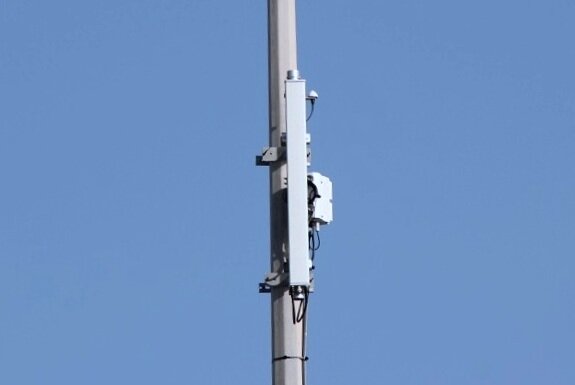
To further boost performance, modern base stations and phones use (Multiple Input, Multiple Output). This technology uses multiple antennas on both the transmitter (gNodeB) and the receiver (your phone) to send and receive multiple data streams simultaneously over the same radio channel. It’s like having multiple conversations at once in the same room without them interfering with each other.
MIMO significantly increases data throughput and link reliability, forming the final crucial piece of the puzzle that connects your voice to the wider network. From a simple sound wave to a complex radio signal managed by a gNodeB, this physical layer connection is the first and most critical step in making a modern mobile call.
What is the primary function of a codec, such as AMR-WB or EVS, in a mobile phone call?
Which technology significantly increases data throughput by using multiple antennas on both the base station and the phone to send and receive multiple data streams simultaneously?
These steps—digitising speech, compressing it with a codec, and transmitting it over the air interface using OFDM and MIMO—form the foundation of every call you make on a 4G or 5G network.