Signal Encoding and Wireless Propagation
Signal Modulation Basics
From Bits to Waves
Digital data, in its raw form, is just a series of ones and zeros. To send this information across a physical medium like air or a cable, we need to convert it into an analog signal. This process is called modulation. Think of it like putting a letter (your data) into an envelope (a carrier wave) to mail it. We modify a property of a continuous, high-frequency carrier wave to represent our digital bits.
Modulation is the process of varying one or more properties of a high-frequency carrier signal to transmit information.
The carrier wave is a simple, predictable sine wave. We can change its amplitude (height), frequency (speed of oscillation), or phase (starting point of the wave's cycle) to encode our data. Each of these methods has distinct advantages and disadvantages, especially regarding how efficiently they use bandwidth and how well they resist interference or noise.
Amplitude Shift Keying (ASK)
The most straightforward modulation technique is Amplitude Shift Keying, or ASK. Here, we change the amplitude of the carrier wave to represent binary data. For instance, a high amplitude can represent a '1', and a very low or zero amplitude can represent a '0'. It's like using a flashlight to send a message: light on is '1', light off is '0'.
Mathematically, for a binary '1' and '0', the ASK signal can be represented as:
Here, is the amplitude of the carrier wave, and is its frequency. While simple to implement, ASK is highly susceptible to , like atmospheric interference or electrical fluctuations. A sudden burst of noise could be misinterpreted as a '1', or it could diminish a '1' signal until it looks like a '0'. This makes it unreliable for high-speed or long-distance communication but suitable for simple applications like garage door openers and some low-speed wireless sensors.
Frequency and Phase
To build more robust systems, we can modify properties of the carrier wave that are less affected by amplitude changes. This brings us to Frequency Shift Keying (FSK) and Phase Shift Keying (PSK).
In FSK, we assign different frequencies to represent '1' and '0'. For example, a '1' might be transmitted at frequency and a '0' at a different frequency, . An early application of this was in dial-up modems, which used audible tones (different frequencies) to send data over phone lines.
Because noise typically adds to the amplitude of a signal rather than changing its frequency, FSK is much more resilient to interference than ASK. However, it requires more bandwidth, as the difference between and needs to be large enough for the receiver to distinguish them clearly.
Phase Shift Keying (PSK) takes a different approach. It keeps the amplitude and frequency constant but modifies the phase of the carrier wave. In the simplest form, Binary PSK (BPSK), we can use the original phase for a '0' and shift the phase by 180 degrees (or radians) for a '1'. This is like flipping the wave upside down.
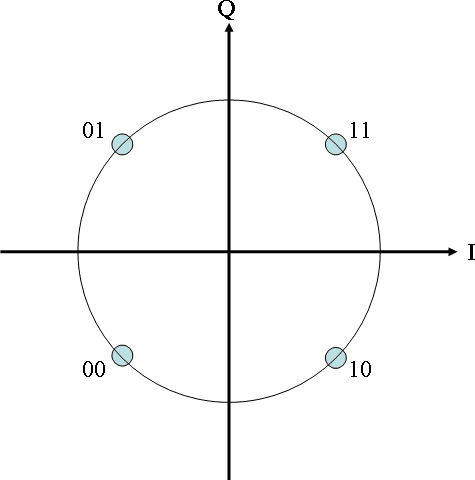
This method is even more power-efficient and noise-resistant than FSK. We can visualize these phase shifts using a , which plots the possible signal states on a complex plane. For BPSK, we have two points on the horizontal axis. By using more phase angles, we can encode more bits per symbol. For example, Quadrature PSK (QPSK) uses four phase angles (0, 90, 180, 270 degrees) to represent two bits at a time (00, 01, 10, 11). This is a form of M-ary signaling, where M is the number of possible symbols (M=4 for QPSK).
The trade-off with M-ary signaling is complexity and error. While sending more bits per symbol increases data rate without using more bandwidth, the points on the constellation diagram get closer together. This makes the system more vulnerable to noise, as a small disturbance could push a signal from one point's decision region into another's, causing a bit error. Choosing the right modulation scheme always involves balancing bandwidth efficiency, power efficiency, and noise immunity for the specific communication channel.
Let's test your understanding of these core modulation concepts.
What is the primary purpose of modulation in the context of digital communications?
Which modulation technique is most susceptible to noise that affects signal amplitude?
Understanding these fundamental trade-offs is key to designing any communication system, from simple sensors to complex satellite links.