Siemens CoreShield & OT Rail Security
Hardware Isolation Layer
The Physical Security Anchor
In operational technology (OT) networks, particularly in railway signaling, security cannot be an afterthought handled by software alone. While IT firewalls are effective for corporate networks, their reliance on software rules and bidirectional communication protocols presents an unacceptable risk to critical infrastructure. A software vulnerability or misconfiguration could allow malicious commands to travel back into the signaling system, with potentially catastrophic consequences. Securing these systems requires a fundamentally different approach, one that is physically enforced at the hardware level.
This is the role of the Siemens CoreShield Data Capture Unit (DCU). It serves as the physical foundation for OT security, creating an impassable barrier between the sensitive signaling network and external monitoring systems. Instead of relying on software to permit or deny traffic, the DCU enforces security through its physical design, ensuring data can only flow in one direction.
One-Way Data Flow by Design
The CoreShield DCU functions as a hardware data diode. At its core is a principle called , which physically separates the input and output circuits. There is no electrical connection between the side of the device connected to the railway's signaling network and the side connected to the external monitoring or analytics systems. Data is transmitted across this gap using light, effectively creating a one-way street. Information can be sent out for monitoring, but it is physically impossible for any signal, command, or piece of malware to travel back into the critical network.
Non-Invasive Data Tapping
To ensure the DCU does not disrupt existing operations, it taps into the network using . Rather than physically cutting into a cable and creating a new point of failure, the DCU's sensors are clamped around the existing Ethernet cables. They read the data flowing through the wires by detecting the magnetic fields generated by the electrical signals. This method is completely passive and interference-free. The original signaling network remains untouched and electrically isolated, unaware that its data is being monitored.
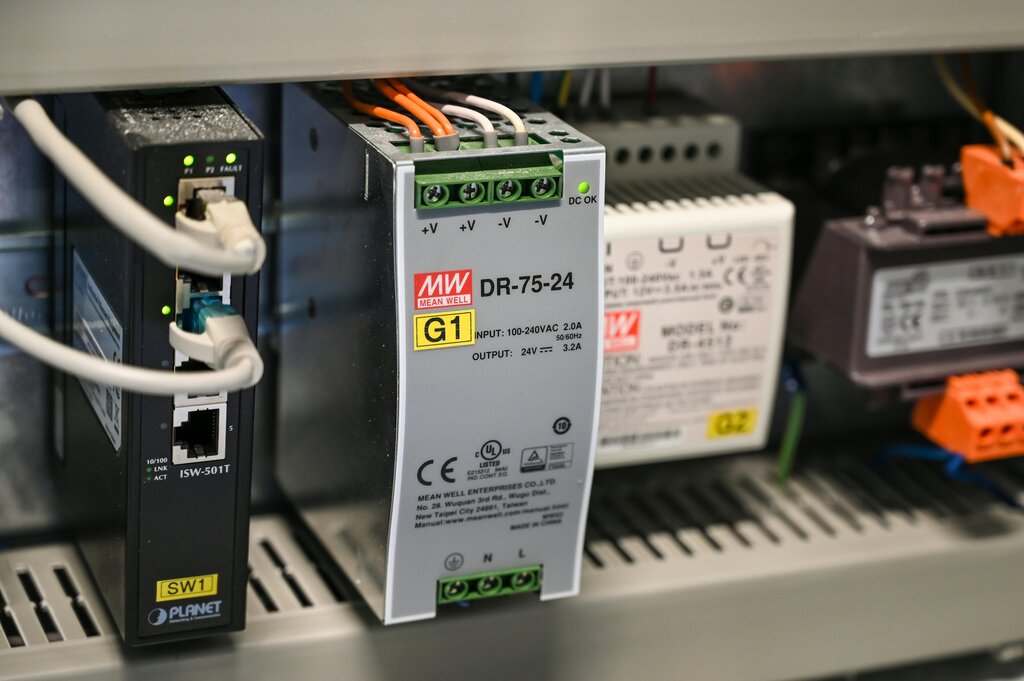
This design makes deployment straightforward. The CoreShield DCU is a compact unit designed to be mounted on a standard DIN rail inside a trackside cabinet. It's built to withstand the harsh conditions of a railway environment, operating in a wide temperature range and requiring a flexible power supply of 24-110 VDC. With a data throughput capacity of 200 Mbit/s, it can handle the data loads of modern signaling systems without creating a bottleneck.
The unit's security posture is validated by its compliance with . This certification confirms that the component is robust against intentional attacks from sophisticated actors, providing a high degree of confidence in its ability to protect the network's integrity.
By implementing a hardware-based, one-way data flow, the CoreShield DCU provides a verifiable security anchor for any railway signaling modernization project. It allows for the collection of vital operational data for analytics and predictive maintenance while guaranteeing that the core signaling network remains secure and isolated from external threats.
Why is a hardware-based data diode like the CoreShield DCU considered superior to a traditional IT firewall for securing critical railway signaling networks?
The CoreShield DCU uses a method called [{...}] to tap into network cables passively by reading the magnetic fields generated by electrical signals, ensuring it doesn't interfere with the live network.