Shorthand Mastery for Modern Note-Taking
Teeline Alphabet Mastery
The Teeline Alphabet
Teeline shorthand transforms the familiar English alphabet into a system of swift, simple strokes. Instead of drawing the complex curves of each letter, you'll learn to write its core essence. The system is based on the lowercase alphabet you already know, but with all the unnecessary parts stripped away. This focus on is what gives Teeline its speed. An 'a' becomes a small triangle, a 'd' becomes a simple curve, and an 'f' becomes an angled line.
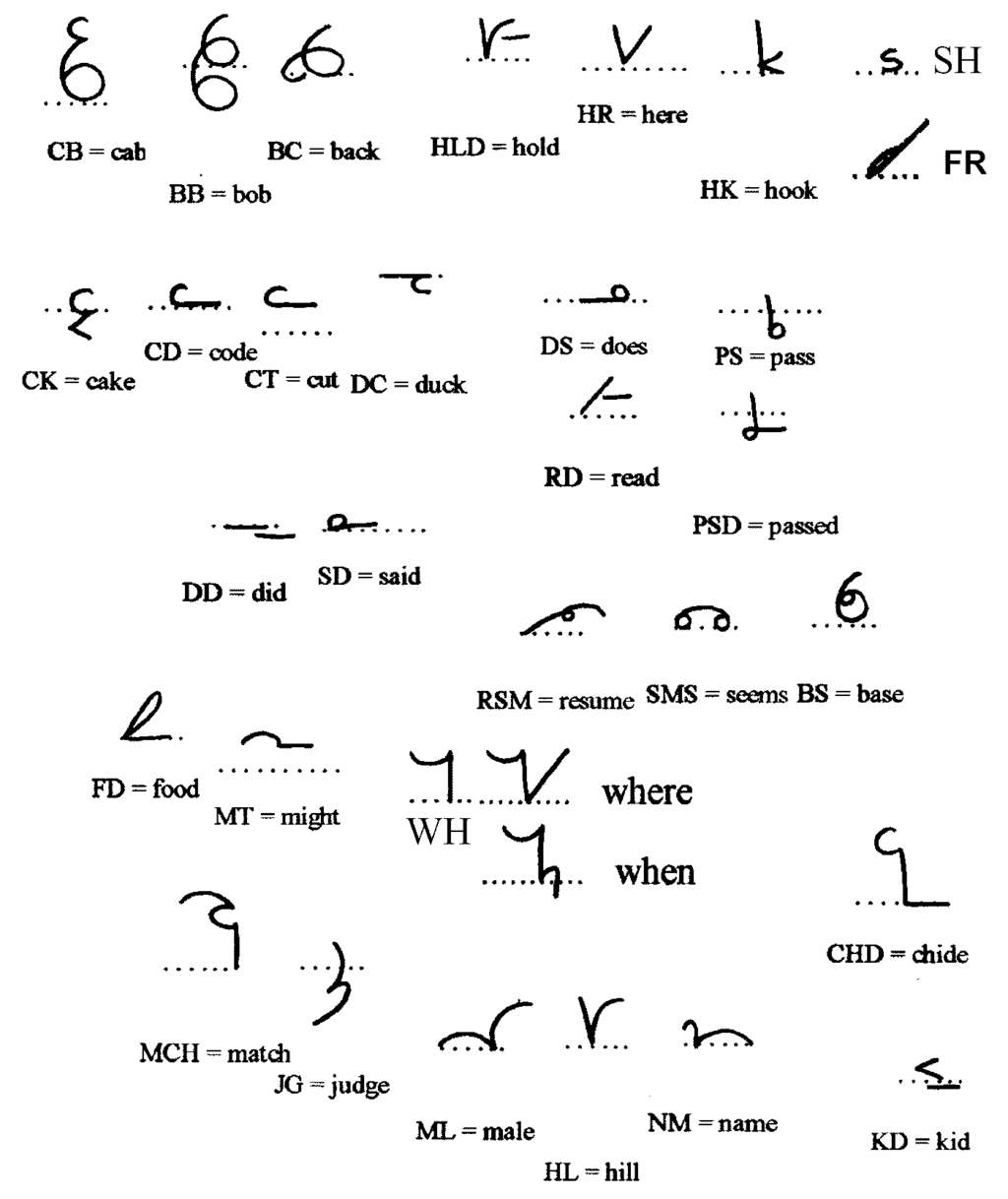
Think of it as deconstructing letters. The letter 't' is just its crossbar, a simple horizontal dash. The letter 'm' is reduced to its humps, written as a longer, curved line. The goal isn't to perfectly replicate the letter, but to create a distinct, fast symbol for it.
Size and Position Matter
In Teeline, the size of a character is critical. Some letters share the same shape but differ in size. For example, 'e' is a small horizontal dash, while 't' is a full-sized horizontal dash. Similarly, the letter 'i' is a small flick, while 'l' is a full-sized upward stroke. Maintaining this distinction is fundamental to reading your own notes later.
| Letter | Teeline Form | Key Characteristic |
|---|---|---|
| A | Small triangle/angle | Small, based on 'a' shape |
| B | Upward angled line | Full height, based on 'b' stem |
| C | Shallow curve | Small, like the top of 'c' |
| D | Half-circle curve | Full height, based on 'd' curve |
| E | Small horizontal dash | Small size |
| F | Angled line down and right | Full height, from the crossbar |
| G | Horizontal line with downward hook | Based on the tail of 'g' |
| H | Two small dashes | Represents the two stems of 'h' |
| I | Small upward flick/dot | Small size |
| J | Downward curve/hook | Below the line, from 'j' tail |
| K | Large shallow curve | Full height |
| L | Upward vertical line | Full height |
| M | Long, low curve | Based on the humps of 'm' |
| N | Short, low curve | Based on the hump of 'n' |
| O | Small circle/oval | Small size |
| P | Downward vertical line | Full height, below the line |
| Q | Small circle with downward tail | Similar to 'o' but with a tail |
| R | Short angled line up | Based on the shoulder of 'r' |
| S | Small circle | Identical to 'o' initially |
| T | Full-sized horizontal dash | Full size |
| U | Small downward curve/cup | Small size, like bottom of 'u' |
| V | Angled 'v' shape | Small size |
| W | Small 'w' shape | Small size |
| X | Cross shape | Written as two strokes |
| Y | Downward dipping curve | Dips below the line |
| Z | Small jagged line | Small size |
Your writing position on the page also matters. Characters are generally written on or in relation to a baseline, just like regular handwriting. Letters like 'j' and 'p' will dip below this imaginary line, while letters like 'b' and 'l' will extend fully upwards.
Building Muscle Memory
Knowing the shapes is the first step. The next is making them second nature. This requires building through repetition. Don't worry about speed at first. Focus on forming each character correctly and consistently.
A good pen and paper can make a difference. A smooth-flowing ballpoint or gel pen is ideal. Avoid anything that requires pressure, like a pencil, as it will slow you down. Lined paper provides a helpful baseline for positioning your strokes.
Start by writing each letter of the Teeline alphabet five times in a row. Say the letter's name as you write its symbol. This connects the visual shape, the physical movement, and the sound in your mind.
Once you're comfortable with individual letters, practice common combinations. The real skill in Teeline is the ability to flow from one character to the next without pausing. Practice writing pairs like 'th', 'ch', 'sh', and 'wh'. Notice how the end of one letter becomes the beginning of the next.
With a solid grasp of the alphabet and how letters connect, you've built the foundation for writing anything in Teeline. Let's review the symbols before testing your knowledge.
What is the primary basis for the Teeline shorthand system?
In Teeline, what is the critical difference between the symbols for letters like 'i' and 'l'?
Consistent practice is the only way to achieve fluency. Dedicate a few minutes each day to drilling the alphabet and simple words, and you'll quickly see your speed and confidence grow.