Shop Floor Excellence
Understanding Continuous Improvement
The Pursuit of Better
In manufacturing, standing still means falling behind. The processes, tools, and techniques that work today might be inefficient tomorrow. Continuous improvement is the simple but powerful idea that a company should always be looking for ways to get better. It’s not about massive, disruptive overhauls. Instead, it’s a commitment to making small, ongoing changes to improve quality, efficiency, and safety.
This isn't a project with a start and end date. It's a fundamental part of the company culture, a mindset that every employee adopts. From the factory floor to the executive suite, everyone is encouraged to spot opportunities for enhancement. This constant refinement helps a business stay competitive, reduce costs, and deliver better products to its customers.
Continuous improvement is a journey, not a destination. The goal is constant, incremental progress, not a one-time fix.
The concept isn't new. Its roots trace back to the early 20th century, but it gained significant momentum in post-World War II Japan. American statistician W. Edwards Deming introduced ideas about quality control that Japanese manufacturers eagerly adopted. They built on these principles, creating a culture of continuous improvement that helped fuel their country's remarkable economic recovery and manufacturing dominance.
A Simple Loop for Improvement
So how do you structure this ongoing search for 'better'? One of the most foundational tools is the Plan-Do-Check-Act (PDCA) cycle. It provides a simple, four-step framework for testing ideas and implementing change in a controlled way.
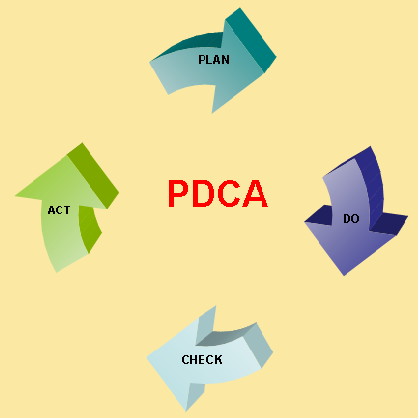
Here’s how the cycle works:
- Plan: Identify an opportunity for improvement and develop a hypothesis. What do you want to change, and what outcome do you expect? This could be as simple as reorganizing a workstation to reduce wasted motion.
- Do: Implement the change on a small scale. You don’t need to roll it out to the entire factory at once. Test your idea with a single team or on one production line.
- Check: Observe the results of your test. Did the change have the effect you predicted? Collect data to measure the impact. Was the process faster? Were there fewer errors?
- Act: If the change was successful, standardize it and implement it more broadly. If it wasn't, what did you learn? Use that knowledge to start the cycle over again with a new plan.
This loop repeats endlessly. Each time through the cycle, you gain a deeper understanding of your processes and make them a little bit better.
Why It Matters
Embracing continuous improvement isn't just about feeling productive. It delivers tangible results that directly impact the bottom line and overall health of the business.
First, it increases efficiency. By constantly refining processes, you can produce more with the same resources. Small tweaks, like adjusting the layout of a workspace or optimizing machine settings, add up to significant gains in output over time.
Second, it reduces waste. Waste in manufacturing isn't just about scrap material. It also includes wasted time, excess inventory, and unnecessary movement of people and products. A culture of continuous improvement trains everyone to see and eliminate these forms of waste, which directly cuts costs.
Finally, it enhances product quality. As processes become more standardized and efficient, they also become more predictable. This consistency leads to fewer defects and a more reliable product for the customer. Happy customers are repeat customers, and high quality builds a strong brand reputation.
Ultimately, these benefits create a more resilient, competitive, and profitable manufacturing operation.
Time to check your understanding.
What is the core principle of continuous improvement in a manufacturing context?
In the Plan-Do-Check-Act (PDCA) cycle, what happens during the 'Check' phase?
By adopting this mindset, you set the stage for a stronger, more adaptable organization. The key is to start small and build momentum.