Shooting Method for Particle in a Box
Introduction to Quantum Mechanics
The Quantum Playbook
In the world we see, things are predictable. If you kick a soccer ball, you can calculate its path. You know where it is and where it's going. But when we zoom way down to the level of atoms and electrons, the rules change completely. This is the realm of quantum mechanics, and its playbook is written in the language of mathematics.
At the heart of it all is a concept called the wave function. It's the central character in the quantum story. Instead of telling you exactly where a particle is, the wave function, usually written as the Greek letter psi ($ \Psi $), tells you everything you could know about it.
Waves of Probability
So, what is a wave function? It isn't a physical wave, like a ripple in a pond. Think of it as a mathematical description of a particle's state. It holds all the information about its position, momentum, and other properties, but in a fuzzy, probabilistic way.
The wave function itself isn't what we measure directly. The key is its squared value, written as . This value gives us the probability density of finding the particle at a specific point . A high value means a high probability of finding the particle there; a low value means a low probability.
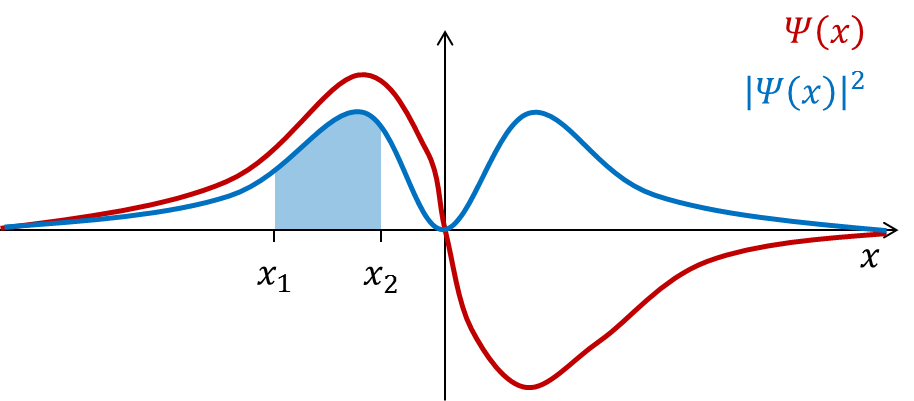
Imagine a cloud of possibilities. The densest parts of the cloud are where the particle is most likely to be, but it could theoretically be anywhere the cloud exists. The moment you measure the particle's position, the cloud collapses to a single point, and the particle has a definite location. Before the measurement, all we have are probabilities.
The Schrödinger Equation
How do we know how the wave function behaves over time? That's where the Schrödinger equation comes in. It's the master equation of quantum mechanics for non-relativistic systems. Just as Newton's second law ($ F=ma $) governs the motion of objects in our everyday world, the Schrödinger equation governs the evolution of the wave function.
Solving this equation for a given situation tells us what the wave function is, and therefore gives us the probability map for the particle for all future times. It's the engine that drives the quantum world.
Asking with Operators
In classical physics, you can measure a ball's position and momentum simultaneously. In quantum mechanics, things aren't so simple. Physical properties like position, momentum, and energy are called "observables," and each one is associated with a mathematical tool called an operator.
An operator is a set of instructions. When you apply an operator to a wave function, it extracts the information about that specific observable. For example, to find the energy of a system, you apply the energy operator, called the Hamiltonian ($ \hat{H} $), to the wave function.
Think of it this way: The wave function is a sealed package of information. Operators are the specific tools you use to open the package and look at just one piece of information at a time.
The Hamiltonian operator is special because it appears right in the Schrödinger equation. This shows the deep link between a system's energy and how its quantum state evolves. Different operators allow us to ask different questions about the quantum system, unlocking the secrets held within the wave function.
Now, let's test your understanding of these core concepts.
What is the primary role of the wave function, often represented as , in quantum mechanics?
The quantity is known as the probability density. What does it represent?