Shipbuilding Efficiency and Advanced Practices
Advanced Ship Design
Beyond the Blueprint
You're already familiar with how Computer-Aided Design (CAD) software creates the initial blueprints for a ship. But modern naval architecture pushes far beyond static, 2D drawings. The real power lies in making designs intelligent and adaptable from the very first line. This is where parametric modeling comes in.
Parametric modeling isn't about drawing a shape; it's about defining the rules that create the shape.
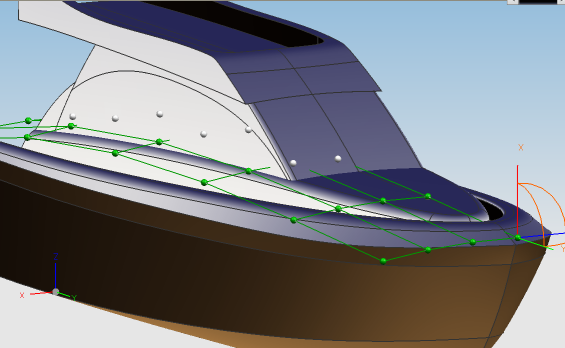
Think of it like a smart spreadsheet. You don't just type in final numbers; you create formulas. If you change one input, all the related calculations update automatically. In ship design, this means defining a hull not with fixed coordinates, but with parameters like length, beam, and draft. These parameters are linked by geometric and engineering rules. When a designer adjusts the beam, the rest of the hull geometry intelligently resizes to maintain structural integrity and hydrodynamic properties. This allows for rapid iteration and exploration of different design possibilities without starting from scratch each time.
The Digital Twin
A design created with parametric modeling is the perfect foundation for a digital twin. This isn't just a 3D model; it's a dynamic, data-rich virtual replica of the physical ship. It's born during the design phase and evolves throughout the ship's entire life, from construction to operation and eventual decommissioning.
The adoption of digital twin technology has transformed this stage by allowing designers to simulate and optimize ship performance before construction begins.
During design, the digital twin serves as a virtual prototype. Engineers can simulate how the ship will behave in heavy seas, test the efficiency of its propulsion systems, and even model how maintenance crews will access equipment—all before a single piece of steel is cut. This virtual testing ground drastically reduces the risk of costly errors and allows for a much more refined final product.
Optimizing with AI
Once a digital framework is in place, designers can use advanced computational methods to find the best possible design. This is especially true for the hull, where tiny changes in shape can have huge effects on performance. Deep learning, a type of artificial intelligence, is now used to accelerate this process.
Instead of an engineer manually tweaking the design and re-running simulations—a process that can take weeks—a deep learning model can be trained on thousands of existing hull designs and their performance data. The model learns the complex relationship between shape and efficiency. It can then predict the performance of a new hull shape almost instantly or even generate novel, highly optimized designs on its own.
But what does "best" even mean? A fast ship might burn too much fuel. A stable ship might have too much drag. A ship with massive cargo capacity might be too slow. These are competing goals, and this is where multi-objective optimization comes in.
Multi-objective optimization is the art of finding the best compromise.
This technique uses algorithms to explore the entire design space, balancing conflicting objectives simultaneously. For example, the goal might be to design a container ship that minimizes fuel consumption while maximizing cargo capacity and maintaining a specific stability level. Instead of a single "perfect" solution, the algorithm produces a set of optimal trade-offs, often visualized on a graph called a Pareto front. This allows designers and clients to make informed decisions, choosing the design that best fits their specific operational and economic needs.
What is the primary advantage of using parametric modeling in ship design over traditional static drafting?
A digital twin of a ship is best described as a...
These advanced digital methods represent a fundamental shift in shipbuilding, moving from a process of drawing and building to one of simulation, prediction, and optimization.