Sharks Through Deep Time
Geological Time
A Different Kind of Time
Human history feels long. We think of ancient civilizations as dating back thousands of years. But the Earth's story is written on a completely different scale. It spans billions of years, a stretch so vast it's hard for our minds to grasp. This immense timeline is known as geological time.
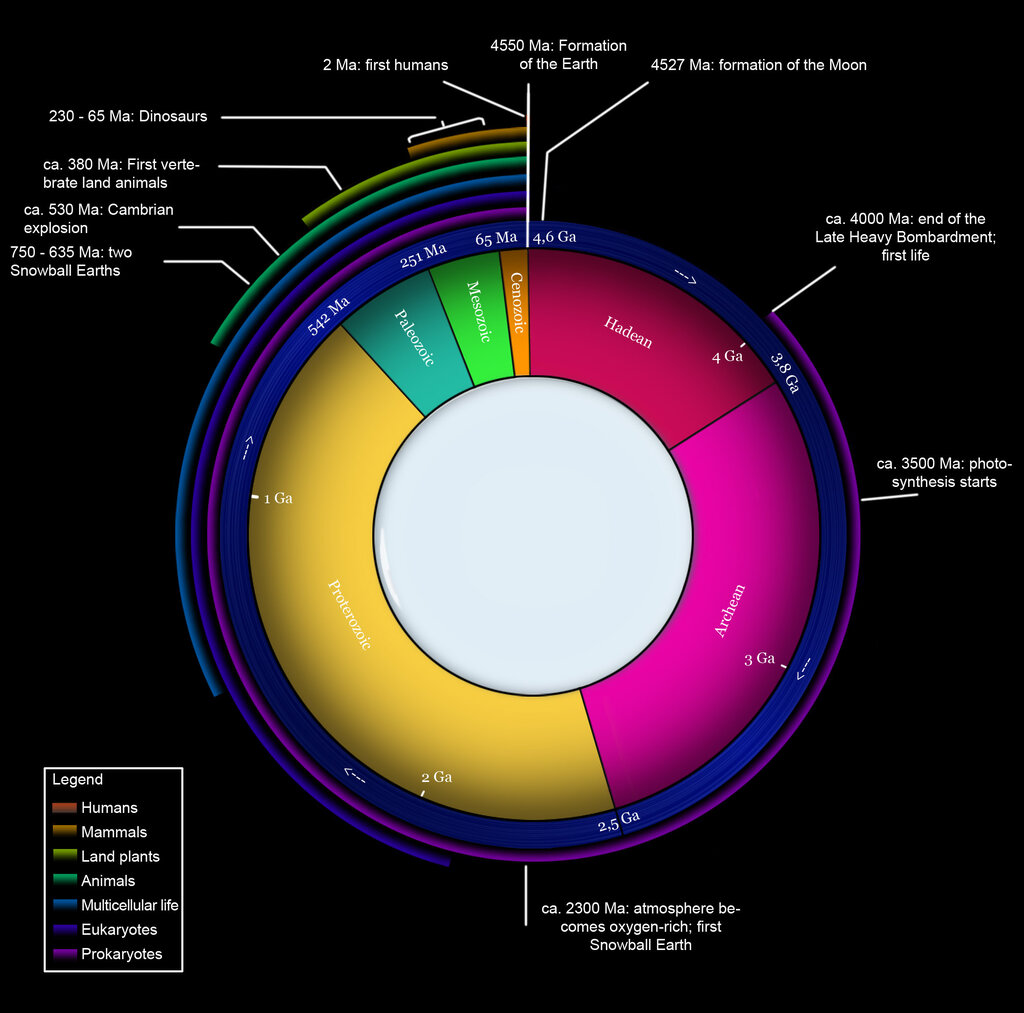
To make sense of this, scientists often use analogies. Imagine the entire 4.5 billion years of Earth's history compressed into a single calendar year. The Earth forms on January 1st. The first signs of life don't appear until late March. The dinosaurs roam from mid-December until the 26th. All of recorded human history flashes by in the last minute before midnight on New Year's Eve.
This is the concept of Deep Time—the multimillion-year timeframe within which scientists believe the earth has existed, and which is supported by the observation of natural, rather than supernatural, phenomena.
Geological Time
noun
The immense period of time over which Earth's geologic history is viewed, stretching from the planet's formation to the present day.
Earth’s Calendar
To organize this vast history, geologists have created the Geological Time Scale. It’s like a calendar for the planet, but instead of months and days, it uses divisions called eons, eras, periods, and epochs. These are nested within each other, from the largest spans of time down to the most specific.
An eon is the largest division, spanning hundreds of millions to billions of years. Eons are broken down into eras, which are typically marked by major changes in the fossil record, like the rise and fall of dominant life forms. Eras are subdivided into periods, and periods are further divided into epochs. We live in the Holocene epoch, which is part of the Quaternary period, in the Cenozoic era, all within the Phanerozoic eon.
| Eon | Time Span (Approx.) | Key Characteristics |
|---|---|---|
| Phanerozoic | 541 million years ago – Present | "Visible life." Abundant animal and plant life. |
| Proterozoic | 2.5 billion – 541 million years ago | Oxygen builds in the atmosphere; first complex cells appear. |
| Archean | 4 billion – 2.5 billion years ago | First life emerges (prokaryotes). |
| Hadean | 4.54 billion – 4 billion years ago | Earth's formation; a hot, molten planet. |
Reading the Rocks
How do scientists assign dates to events that happened millions or billions of years ago? They use two main approaches.
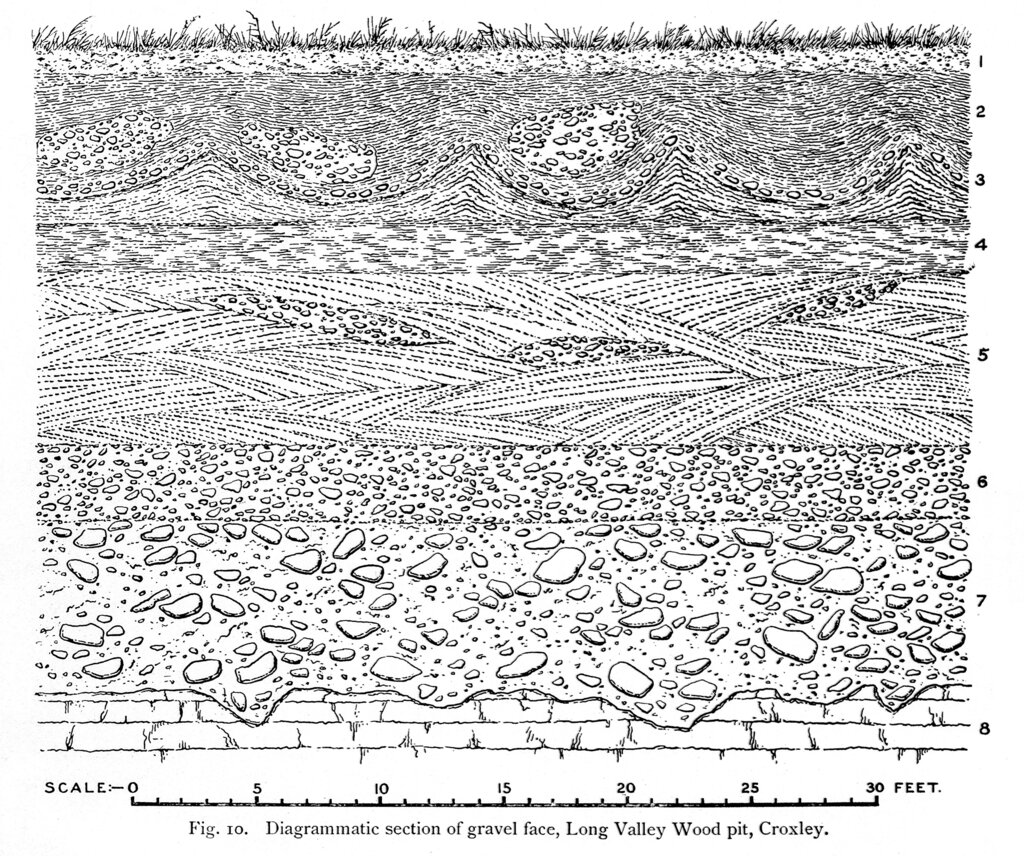
First is relative dating. This method doesn't give a specific age in years; instead, it places events in order. The key principle is superposition: in a sequence of undisturbed rock layers, the oldest layers are at the bottom and the youngest are at the top. By studying these layers, or strata, geologists can determine the relative order of past events.
The second method is absolute dating, which provides a numerical age. The most common form is radiometric dating. Rocks contain naturally occurring radioactive elements that decay at a predictable rate. For example, uranium decays into lead over a very long time. By measuring the ratio of the original element (the parent) to the decayed element (the daughter), scientists can calculate how many years have passed since the rock formed.
By combining these methods, geologists can piece together the complete story of Earth's past. Fossils found in a rock layer give clues about the life of that period, while radiometric dating of the surrounding rock can nail down a specific age in millions of years.
The combined force of geological uniformitarianism and biological evolution painted a picture of a dynamic, ancient world constantly changing, with life itself being an integral, evolving part of that grand narrative.
Understanding Deep Time is fundamental to biology. It provides the vast canvas on which evolution has painted its masterpiece. The slow, gradual changes that lead to new species, the recovery of life after catastrophic events, and the rise and fall of entire ecosystems all make sense only when viewed through the lens of geological time. It shows us that life is not static; it is a continuous story of change, adaptation, and resilience written in the rocks of an ancient Earth.
Time to check your understanding of these foundational concepts.
Which of the following best describes the concept of 'Deep Time'?
A geologist examines a cliff face and determines that the rock layer at the bottom is older than the layer at the top, without assigning a specific age in years. What method is she using?