Set Theory and Zero-Knowledge Proofs
Set Theory Basics
What Is a Set?
Think of a set as a collection of unique things. These "things," called elements, can be anything: numbers, names, fruits, or even other sets. The key rules are that each element can only appear once, and the order of the elements doesn't matter.
A set is simply a group of distinct items. The set containing the numbers 1, 2, and 3 is the same as the set containing 3, 2, and 1.
We write sets using curly braces {}. For example, a set of primary colors would be:
{red, yellow, blue}
A set of the first five even numbers would be:
{2, 4, 6, 8, 10}
It's a simple but powerful way to group related items together, which is a foundational idea in many areas of math and computer science.
Subsets
A subset is a set that is entirely contained within another set. Imagine you have a set of all pets: {dog, cat, fish, bird}. A set containing just {dog, cat} would be a subset of your pet set, because every element in it is also in the original set.
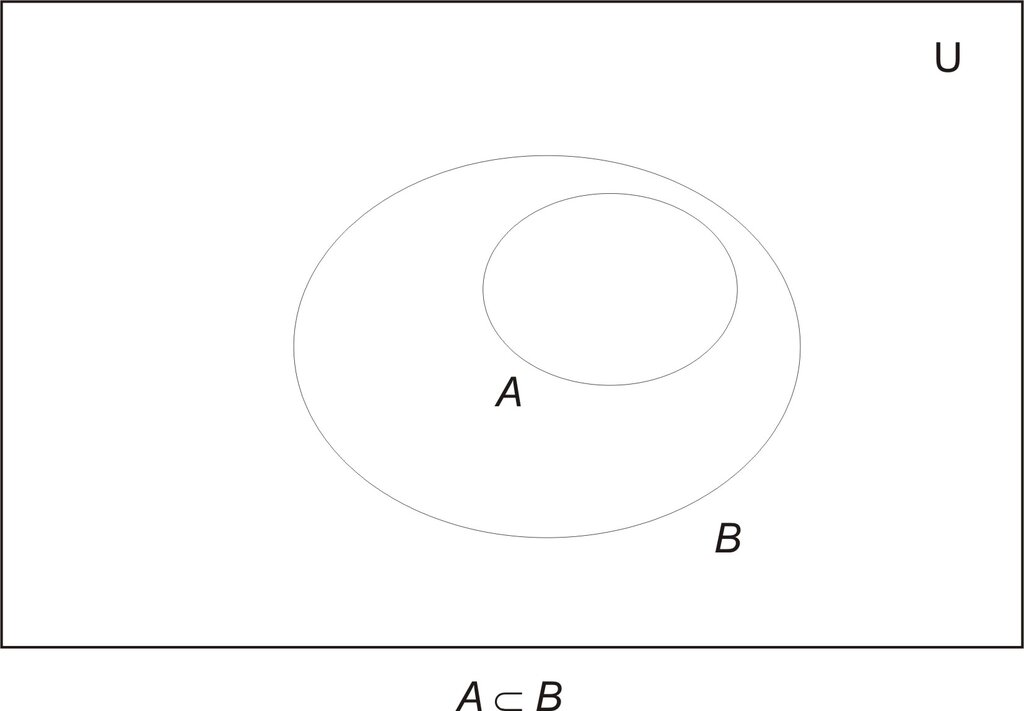
We use the symbol to show that one set is a subset of another. Using our pet example, we could write:
{dog, cat} ⊆ {dog, cat, fish, bird}
This reads as "the set containing 'dog' and 'cat' is a subset of the set containing 'dog', 'cat', 'fish', and 'bird'."
Combining Sets
We can also perform operations on sets. Two of the most common are union and intersection. They allow us to combine sets or find what they have in common.
Union
noun
The union of two sets creates a new set containing all the elements from both original sets. Any duplicates are removed.
The symbol for union is . Let's say we have two sets:
The union of A and B, written as , would be:
Intersection
noun
The intersection of two sets creates a new set containing only the elements that are present in both original sets.
The symbol for intersection is . Using the same sets A and B:
The intersection of A and B, written as , would be:
This is because 3 is the only element that appears in both sets.
The Empty Set
What happens if two sets have no elements in common? Their intersection would be a set with nothing in it. This special set is called the empty set.
The empty set is a set containing zero elements. It's like an empty bag or a box with nothing inside.
We represent the empty set with the symbol or with empty curly braces, {}.
For example, if we have:
Then the intersection is the empty set:
It might seem strange to have a set for nothing, but it's a very important concept in mathematics, acting as a baseline or a starting point, similar to how the number zero works.
What is the defining characteristic of a set in mathematics?
Given Set X = {apple, orange, banana} and Set Y = {orange, grape}, what is the union of X and Y, written as ?