ServiceNow Developer Mastery
ServiceNow Platform Overview
Understanding the Now Platform
ServiceNow is a cloud-based platform that helps companies manage digital workflows for enterprise operations. Think of it as a central hub for automating and streamlining all sorts of business processes, from IT support tickets to employee onboarding.
The Now Platform is the foundation of ServiceNow’s offerings, providing a unified system for managing various business processes and services.
It started with a focus on IT Service Management (ITSM), which is about managing the end-to-end delivery of IT services to customers. But its capabilities have grown far beyond that. Today, it helps connect different departments like HR, Customer Service, and Security on a single system.
The Platform's Architecture
ServiceNow uses a unique multi-instance architecture. Unlike many other cloud services where multiple customers share the same application and database, each ServiceNow customer gets their own separate, isolated instance. An instance includes both the application logic and a dedicated database.
This separation is a big deal. It means your company's data is completely isolated, giving you more security and control. It also allows you to configure and customize your instance without affecting any other customer. Updates from ServiceNow are applied to each instance individually, ensuring stability.
At its core, the platform is built on a single data model. This means all applications on the platform share the same data structure, which makes it easy for different processes and departments to work together seamlessly. Information flows smoothly without the need for complex, brittle integrations.
Core Functionalities and ITSM
ServiceNow provides a suite of applications to manage different business functions. While it can do many things, its roots are in IT Service Management (ITSM). ITSM refers to the activities performed by an organization to design, build, deliver, operate, and control IT services offered to customers.
Essentially, ITSM ensures that the right processes, people, and technology are in place so the organization can meet its business goals.
The platform includes several key applications to support these goals.
| Application | Purpose |
|---|---|
| Incident Management | Restores normal service operation as quickly as possible after an outage. |
| Problem Management | Finds and resolves the root cause of recurring incidents. |
| Change Management | Controls the lifecycle of all changes to minimize disruption to IT services. |
| Service Catalog | Provides a user-friendly storefront for users to request IT services and products. |
| Knowledge Management | Creates and shares knowledge articles to help users and IT staff solve issues. |
Beyond these ITSM applications, the platform's power comes from its underlying capabilities like workflow automation, reporting dashboards, and a central database called the Configuration Management Database (CMDB), which tracks all of an organization's technology components and their relationships.
Navigating the User Interface
When you first log in to a ServiceNow instance, you'll see a web-based user interface designed for efficiency. It's often referred to as the Now Platform UI, or UI16. Understanding its main components is key to getting around.
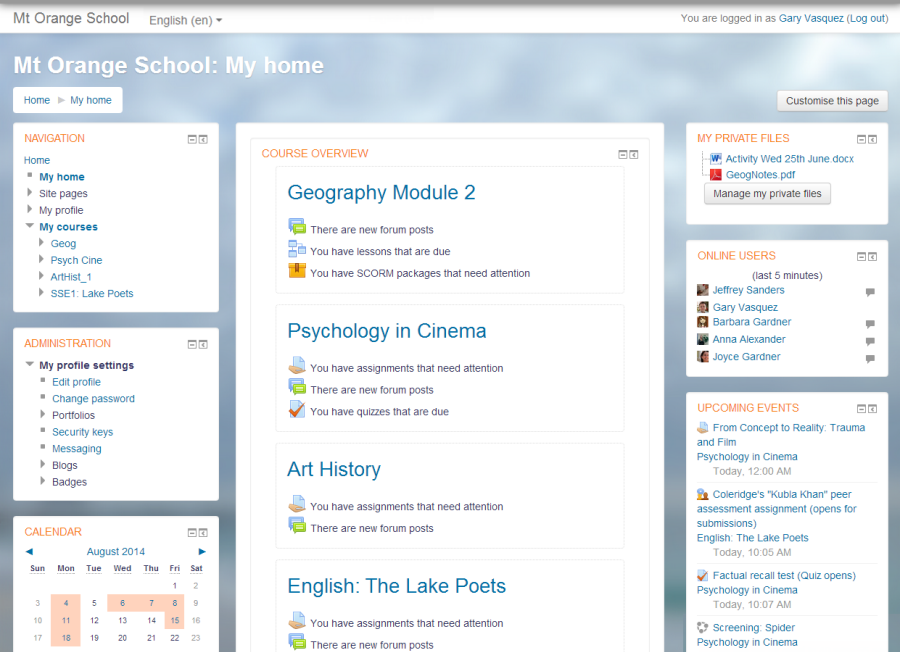
The interface is typically divided into three main parts:
- Banner Frame: This runs across the top of the screen. It contains the company logo, user menu, global search, and other system-wide controls. It's always visible, no matter where you are in the platform.
- Application Navigator: Located on the left side, this is your primary way of finding applications and modules. You can search for what you need or expand sections to browse. It's like the start menu for ServiceNow.
- Content Frame: This is the main work area on the right. It displays the lists, forms, dashboards, and reports you're working with. When you click a link in the Application Navigator, the resulting page loads here.
This consistent layout makes it easy to learn and navigate the platform, even as you begin to explore its vast set of features and applications.
What is the primary purpose of the ServiceNow platform?
What is a key feature of ServiceNow's multi-instance architecture?