Sensation and Perception in Psychology
Sensory Transduction Mechanisms
From Stimulus to Signal
Your brain doesn't understand light waves, sound pressure, or the shape of a molecule. It speaks only one language: electrochemical signals. The process of converting physical energy from the outside world into this neural language is called sensory transduction. It's the first and most critical step in perception.
This translation is performed by specialized cells called sensory receptors. Each type of receptor is tuned to a specific form of energy. Photoreceptors in your eyes respond to light, mechanoreceptors in your skin respond to pressure, and chemoreceptors on your tongue respond to chemicals in food. When a stimulus of the right kind and sufficient strength hits a receptor cell, it doesn't immediately fire a full-blown signal. Instead, it generates a small, local electrical change called a receptor potential
Unlike the all-or-nothing action potentials that travel down axons, receptor potentials are graded. This means their size is directly proportional to the strength of the stimulus. A gentle touch creates a small receptor potential, while a firm press creates a larger one. If this graded potential is strong enough to push the neuron's membrane voltage to a critical threshold, it triggers one or more action potentials that travel towards the brain.
transduction
noun
The process of converting one form of energy into another. In the nervous system, it refers to the conversion of a physical stimulus—such as light, sound, or pressure—into an electrical signal that can be interpreted by neurons.
The Language of Neurons
So, if all action potentials are fundamentally the same size, how does the brain know the difference between a dim light and a bright one, or a soft whisper and a loud bang? This is where neural coding comes in. The brain interprets stimulus intensity based on the frequency of action potentials. A weak stimulus might trigger just a few action potentials per second, while a strong stimulus will cause the neuron to fire much more rapidly. This is known as frequency coding.
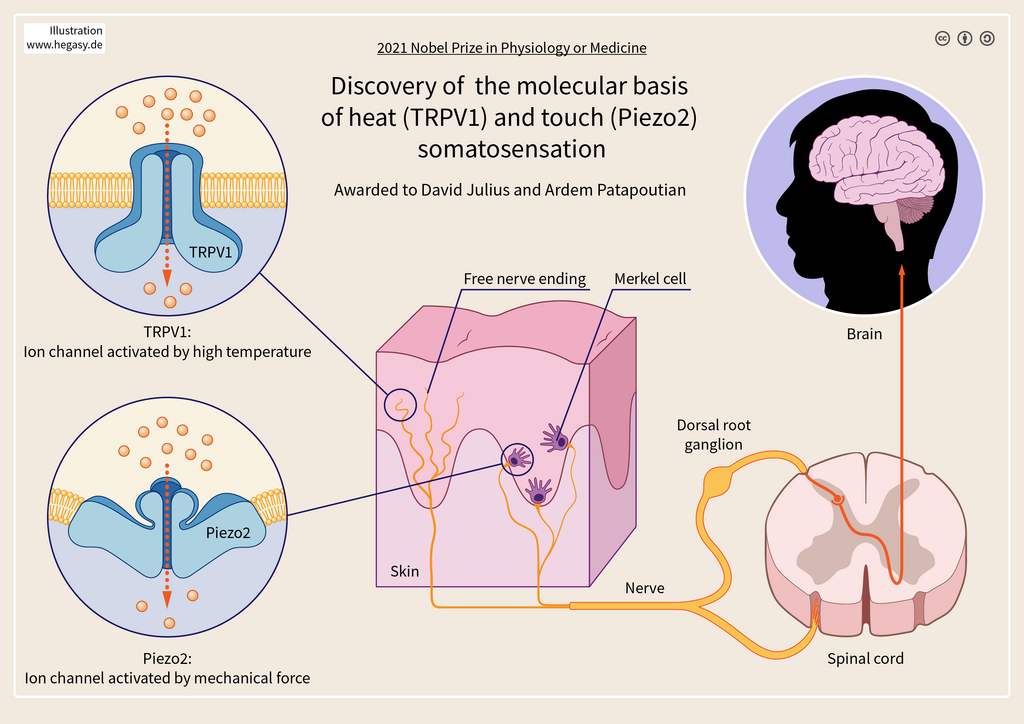
The brain also needs to know what type of stimulus it's receiving—is it light, sound, or touch? This is solved by the 'labelled line' principle. Each sensory neuron connects to a specific part of the brain. Signals from the optic nerve are always interpreted as light, signals from the auditory nerve are always interpreted as sound, and so on. The pathway itself 'labels' the signal, telling the brain its origin and modality, regardless of the fact that the signal itself is just a generic action potential.
Mapping the World in Your Brain
Once a signal is generated, it begins its journey. The typical pathway for most sensory information is from the receptor cell, along an afferent neuron, to a relay station in the brainstem or spinal cord. From there, most signals travel to the thalamus, a central hub deep in the brain that acts like a switchboard, directing incoming information to the correct destination.
It receives sensory information and sends this to the cortex in a relay.
The final destination is the a specific region of the cerebral cortex dedicated to processing that sense. There's a primary visual cortex, a primary auditory cortex, a primary somatosensory cortex (for touch), and so on. These areas are not just jumbled collections of neurons; they are highly organized. For example, the primary somatosensory cortex contains a map of the entire body, known as a homunculus. Areas with higher sensory acuity, like the fingertips and lips, have a much larger representation in the cortex than less sensitive areas like the back.
This mapping allows the brain to know not only what kind of stimulus it's receiving but also where it's coming from. It's how you can tell whether a mosquito landed on your arm or your leg without looking. The precision of our biological sensors, combined with this elegant neural coding and mapping, is what allows us to build a rich, detailed perception of the world from simple physical energy.
What is the fundamental process of converting external physical energy, like light or sound, into the brain's electrochemical signals?
How does a receptor potential differ from an action potential?