Senior Java Enterprise Microservices Architect
Microservices Fundamentals
Breaking Down the Monolith
Imagine building an application like constructing a house. For a long time, the standard approach was to build a single, massive structure where every room is interconnected and relies on the same foundation, plumbing, and electrical systems. This is a monolithic architecture. Everything is in one place, tightly coupled together. If you need to renovate the kitchen, you might have to shut down the water for the entire house. If a problem occurs in one part, it can affect the whole system.
Microservices offer a different approach. Instead of one giant house, imagine building a small village of specialized buildings. There's a kitchen building, a sleeping building, and a living room building. Each is self-contained with its own plumbing and power. They are connected by pathways, but they operate independently. If you need to upgrade the kitchen, you only work on the kitchen building; the rest of the village functions without interruption. This is the core idea of microservices: an application is built as a collection of small, independent services.
Each microservice is designed to handle a specific business function, like user authentication, payment processing, or product inventory. It runs as its own process and communicates with other services through well-defined interfaces, usually APIs.
A Tale of Two Architectures
The difference between monolithic and microservices architectures is fundamental. A monolith is a single unit. All its code is in one codebase, and it's deployed as a single application. A change to any part of the application requires rebuilding and deploying the entire thing.
A microservices architecture, on the other hand, breaks the application into smaller, loosely coupled services. Each service is developed, deployed, and scaled independently.
Here's a quick breakdown of the differences:
| Feature | Monolithic Architecture | Microservices Architecture |
|---|---|---|
| Deployment | Entire application deployed as one unit | Services deployed independently |
| Scalability | Scale the entire application | Scale individual services as needed |
| Technology Stack | Single, uniform technology stack | Each service can use its own technology stack |
| Fault Isolation | An error can bring down the entire system | An error in one service may not affect others |
The Advantages
Breaking up a large application into smaller services brings several key benefits.
Scalability: This is a major driver for adopting microservices. With a monolith, if one feature is getting a lot of traffic, you have to scale the entire application. With microservices, you can scale just the service that needs more resources. An e-commerce site, for instance, could scale its
searchservice during holiday shopping seasons without touching itsuser-profileservice.
Flexibility: Because services are independent, teams can choose the best technology for their specific job. The team building a real-time notification service might use Node.js, while the team working on a machine learning-powered recommendation engine might use Python. This freedom allows for more innovation and optimization.
Maintainability: A smaller codebase is easier to understand, manage, and update. Small, focused teams can own a service from development to deployment. This autonomy often leads to faster development cycles and higher-quality code.
The Challenges
Of course, this approach isn't without its own set of complexities. While microservices solve some problems, they introduce others.
One of the biggest hurdles is data management. In a monolith, all data typically lives in one large database. In a microservices architecture, each service often manages its own database. This is great for keeping services independent, but it makes tasks like running a query that joins data from multiple services much more complex. Ensuring data consistency across different databases can be a significant challenge.
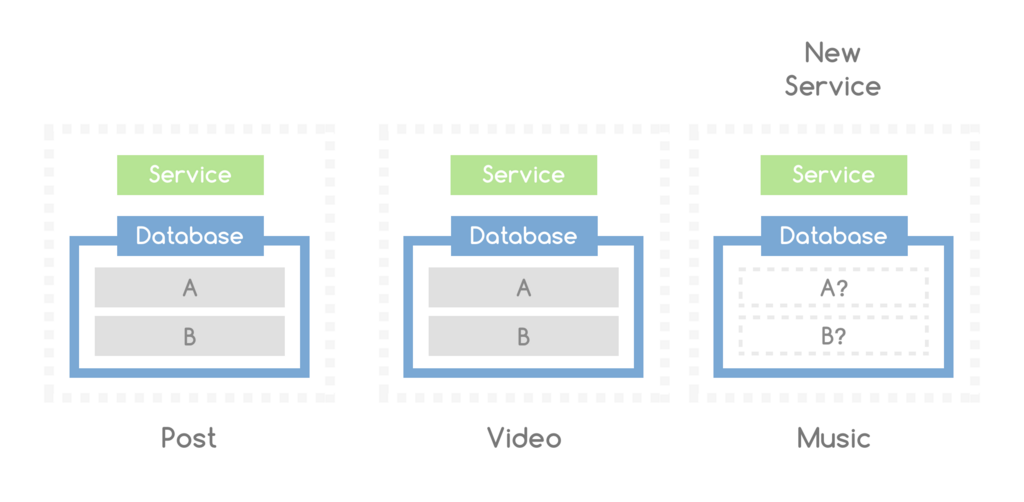
Another challenge is inter-service communication. Services need to talk to each other. This happens over a network, which is inherently less reliable than in-process communication within a monolith. Developers must handle network latency, failures, and design resilient communication patterns.
Finally, the sheer operational overhead of managing dozens or even hundreds of services can be daunting. You need robust automation for testing, deployment, and monitoring to keep everything running smoothly. The system as a whole becomes a complex distributed system.
Many large tech companies like Netflix, Amazon, and Uber have successfully navigated these challenges and use microservices to power their platforms. For them, the benefits of scalability and flexibility outweigh the added complexity.
Now that you have a grasp of the fundamentals, let's test your knowledge.
Which statement best describes a key difference between monolithic and microservices architectures?
One of the significant challenges introduced by a microservices architecture is managing data consistency across different services.
Understanding these core concepts is the first step. The trade-offs between a simple monolith and a complex but scalable microservices architecture are crucial in modern software design.