Seneca: Epistolary Meta-Critique
Epistolary Self-Fashioning
From Dialogue to Letter
Seneca's transition from the structured 'Dialogi' to the 'Epistulae Morales' represents a strategic shift in both genre and pedagogical approach. The former are largely impersonal, theoretical expositions of Stoic doctrine. The latter, however, adopt the epistolary form to construct an intimate, evolving philosophical journey. This was not a collection of spontaneous correspondence but a carefully curated literary project. Seneca weaponizes the letter's inherent subjectivity, creating a textual space where the process of becoming a Stoic can be performed for an audience.
Seneca creates a literary persona for himself.
The letters simulate interiority. They present Seneca not as a finished sage, but as a fellow traveler on the path to virtue, grappling with the same daily struggles as his addressee, Lucilius. This performance of vulnerability is a rhetorical masterstroke. It allows Seneca to guide the reader through complex ethical problems without the alienating tone of a remote lecturer. The genre itself becomes an argument for the accessibility of Stoicism. It is a philosophy not just to be known, but to be lived, moment by moment, letter by letter.
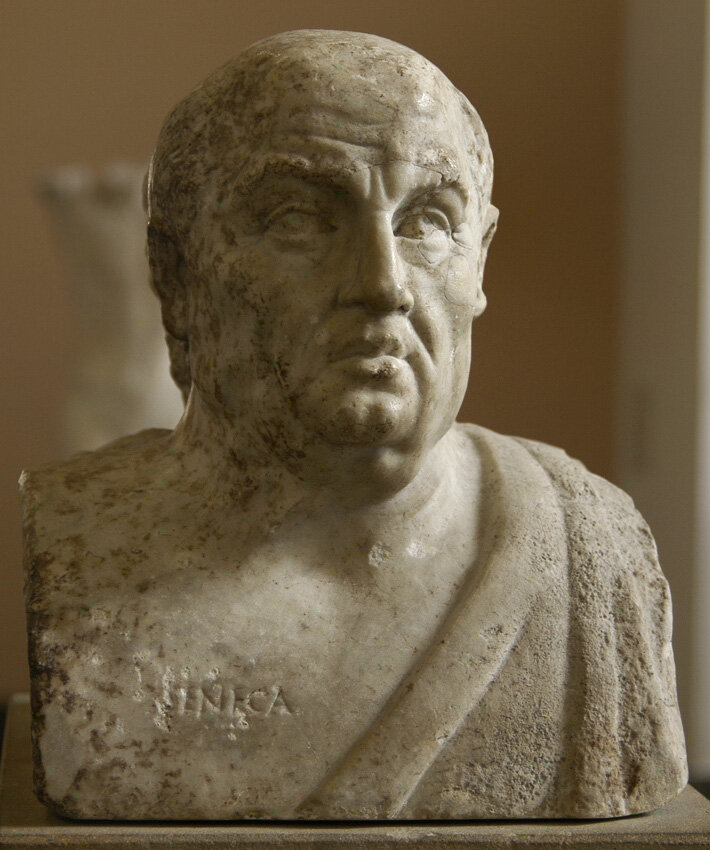
The 'Persona' of the Sage
The Seneca of the 'Epistulae' is a deliberate literary construct, a designed to embody the practical application of Stoic ethics. This act of 'self-fashioning' was crucial. Written during his forced retirement from Nero's court, the letters serve as a self-justification and a pivot from a life of political power to one of philosophical contemplation. By documenting his own moral progress, Seneca implicitly argues for the superiority of the philosophical life over the corruptions of public service he had just escaped.
This constructed self is not a static ideal. It evolves throughout the collection. Early letters show a Seneca more focused on basic precepts, while later ones tackle more esoteric points of doctrine. This progression mirrors the expected development of the student, Lucilius, and by extension, the reader. The 'Seneca' of the letters is an exemplar in motion, demonstrating that the pursuit of the is a dynamic process, not a destination.
Lucilius as Literary Foil
The identity of Lucilius Junior, the recipient of the letters, is a subject of scholarly debate. Whether he was a real historical friend or a purely literary invention is almost secondary to his function within the text. Lucilius operates as a pedagogical artifice, a mirror reflecting the questions, doubts, and progress of an ideal student. His supposed circumstances—a busy public official in Sicily—provide Seneca with endless concrete scenarios to which Stoic principles can be applied.
Lucilius's 'voice' is constructed entirely by Seneca. His supposed inquiries set the agenda for each letter, allowing Seneca to present his philosophy not as a monolithic system, but as a responsive, dialogic practice. This rhetorical strategy makes the 'Epistulae' feel like a conversation. It transforms abstract ethical theory into practical advice tailored to a specific, albeit constructed, individual. In doing so, Seneca invites every reader to substitute themselves for Lucilius, to see their own lives as the raw material for philosophical work.
By addressing a 'friend', Seneca addresses everyone. The specific becomes universal.
Now let's check your understanding of these literary strategies.
What is the primary rhetorical shift from Seneca's 'Dialogi' to his 'Epistulae Morales'?
The persona Seneca adopts in the 'Epistulae' is best described as:
Seneca's project in the 'Epistulae Morales' demonstrates the power of genre to shape philosophical argument. He didn't just write about Stoicism; he performed it, creating a durable literary persona that has guided readers for centuries.