Semiconductor Supply Chain Risk Analysis
Semiconductor Supply Chain Overview
From Sand to Smartphone
Every time you use your phone, computer, or car, you're relying on a tiny, complex marvel of engineering: the semiconductor chip. These chips are the brains of modern electronics, but they don't just appear out of thin air. They're the product of one of the most intricate and global supply chains ever created.
Think of it like building a world-class meal. You don't get all your ingredients from one farm. The spices might come from Asia, the vegetables from South America, and the meat from a local ranch. A master chef then transforms these raw ingredients into a final dish. The semiconductor supply chain works similarly, involving specialized players from all over the world, each mastering one part of a highly complex process.
The Key Players
The journey from raw material to finished chip involves several distinct stages and specialized companies. It's not a single production line but a network of collaborators, each handing off their work to the next expert.
First are the raw material suppliers. The primary ingredient for most chips is silicon, which is refined from common quartz sand into ultra-pure, single-crystal cylinders called ingots. These ingots are then sliced into thin, perfectly polished discs known as wafers. Other essential materials include specialized chemicals, gases, and metals needed for the fabrication process.
Next come the designers, often called fabless companies. These are the architects of the chip. They dream up the complex circuitry and create the blueprints, but they don't actually build anything. Think of companies like Apple, NVIDIA, or Qualcomm; they design powerful chips but outsource the physical production.
The blueprints go to the builders, known as foundries. These are the high-tech factories (or "fabs") that turn designs into physical reality. Companies like TSMC in Taiwan or Samsung in South Korea operate these massive, ultra-clean facilities, etching billions of transistors onto the silicon wafers. Some companies, called Integrated Device Manufacturers (IDMs) like Intel, handle both the design and the manufacturing in-house.
Once a wafer full of chips is fabricated, it moves to the next stage: Assembly, Test, and Packaging (ATP). Here, the wafer is sliced to separate the individual chips (called dies). Each die is tested, placed into a protective casing with connecting pins, and tested again. This crucial step is often handled by specialized companies known as Outsourced Semiconductor Assembly and Test (OSAT) providers.
Finally, the finished, packaged chips are sent to distributors or directly to the electronics companies that will put them into the final products we use every day.
This graphic shows the basic flow, but the reality is even more complex, with each arrow representing a massive logistical operation that often spans oceans.
A Global Journey
No single country controls the entire semiconductor supply chain. Instead, different regions have developed deep expertise in specific stages. This specialization has driven incredible innovation but also created a geographically dispersed and interdependent system.
The United States, for example, is a leader in chip design and the sophisticated software used to create those designs. Europe, particularly the Netherlands, is home to companies like ASML, which builds the indispensable lithography machines needed to print circuits onto silicon.
East Asia is the dominant force in manufacturing. Taiwan and South Korea are the world's leading producers of the most advanced chips. Other countries in the region, like Malaysia and Vietnam, are major hubs for the assembly, testing, and packaging stages.
This global distribution means that a single chip can travel tens of thousands of miles before it's even installed in a device. A design from California might be sent to Taiwan for fabrication, then to Malaysia for packaging, before finally being shipped to China to be assembled into a phone that's sold in Germany.
This sophisticated global semiconductor chain has been made possible by decades of collaboration between companies in different countries.
Making a Chip
The heart of the supply chain is the manufacturing process itself. It takes place in a cleanroom, an environment thousands of times cleaner than a hospital operating room, because a single speck of dust can ruin a chip.
The process begins with a blank silicon wafer. Through a series of steps, layers of different materials are deposited onto the wafer, and intricate patterns are etched into them using a process called photolithography. This is like a highly advanced form of photography, using light to print the chip's circuit design onto the silicon. This deposit-and-etch cycle is repeated hundreds of times, building up the complex, three-dimensional structure of transistors and wires that form the integrated circuit.
Once all the layers are complete, the wafer holds hundreds or even thousands of identical chips.
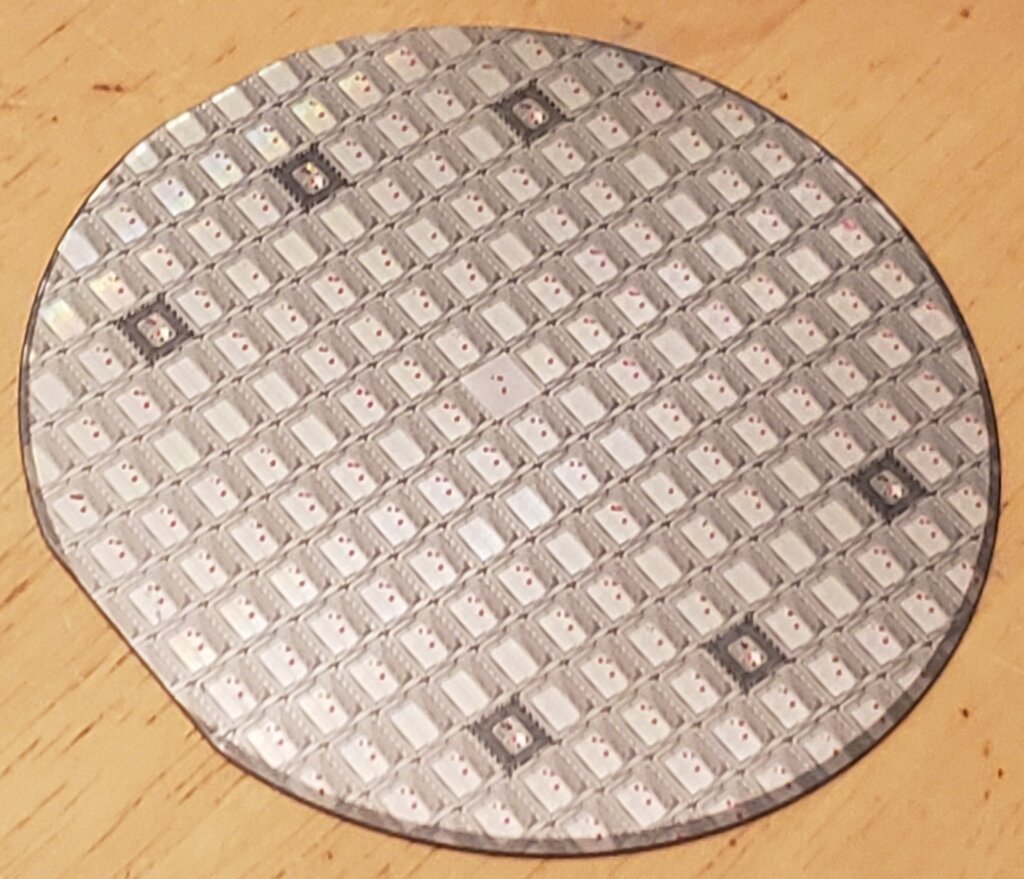
Each of these chips is then individually cut from the wafer, tested, and packaged. This entire journey, from refining sand to fabricating and packaging a chip, can take more than three months to complete. It's a testament to global cooperation and incredible precision.
Which of the following best describes the typical sequence of stages in the semiconductor supply chain?
A company that designs a chip but outsources the physical manufacturing to a factory like TSMC is known as a(n) ____ company.