Semiconductor Manufacturing Equipment Explained
Semiconductor Basics
Conductors, Insulators, and In-Betweens
Some materials, like copper, let electricity flow through them easily. These are called conductors. Others, like rubber, block electricity almost completely. They're known as insulators. Semiconductors are special materials that fall somewhere in the middle. Their ability to conduct electricity can be precisely controlled, which is what makes them so useful.
Silicon is the most common semiconductor. In its pure, crystalline form, it's a fairly poor conductor. Each silicon atom has four outer electrons, called valence electrons, that it shares with its four neighbors. This creates strong covalent bonds, locking the electrons in place. With no free-moving electrons, very little current can flow.
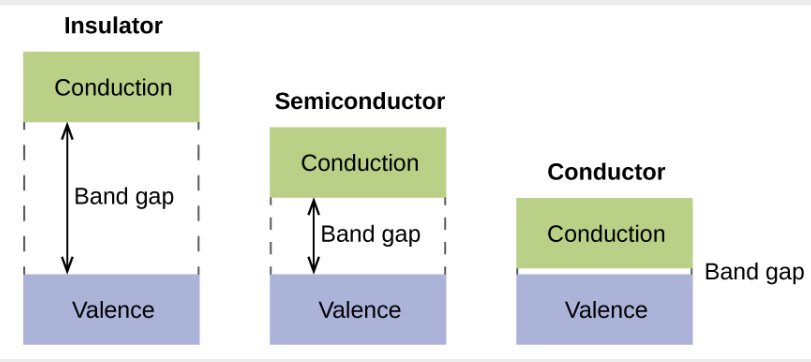
To understand how semiconductors work, we use something called band theory. Electrons in an atom exist at specific energy levels. When atoms bond together in a solid, these levels merge into continuous energy ranges called bands. The highest energy band filled with electrons is the valence band. The next band up, which is mostly empty, is the conduction band.
For an electron to move freely and conduct electricity, it must jump from the valence band to the conduction band. The energy difference between these two bands is called the band gap. Insulators have a very large band gap, making it nearly impossible for electrons to make the jump. Conductors have overlapping bands, so electrons move freely. Semiconductors have a small, manageable band gap. A little energy, like from heat or light, can be enough to knock an electron loose, allowing it to conduct.
Charge Carriers
When an electron jumps to the conduction band, it leaves behind an empty spot in the valence band. This vacancy is called a hole. A hole isn't a physical particle, but it acts like one. It behaves like a positive charge because the spot it occupies is missing a negatively charged electron.
Just as the free electron can move through the conduction band, the hole can also move. A nearby electron in the valence band can hop into the hole, effectively moving the hole to a new location. In semiconductors, electrical current is the combined movement of both free electrons (negative charge carriers) and holes (positive charge carriers).
A semiconductor in its pure form is called an intrinsic semiconductor. At room temperature, it has a very small number of free electrons and holes, so it doesn't conduct well. To make it useful, we intentionally add impurities in a process called doping.
P-type and N-type Doping
Doping changes the electrical properties of the semiconductor, creating what's called an extrinsic semiconductor. There are two types.
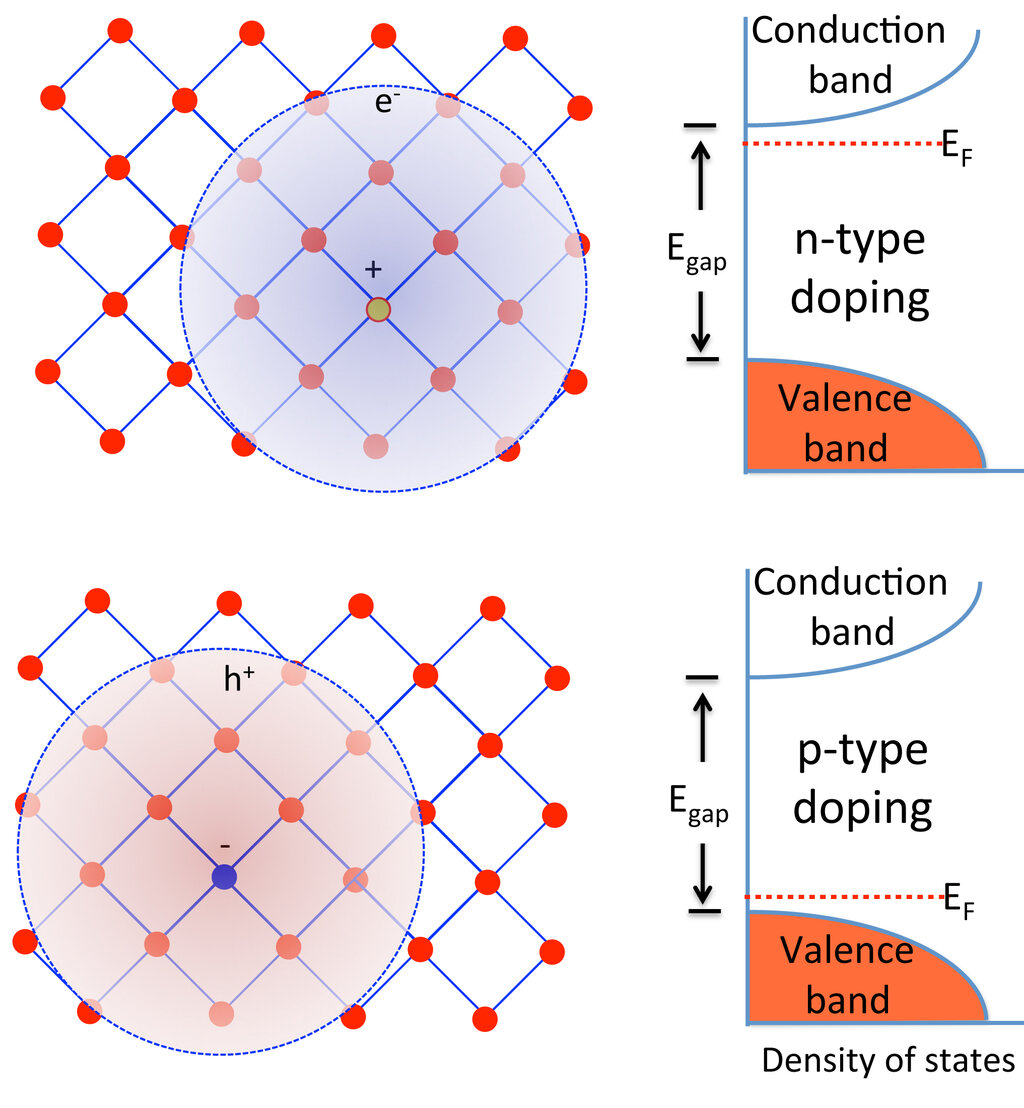
N-type: To create N-type silicon, we add an element with five valence electrons, like phosphorus. Four of phosphorus's electrons bond with the neighboring silicon atoms, but the fifth one is left over. This extra electron is not part of a bond and can easily move into the conduction band. Since we've added atoms that donate electrons, these impurities are called donors. The material is called N-type because the primary charge carriers are negative electrons.
P-type: To create P-type silicon, we add an element with three valence electrons, such as boron. When boron is in the silicon crystal, it can only form three bonds with its neighbors. This leaves one bond incomplete, creating a hole. This hole can easily accept an electron from a nearby silicon atom, causing the hole to move. Since these impurities accept electrons, they are called acceptors. The material is called P-type because the primary charge carriers are positive holes.
The magic of semiconductors happens when we join P-type and N-type materials together. The boundary where they meet is called a p-n junction. This simple structure is the fundamental building block for most semiconductor devices, including diodes and transistors.
Diodes allow current to flow in only one direction, while transistors can act as switches or amplifiers. By combining millions or even billions of these tiny components on a single chip, we can create complex integrated circuits, the brains behind all modern electronics.
Semiconductors are the lifeblood of modern technology — from AI to cloud computing to self-driving cars.
Let's check your understanding of these core concepts.
What is the key property of a semiconductor that makes it so useful in electronics?
In the context of band theory, what does the 'band gap' represent?
By controlling the flow of electrons and holes, these carefully engineered materials make everything from your phone to massive data centers possible.